

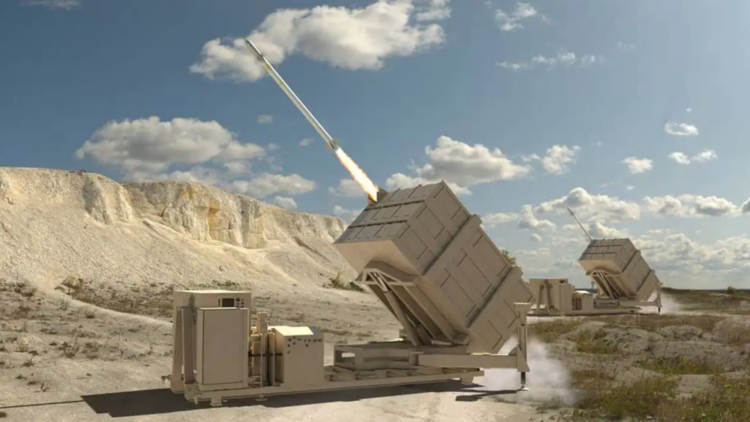
Notably, the system’s capability to engage multiple targets simultaneously amplifies its operational prowess.
Enduring Shield, the company’s name for the #IFPC launcher, validated “end-to-end launch functionality of the weapon system, including sending the AIM-9X interceptor to a designated target location.
A simulated IBCS interface was also used as part of the test. 👇 https://t.co/FHht8aQqwD pic.twitter.com/Nom3BrNEds— AirPower 2.0 (MIL_STD) (@AirPowerNEW1) December 19, 2023
Leidos emphasized that the system is set to fill a crucial role in addressing the gap between the US Army’s tactical short-range air defense systems and the Terminal High Altitude Area Defense (THAAD) anti-ballistic missile defense system.
Positioned as the US Army’s Indirect Fire Protection Capability, Enduring Shield is expected to fortify the nation’s defense posture against evolving threats.
Addressing Contemporary Challenges
While the Enduring Shield system has reached a significant milestone, its journey has not been without challenges.
Initially awarded a $247-million contract to construct 16 prototype launchers for the US Army in September 2021, Leidos faced a setback due to supply chain issues.
As a result, a one-year delay ensued, impacting the timely delivery of the prototype launchers.
Consequently, the fielding date of the system is expected to be affected by this delay.
“If you went to Dynetics today, you’d see six to seven launchers being built up on the factory floor,” Brig. Gen. Frank Lozano told Defense News in August. “They’re actually having to bring into their facility some of the hardware design effort because some of their sub-tier suppliers are having challenges delivering.”
Lozano also explained the technical challenges, particularly those related to thermal management in the IFPC (Indirect Fire Protection Capability) launcher.
According to him, the system faces difficulties in maintaining a suitable temperature for the AIM-9X missile, initially designed for high-altitude aircraft, when stored on the launcher at ground level.
To achieve this, complex thermal systems with fans are required to condition and regulate the missile’s ambient temperature for proper operation in different environments, especially hot ones like the White Sands Missile Range in New Mexico.
The launchers were expected to be deployed to the service in 2022, but a prototype is still needed, and with the delay, the system’s fielding date is more likely to be pushed as well.
Despite these challenges, Leidos remains committed to overcoming hurdles, ensuring the Enduring Shield air defense system’s timely deployment and operational readiness.
The successful launch of the AIM-9X missile interceptor marks a pivotal moment in the development of the US Army‘s Enduring Shield air defense system.
While challenges persist, the dedication to overcoming obstacles remains unwavering, reflecting the resilience and determination in advancing cutting-edge defense technology for national security.
—
You might also want to check out:










COMMENTS