As the steppe turns to mud and the skies to low cloud, Russia trades men for meters while Ukraine adapts, holds its hubs, and waits for the freeze.
Read the full article for more on:
Important insights and detailed analysis
Expert commentary on current events
Breaking developments and updates
Updating summary...
One Million Casualties Later: The War Putin Can’t Afford to Lose
Benjamin Reed
Speed
1x
Listen
COMMENTS
As the steppe turns to mud and the skies to low cloud, Russia trades men for meters while Ukraine adapts, holds its hubs, and waits for the freeze.
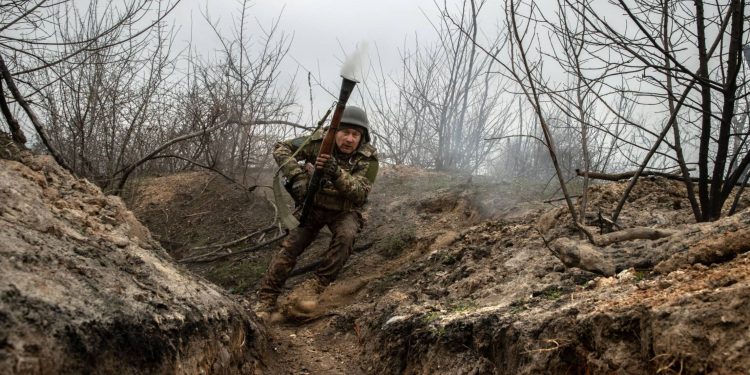
Trench warfare for the 21st Century. A Ukrainian soldier near Bakhmut, Ukraine. Image Credit: Tyler Hicks / New York Times
I left Ukraine for the last time on January 1, 2024. At the time, I carried deep doubts about Kyiv’s ability to sustain the fight. I had seen the strain firsthand, having served alongside Ukrainian units, and I wondered how long the country could endure. Now, as the war stands on the threshold of 2026, my perspective has changed. Ukraine has not broken. It has adapted.
Advertisement
Russia’s 2025 summer push is running out of dry ground. Within weeks, eastern Ukraine will sink into rasputitsa, the season of mud that clogs farm tracks, floods trench lines, and turns every off-road move into a recovery operation. Historically, both armies slow their maneuvering until the steppe freezes solid by late December. Logistics grind down, and drones struggle in wind, rain, and low cloud. Moisture corrodes cheap electronics, visibility drops, and the cost of each kilometer gained increases. The war does not stop; it simply becomes heavier.
In earlier publications, I wrote that the outcome of Russia’s summer campaign would be measured by three settlements: Pokrovsk, Kostiantynivka, and Kupiansk. Each has become a gauge of the wider conflict, revealing not only Moscow’s capacity to attack but Ukraine’s endurance to hold.
Where Russia actually pushed and what still stands
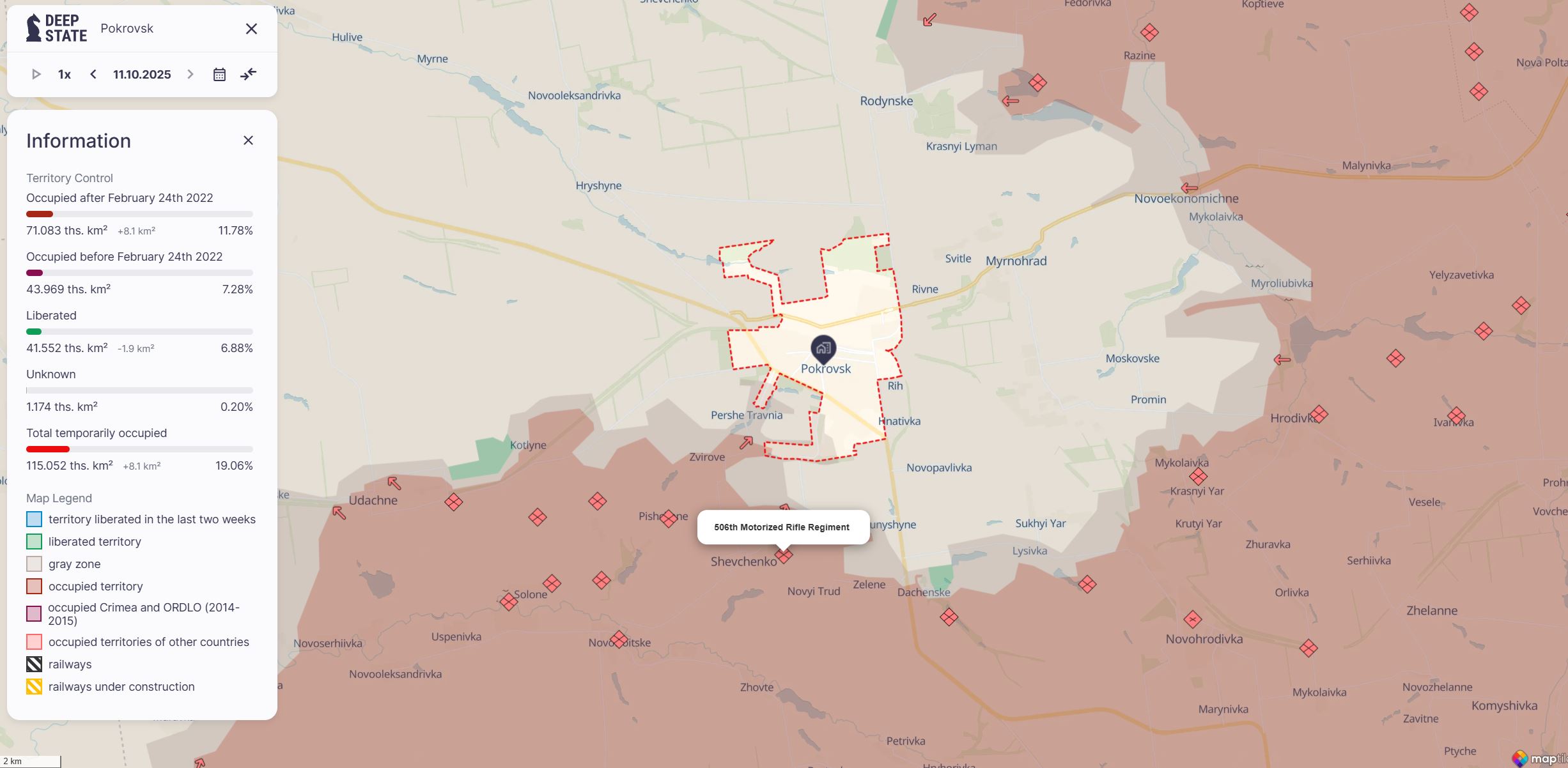
Pokrovsk.The battle for Pokrovsk has dragged on since July 18, 2024, and the human cost continues to climb. What began as a modest push for a small industrial town has turned into one of the most violent demonstrations of Ukraine’s developing “drone defense in depth” strategy. Soldiers on the ground describe staggering Russian casualties, not as evidence of failed tactics but as proof of Moscow’s enduring readiness to trade men for meters.
Advertisement
Throughout 2025, Russian forces have pressed west along the Donetsk rail corridor, aiming to sever Ukrainian supply lines and isolate the logistics hub anchoring the sector. Yet Pokrovsk still holds. ISW reports from August through October confirm constant Russian assaults “in the Pokrovsk direction,” but no verified breakthroughs. In some areas, Ukrainian counterattacks have even regained ground.
A recent video circulated by analyst Preston Stewart showed a sizable Russian armored column advancing toward Pokrovsk, only to be destroyed in sequence by Ukrainian FPV drones. The footage underscores both Ukraine’s precision and Russia’s material strain. Analysts note a shortage of modern APCs across Russian formations, forcing units to convert tanks into improvised troop carriers clad in welded “turtle shells.” The tactic offers limited protection but reflects deeper logistical exhaustion within Russia’s armored reserves.
Advertisement
As Reuters reported earlier this year, the Kremlin’s operational goal remains the same: to cut off Pokrovsk and starve the defensive belt further west. For now, that ambition remains unrealized. The front endures as it has all year—a grinding contest of attrition, costly, unrelenting, and without decisive collapse.
(Source: https://deepstatemap.live/)
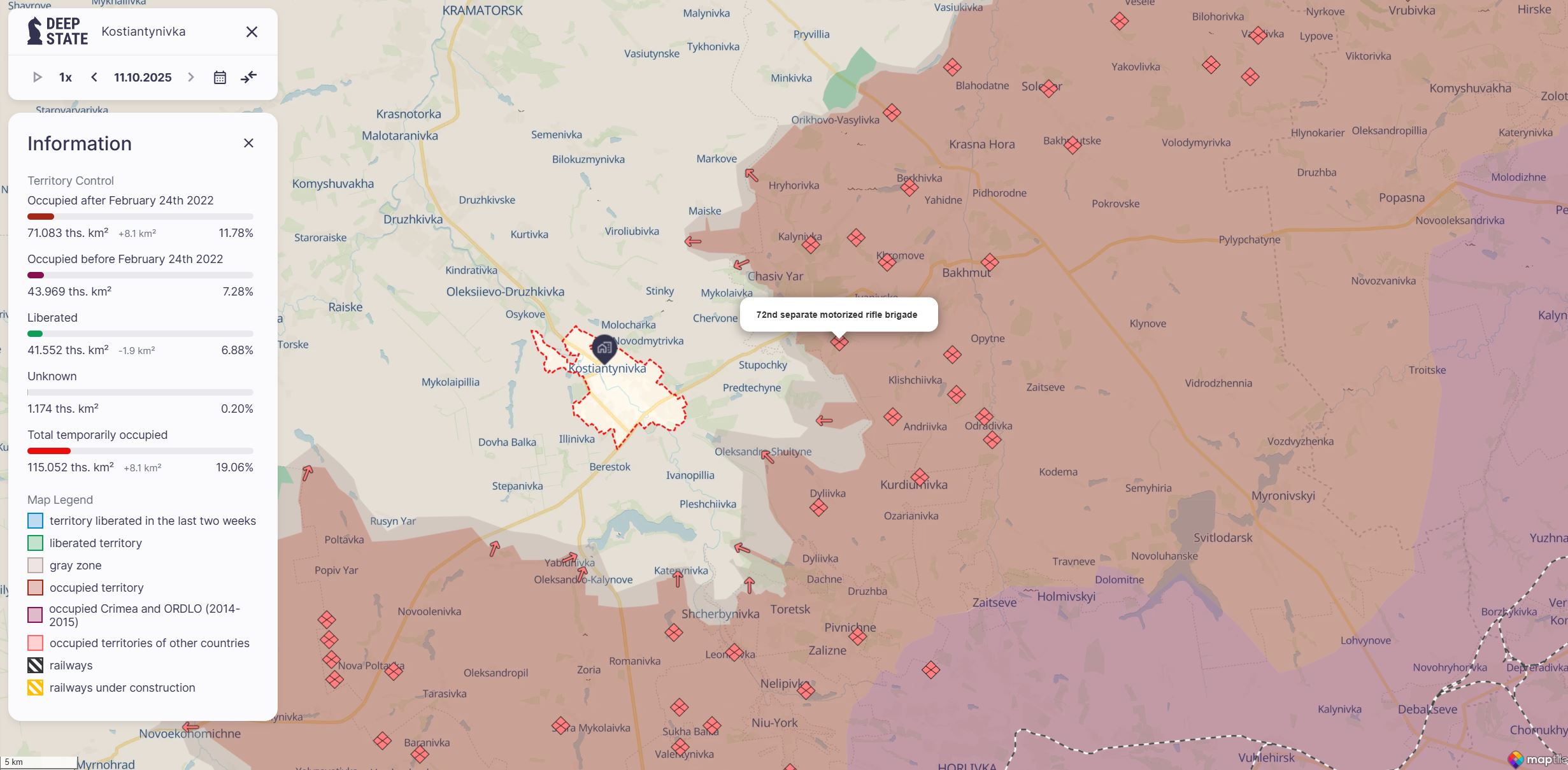
Kostiantynivka. Positioned south of the Sloviansk–Kramatorsk axis, Kostiantynivka remains a vital hinge in Ukraine’s eastern defense, securing the rail lines to Toretsk and the embattled city of Chasiv Yar. Russia partially controls Chasiv Yar following its 2023 capture of nearby Bakhmut, only about eleven kilometers away. Despite Moscow’s earlier claims of victory there, Ukrainian forces remain close enough to contest the area, a reminder of how limited Russia’s territorial gains have been given the scale of its losses.
Russian units continue to test Kostiantynivka’s perimeter from three directions: northeast through Chasiv Yar, east via Stupochky, and south toward Predtechyne. Over the past week, Ukraine’s General Staff reported repelling a mechanized assault near the city and destroying several armored vehicles.
Advertisement
Independent analyses from DeepState and ISW confirm steady Russian pressure along this front, but no verified breakthroughs. Satellite and geolocated imagery indicate that gains since early summer have been incremental, measured in hundreds of meters rather than kilometers. The city’s terrain and defensive depth continue to favor Ukraine. Soldiers rotated from Chasiv Yar describe a battlefield defined by artillery exchanges and FPV drone duels, with large-scale armored assaults giving way to a slower, grinding war of attrition. The momentum that carried Moscow through early summer appears to have flattened into a costly stalemate.
(source: https://deepstatemap.live/ )
Kupiansk. On the northern front, Kupiansk remains under steady Russian pressure from the Dvorichna axis and across the Oskil River line. The fight here has become one of endurance rather than maneuver. Russian units continue to probe Ukrainian defenses west of the river, seeking to reach the rail junctions that sustain the city. The map reflects slow but persistent encroachment, with Kupiansk’s outskirts now under direct artillery observation.
It is my assessment thatKupiansk will likely fall by the end of the year. The reasoning is straightforward. Russian forces have maintained consistent momentum while Ukraine’s northern reserves are stretched thin across multiple sectors. The loss of Kupiansk would not signal a collapse, but it would mark a shift in initiative, both psychological and logistical, given the city’s importance as a supply hub for Kharkiv Oblast.
For now, the line holds. Each week of shelling and limited advance, however, suggests that Moscow’s methodical approach may eventually succeed. Whether Ukraine can trade space for time without triggering a wider withdrawal remains one of the central questions as the front moves toward winter.
My Takeaways
In the first half of 2025, I believed—along with many others—that Russian President Vladimir Putin might eventually accept former U.S. President Donald Trump’s proposed peace framework. That expectation now feels distant. Despite speculation that the coming winter could bring another round of negotiations, there is little evidence that either side is prepared to compromise in a meaningful way.
Ukrainian defenses are holding under enormous pressure, yet there is no indication that Kyiv possesses the offensive capacity to retake significant territory without a dramatic shift inside Russia. Such a shift would likely require internal upheaval: a mutiny, a regime change, or a major economic collapse.None of those scenarios appear imminent, and it is worth remembering that many of the figures poised to succeed Putin are even more hardline and revanchist than he is.
At the same time, Moscow shows no sign of preparing another large-scale mobilization like that of autumn 2022. The move would be deeply unpopular and politically costly unless triggered by a strategic shock—something on the order of a Ukrainian incursion into Crimea or a direct strike on the Kremlin. Instead, the Russian approach has been to sustain the war through adaptation: refitting old armored vehicles as improvised troop carriers, leaning heavily on drone and artillery warfare, and converting its economy into a semi-permanent war footing. Russia has no intention of stopping this war and, in many ways, cannot afford to lose it.
Ukraine, for its part, has demonstrated a steady ability to hold territory despite relentless bombardment. The situation on several fronts remains precarious, but Kyiv still retains large portions of its untapped mobilization base:particularly men aged 18 to 25, who have not yet been called up. Western aid continues to flow. The United States, NATO, and the European Union remain committed to supplying matériel and financial assistance, and there are no serious indicators of an imminent pause.
A War Without an Exit
Looking ahead, it is increasingly clear that innovation may determine who eventually gains the upper hand. Both sides are now experimenting with AI-assisted drones, automated targeting, and electronic countermeasures. If one side manages to exploit a decisive technological edge, it could alter the front lines far more quickly than any ground offensive.
As for casualties, estimates vary widely. Leaked Russian Ministry of Defense figures from early October suggest an average of roughly 500 Russian casualties per day, which aligns with open-source assessments when cross-referenced with satellite analysis and name-confirmed databases. A cautious midpoint assessment places Russian total personnel losses near one million and Ukrainian losses around half that number since February 2022.These ranges account for both killed and wounded, and they reflect the best available synthesis of official data, independent verification, and OSINT modeling.
In summary: this war will continue to grind forward, not because either side expects a decisive victory, but because both believe they can still outlast the other. Whether the outcome is shaped by battlefield innovation, economic endurance, or sheer exhaustion, the end is unlikely to come soon.
Advertisement
What readers are saying
Generating a quick summary of the conversation...
This summary is AI-generated. AI can make mistakes and this summary is not a replacement for reading the comments.










COMMENTS