
DEIR EZ-ZOR, Syria — They say revenge is a dish best served cold, and today the Islamic State in Syria is discovering what happens when you kill our American brothers in arms.
Earlier today, American warplanes and rockets tore through the night sky over eastern Syria, delivering a message that required no translation. Kill Americans, and the response will arrive at altitude, on time, and with receipts. We know who you are, and your time is up.
The strikes, part of what U.S. officials identified as Operation Hawkeye Strike, slammed Islamic State positions across central and eastern Syria in a coordinated assault that ranked among the most aggressive U.S. counterterrorism actions since the territorial collapse of the ISIS caliphate. This was not routine pressure. This was pure, pounding punishment.
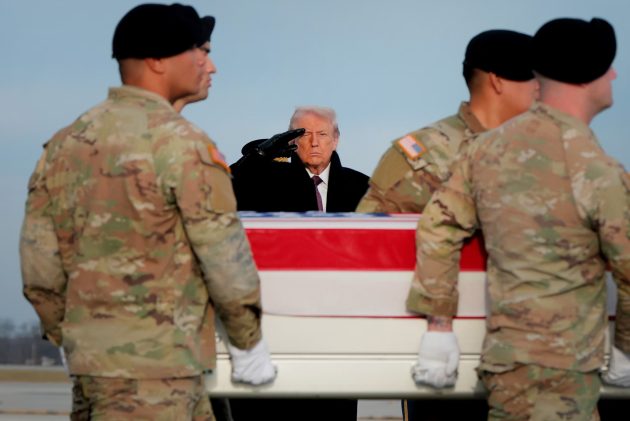
The trigger came six days earlier near the ruins of Palmyra, where history has a habit of watching modern wars repeat old mistakes. On December 13, an attacker opened fire on a joint patrol, killing Sgt. Edgar Brian Torres-Tovar and Sgt. William Nathaniel Howard of the Iowa Army National Guard, along with American civilian interpreter Ayad Mansoor Sakat. Three additional U.S. troops were wounded, as were members of Syrian security forces.
Syrian authorities said the attacker had ties to internal security services and was suspected of ISIS sympathies. He was killed during the assault. No claim of responsibility followed, which in Syria often says more than a press release ever could.
According to U.S. officials, the ambush fit a familiar pattern. ISIS sleeper cells are exploiting fractured authority, porous loyalties, and a country still stitched together with bad deals and worse compromises. The enemy did not disappear when the caliphate fell. It adapted. It slithered back into the desert, and in Palmyra, it struck.
Washington answered.
FAFO
On December 19, U.S. Central Command authorized a sweeping retaliation aimed at ISIS fighters, logistics hubs, weapons storage sites, and command infrastructure. Airstrikes and rocket artillery hit multiple locations, with confirmed strike activity in and around Deir ez-Zor and Raqqa.
Pentagon officials said dozens of ISIS-linked sites were targeted. The message was delivered loud and clear: poke the eagle, and the talons will rip you apart.
The aircraft mix reflected intent. F-15s and F-16s for precision and reach. A-10s for when someone wanted to be certain. Apache helicopters for close work. Long-range rocket systems added weight from a distance. Officials confirmed coordination with coalition partners, though they declined to name participating nations.
Coordinated Chaos
This strike package did not materialize overnight. In the week leading up to December 19, U.S. and partner forces conducted at least ten raids across Iraq and Syria, killing or capturing more than twenty ISIS suspects. Those operations generated intelligence that fed directly into Hawkeye Strike. This was not rage. It was preparation. Cold, methodical, precise preparation.
Battle damage assessments remain ongoing, and officials have not released precise casualty figures. That silence is deliberate. Counting bodies is less important than breaking networks, denying sanctuary, and forcing the enemy back into survival mode.
The United States currently maintains roughly 1,000 troops in Syria (a mix of SOF and conventional forces). This is a reduced footprint tasked with counterterrorism operations and support to local security partners. That smaller presence has not dulled the spear. If anything, it has sharpened it. Less manpower means fewer distractions. The mission stays simple.
ISIS continues to exploit ungoverned spaces, political fragmentation, and the gray zones between rival factions. That reality has not changed. What did change on December 19 was the cost of testing American resolve.
For the families of Torres-Tovar, Howard, and Sakat, no strike will fill the space left behind. But for those watching from caves, safe houses, and borrowed uniforms, the lesson was unmistakable. There are moments when the United States debates itself endlessly. This was not one of them.
There can be no escape for those foolish enough to take us on.
The skies over eastern Syria have settled for now. The damage has been done. And somewhere in the wreckage of another failed jihadist gamble, the survivors are recalculating.
They should.
For what’s left of ISIS, December 19 was not a speech, a warning, or a debate. It was not the response of a weak, woke administration.
It was a reminder written in ordinance and blood and delivered on target: you can choose the time and place of your attack, but you do not get to choose the response.








COMMENTS