

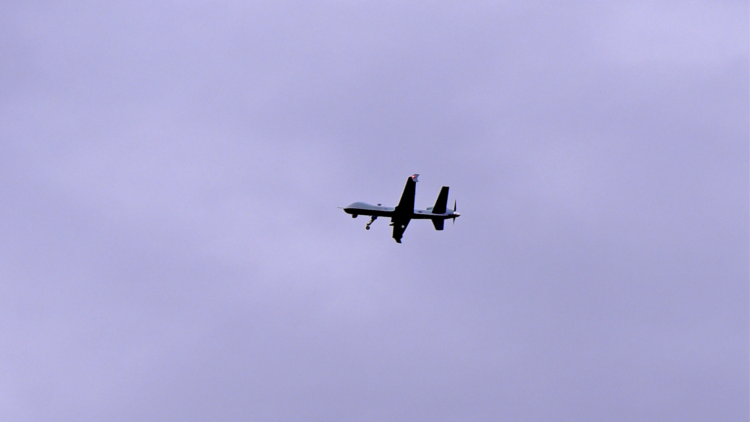
US official tells @Liz_Friden U.S. MQ-9 Reaper drone downed near Balad Air Base north of Baghdad Iraq on Thursday has been recovered by Iraqi security forces. It is unclear if the damaged drone has been returned to U.S. custody yet and if the drone crashed or if it was shot down.
— Jennifer Griffin (@JenGriffinFNC) January 19, 2024
But this isn’t a one-off.
Just two months prior, in November 2023, Yemen’s Houthi rebels brought down a Reaper off Yemen’s coast.
2023 was definitely a tough year for Reapers.
Besides Iraq and Yemen, one got clipped in the Black Sea by a Russian fighter, and two others got singed over Syria by Russian flares.
For those asking, yes, it's looking like a Reaper, note the winglets. https://t.co/6dbjp4ArJn pic.twitter.com/NuR41qisJx
— Aurora Intel (@AuroraIntel) January 18, 2024
It’s like a high-tech game of whack-a-mole but with multimillion-dollar drones and real firepower.
The MQ-9 Reaper: A Veteran’s Workhorse
So, what’s the deal with these MQ-9 Reapers?
Well, after a good run in the Middle East and Afghanistan, where they faced adversaries without the tech to fight back, these birds have earned their stripes.
The US Air Force dubs them Remotely Piloted Aircraft (RPA).
Think of them as the A-10 Thunderbolt II’s remote-controlled cousins.
They can lug around 3,750 pounds (1,700 kilograms) of ordnance, including up to eight Hellfire missiles, and they can cover about 2,000 miles (3,200 kilometers) without a pit stop.
The pilots might be oceans away, but they’ve got the whole world in their hands with satellite links.
Advanced Surveillance Capabilities
But it’s not just about raining fire and brimstone.
The MQ-9s are also the eyes in the sky.
Their Multi-Spectral Targeting System can spy with an array of visual sensors, including infrared and daylight video cameras and even a laser range finder.
They can eavesdrop on the enemy from a safe distance, gathering intel without getting their hands dirty.
Facing New Threats: Is the Drone Still Relevant?
However, these recent shoot-downs are raising some serious questions about the future of these remotely piloted birds.
Iraqi Islamic Resistance forces in Iraq shot down an American MQ-9 "Ripper" drone pic.twitter.com/qky8Gk2GfX
— S p r i n t e r F a c t o r y (@Sprinterfactory) January 18, 2024
With adversaries like China and Russia and well-armed militant groups, the sky’s no longer a free-for-all.
The Air Force is thinking hard about the MQ-9’s place in future battles, planning to phase them out by 2035.
The decision to stop buying more Reapers came in 2021, signaling a shift in strategy.
The Air Force is looking for smaller, stealthier, and better-connected tech to survive in contested skies.
So, what’s next for these UAVs?
The Air Force Special Operations Command (AFSOC) has some ideas.
They’re picturing a future where MQ-9 Reapers act like aircraft carriers in the sky, deploying swarms of smaller drones.
These little guys could set up sensor grids or communication pathways, giving special ops a deeper reach into hostile territory.
This shift has Congress and General Atomics, the drone’s manufacturer, all riled up.
But the Air Force has set its eyes on the horizon, adapting the MQ-9s to be more than just spy cams and missile platforms.
In this new role, they’ll be the mothership, commanding a fleet of smaller drones, each armed to the teeth with the latest gear.
Conclusion: The Evolving Role of the MQ-9
In this grand scheme, the MQ-9s will transform into mobile command centers, orchestrating a network of smaller drones to create a massive sensing grid.
It’s like having a spider web in the sky, with each drone a strand, ready to give special forces the edge they need.
And there you have it. The MQ-9 Reaper, once the terror of the skies, is now navigating a turbulent future.
From being the hunter, it’s now the hunted, and the game has changed.
But in the world of military tech, adaptation is the name of the game, and these Reapers are gearing up for their next act.
The sky’s no longer the limit – it’s the playing field.








COMMENTS