

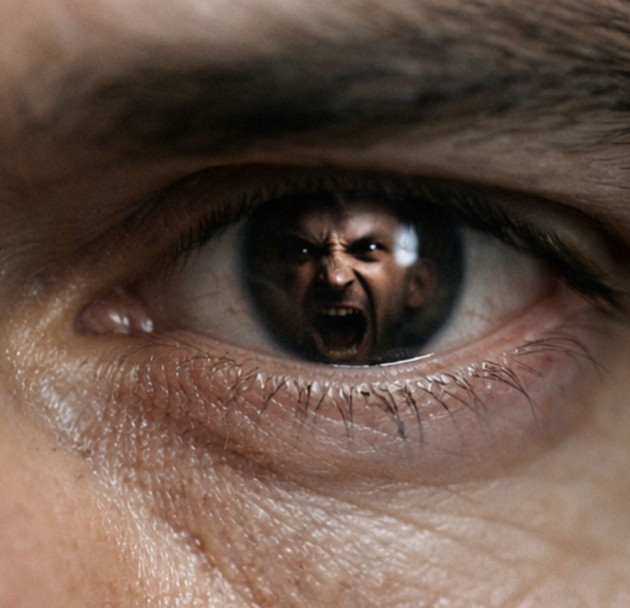
Dave’s wife had turned around in the passenger seat. He could feel it without looking. He kept his eyes on the man’s hands. His chest. His hips… the little signs that tell you what’s coming before it arrives.
Still said nothing.
“What, you got nothing to say?”
Dave tilted his head. Just slightly. Like a dog hearing a frequency you can’t.
The guy shifted his weight. Looked at the car. Looked at Dave’s wife. Looked at the two kids in the back seat, faces pressed to the window like it was a nature documentary.
Then back at Dave.
Dave hadn’t moved, other than invisibly shifting his weight to the balls of his feet. Hadn’t blinked. Hadn’t clenched a fist or squared his shoulders or done any of the things that tell the other guy you’re scared.
He just… waited.
The silence stretched. Five seconds. Ten.
“Whatever, man.” The guy spit on the concrete… landing inches from Dave, though he didn’t look to see. “Not worth my fuckin’ time.”
He got back in the Ram, slammed the door hard enough to rock the chassis, flipped the bird, and pulled out with more tire squeal than the moment required.
Dave replaced the nozzle as he slowly inhaled, then exhaled. Clicked the fuel door shut. Got back in the car.
His wife, quietly upset, stared at him.
“He really thought he had you.”
Dave put the car in drive.
“Yeah. That’s what saved him.”
Dave isn’t real. But you’ve met him.
Maybe you’ve been him.
That moment when everything in you wants to respond, matching volume with volume, aggression with aggression, and yet something deeper says wait. Not out of fear. Out of knowing what happens next if you don’t.
Your conscious self, in a battle with your intuition: Isn’t this weakness? Passivity? No.
Niccolò Machiavelli had a word for it: virtù. It didn’t mean virtue the way we use it now. It meant strength, cunning, and, most importantly, restraint deployed at the right moment.
In The Prince, Machiavelli wrote that it is safer to be feared than loved. Most people stop there and assume he was advocating cruelty. He wasn’t. He warned just as strongly against being hated.
A feared man earns respect. A hated man earns enemies with nothing to lose.
The distinction matters.
Dave didn’t bow up. He didn’t yell or give the guy a story to tell his buddies about the punk at the gas station who ran his mouth. He gave him nothing, which meant the guy had to fill the silence with his own uncertainty.
And uncertainty is a weapon.
Robert Greene built on Machiavelli’s foundation in “The 48 Laws of Power.” Three of his laws explain exactly what happened in that parking lot.
Law 4: Always Say Less Than Necessary.
Greene writes that the less you say, the more powerful you appear. Silence makes people uncomfortable. They don’t know what you’re thinking, so they assume the worst. Their imagination does the work for you.
Dave said zip. The guy in the Ram couldn’t read or predict anything. He didn’t know if Dave was scared, crazy, or something far worse.
So, he filled the silence himself and talked his way right out of the fight he thought he wanted.
Law 9: Win Through Actions, Never Through Argument.
“Demonstrate, do not explicate.”
Dave didn’t explain what he would do. Didn’t threaten. His stillness was the argument. The slight tilt of his head, the weight shift, and the unblinking focus on the man’s hands and hips were statements. The loud guy just couldn’t read the language.
Law 17: Keep Others in Suspended Terror & Cultivate an Air of Unpredictability.
The loud guy showed everything he had. His anger. His insecurity. His need to be seen as dangerous.
Dave showed nothing.
And that’s what scared him. You can prepare for a guy who squares up. You can’t prepare for the guy who just… waits. You don’t know what he’s holding back. You don’t know where the line is. You only know you might not want to find out.
There’s an old interrogation technique that works on the same principle.
Someone gives you a half-truth. Maybe a lie. Instead of calling them out, you say nothing. You hold eye contact. You wait.
Most people can’t handle it. The silence presses on them. They start qualifying. Adding details. Backtracking. And sometimes, they just… confess.
Not because you caught them. Because they caught themselves.
Silence isn’t empty. It’s a mirror. People see their own guilt in it. Sounds like a bluff, you say. It’s not. I’ve watched guilty men confess to things I hadn’t even accused them of yet.
So, what does this mean for you?
You may not be a trained operator. Maybe you’ve never thrown a punch outside of a middle school hallway. That’s fine. This isn’t about being dangerous.
It’s about understanding that restraint is a position of strength, not surrender.
The loudest guy in the room is almost never the most dangerous. He’s advertising. Performing. Trying to convince himself as much as anyone else. The guy you need to worry about is the one who doesn’t need you to know what he’s capable of.
And here’s the part nobody talks about: you don’t have to actually be deadly to project that energy. You just need to be…still. Controlled. Unbothered.
Most confrontations aren’t won by the person who escalates fastest. They’re won by the person who refuses to play the game at all.
Think about what Dave actually accomplished at that gas station.
He didn’t traumatize his kids by brawling in front of them. He didn’t catch an assault charge. Didn’t give some stranger a reason to come back with a weapon. Didn’t put his wife in a position where she’s visiting him in a hospital or a jail cell.
He protected his family by doing… nothing. Or, what looked like nothing.
What he did was control the only thing he could control: himself. And in doing so, he controlled the entire situation.
That’s not passivity. That’s dominance without destruction.
Machiavelli understood that power isn’t about the violence you commit. It’s about the violence you could commit, and visibly choose not to.
Greene put it more bluntly: the person who says less controls more.
Both of them were writing about kings and courts and warfare. But the principles don’t care about context. They work in a boardroom. A custody negotiation. A traffic stop. A gas station in the middle of nowhere with your family in the car.
The goal isn’t to win the fight…
It’s to make it altogether unnecessary.
And if you’re the kind of person who actually does have the training, the experience, the ability to end a confrontation in seconds?
Then you already know this.
The most dangerous people I’ve ever met are the quietest. They don’t need to announce themselves. They’re not trying to convince anyone of anything. They’ve made peace with what they’re capable of, know not to underestimate an opponent, and that peace is what makes them terrifying to people who haven’t… Not to mention, a peaceful solution is always the disciplined person’s goal.
Quiet badassery isn’t an act. It’s what happens when competence meets self-control.
In Dave’s case, silence won. It usually does.
—
Tegan Broadwater spent 13 years with the Fort Worth Police Department, including two years assigned to the FBI working deep undercover inside a violent Crip organization. That operation, detailed in his book Life in the Fishbowl, resulted in 51 convictions. He has since founded Tactical Systems Network, an armed security & protection firm primarily staffed by veterans, is a creative writer and musician, and hosts The Tegan Broadwater Podcast. All book profits benefit children of incarcerated parents. Learn more at TeganBroadwater.com








COMMENTS