

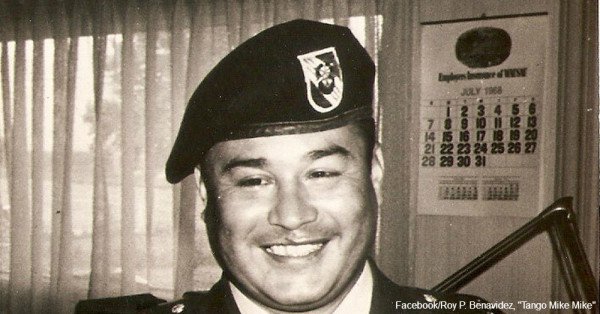
Reaching the trapped team, four men were already dead and the rest were wounded. Benavidez treated the wounded, grabbed an AK from one of the dead men and passed around ammunition. Then he directed air strikes around the perimeter to keep the NVA at bay.
Calling in a Huey to evacuate part of the dead and wounded, he was shot again in the leg. Ignoring his own wounds, he dragged the dead and wounded to the chopper, he provided covering fire. The chopper moved to the second group of men for extract with Benavidez under it, firing at the enemy.
NVA fire increased and smashed into the Huey, killing the pilot and sending the Huey crashing into the ground. Benavidez had made it to the dead team leader and removed the classified documents from around the man’s neck. He was then shot in the stomach by an NVA soldier and another grenade tore into his back and shoulders.
Despite this, and now coughing up blood, he crawled to the downed helicopter. There they formed a small perimeter and passed out the remaining ammunition. He continued to direct air strikes from F-4 Phantom jets and helicopter gunships to push the NVA back. Several of the strikes were danger close.
The North Vietnamese fire increased and mortar rounds were falling everywhere. All of the wounded including Benavidez were hit again. The American helicopter pilots were ready to attempt another rescue attempt.
Grabbing a seriously wounded American SF team member, he hoisted him over his shoulder and lurched toward the waiting helicopter. An NVA soldier believed dead, leaped up and clubbed Benavidez with the butt of his Ak-47, breaking his jaw and knocking him to the ground. As the NVA soldier lunged at Benavidez with his bayonet, Roy grabbed it with his right hand and used his Bowie knife in his left. Pulling the enemy soldier forward he stabbed him but not before suffering a slash to his right hand and his left arm being run thru with the bayonet.
Again, he attempted to drag his American comrade to the helicopter and then noticed two more NVA run from the jungle in the blind spot of the American door gunners. Benavidez grabbed an AK-47 and somehow managed to drop both of the enemy soldiers.
He then made another trip into the perimeter and brought out the team’s interpreter before finally being pushed into the helicopter and lifting off. Holding his intestines in with one hand, he held his dying teammate’s hand with the other.
Having almost bled out on the helicopter, Benavidez slipped into near unconsciousness. A doctor felt for a heartbeat and not registering one, indicated that he should be placed in a body bag with the dead. Benavidez, unable to speak because of the broken jaw, spit in the doctor’s face to let him know he was still alive.
He was then taken into the hospital where the doctors began to treat his myriad of injuries. He had seven gunshot wounds, one of them went thru his back, destroying his right lung and exited just beneath his heart. He had 28 shrapnel wounds in his back, neck, head, legs, feet, and buttocks. Both arms were pierced by a bayonet as well as his hand. His jaw was broken and the back of his head smashed by the enemy’s rifle butt. None of the doctors expected Benavidez to survive. They were wrong.
His wounds were to take a year to heal and he went back to Brooke Army Medical Center. His commander wanted to put Roy in for the Medal of Honor but instead opted for the Distinguished Service Cross believing that he’d at least receive that before his wounds would kill him. Benavidez was awarded the DSC by Gen. William Westmoreland the Chief of Staff of the Army.
Years later after the war, his commander tried to get the Army to reconsider and upgrade Benavidez’s award to the Medal of Honor. But was told that no other American had survived and could confirm his deeds.
Far away in the Fiji Islands, an American, Brian O’Connor who had been the radio man who called for that first frantic call for extraction, read about the development in the newspapers. He wrote a detailed description of the fateful event on that day in May 1968 and that Benavidez was responsible for saving the lives of eight men.
The Pentagon reconsidered and in 1981, President Ronald Reagan presented Benavidez the Medal of Honor. Reagan turned to the press and said, “If the story of his heroism were a movie script, you would not believe it”.
The official citation for Benavidez’s Medal of Honor can be read here:
President Reagan urged Benavidez to speak to the young children of the USA, something Roy took to heart and enjoyed immensely. He spoke about getting an education, learning a trade and love of country.
Here is a YouTube clip of one such speech he gave and it shows the humbleness and patriotism of the man.
Fast forward several years, my path would briefly cross with Benavidez as he was still helping with the American SF’ers hurt. While on a deployment to Central America with the 7th Special Forces Group, my ODA commander suffered a terrible injury which would result in him becoming a quadriplegic.
In the typical snafu of the passing between the Army and the VA, his benefits were put on hold. Benavidez, who was made aware of the situation jumped in and immediately set things straight, going straight to the head of the VA and said he’d contact then ex-President Reagan if need be. The VA benefits kicked in immediately.
We thanked him and Roy would have none of it. “If I can’t use this medal to help out fellow SFers, then it isn’t worth anything,” he said. He was still bringing guys to the chopper in a way. I still have the autographed picture he gave me. It is one of my prized possessions.
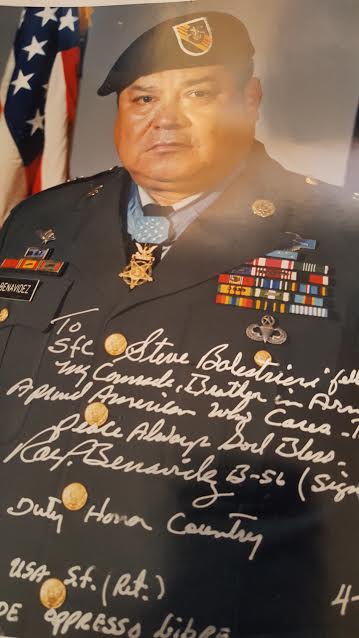
Benavidez died from complications of diabetes in 1998 but his legend will live on. He’s the consummate Special Operator. And on this day 49 years ago, he showed the never quit attitude that the Special Operations Forces pride themselves on. He often finished his speeches with this closing.
I’m asked hundreds of times: Would you do it over again? In my 25 years in the military, I feel like I’ve been overpaid for the service to my country. There will never be enough paper to print the money nor enough gold in Fort Knox for me to have to keep from doing what I did. I’m proud to be an American; and even prouder — and I’m even prouder that I’ve earned the privilege to wear the Green Beret. I live by the motto of “Duty, Honor, Country.”
Photo courtesy Roy Benavidez Facebook
This article was originally published on SpecialOperations.com and written by








COMMENTS