

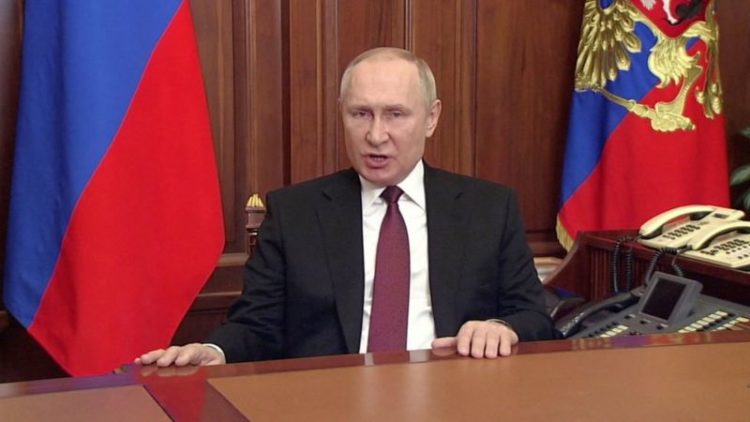
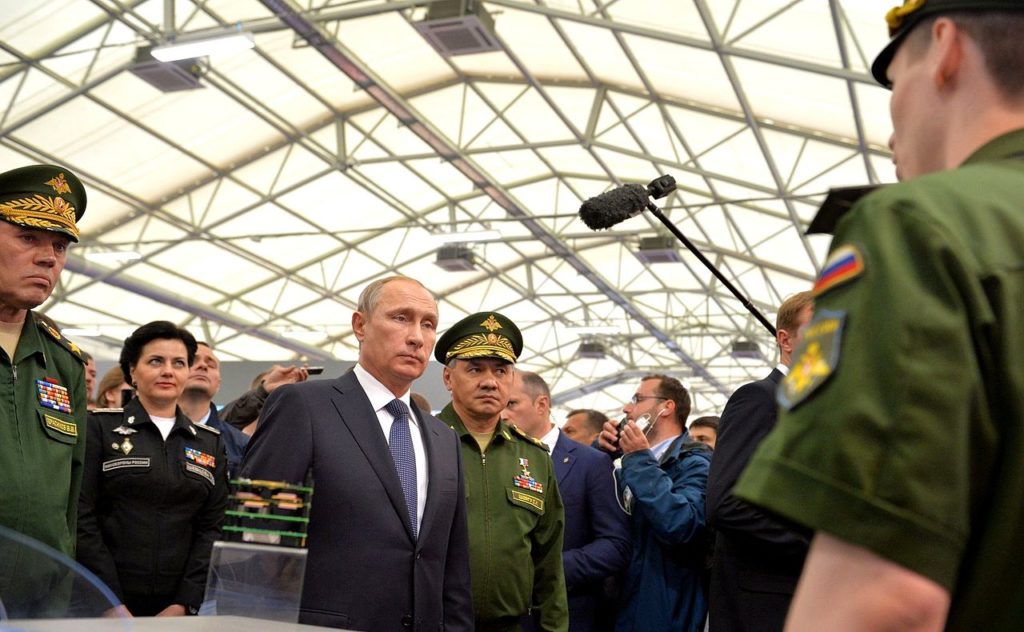
Becoming more paranoid as Russia started to enact its imperial plans in Ukraine after 2014, Putin has surrounded himself with hardliners and warlords—many of which are ‘Yes’ men that tell Putin what to hear to satisfy his ego. Putin’s hardliners, such as Patrushev, Shoigu, Kadyrov, Prigozhin, and others, pushed for a full-fledged invasion of Ukraine, promising the faux Tsar a quick and decisive victory against Kyiv.
Meeting stiff resistance and a NATO response with aid to Ukraine that didn’t come to Georgia, Putin became ever more paranoid. Despite the hardliners hiding the realities on the ground, such as demoralized forces and inadequate logistics, Putin has continued the war—still in his grandeur that the original ‘Novorossiya‘ objectives can be completed.
Putin would also hide the suspicions that the war hasn’t gone according to plan with the Russian public—assuming they, the ‘Proles,’ would be his most significant threat to his rule. In truth, his own ‘Inner Party’ would start to eat each other alive.
The More Ukraine Scores Victories, the Bigger the Infighting
Important victories for Ukraine in the Kharkiv oblast sent Russian society into a shockwave. Realizing his professional army was decimated, Putin ordered an unpopular partial mobilization. The mobilization exacerbated Moscow’s labor shortage and saw hundreds of thousands of their best and brightest flee the country.
After the announcement of partial mobilization, Ukraine would liberate the left bank of Kherson—a critical turning point in the war as Russia used the city as a launchpad to invade Odesa and land-lock Ukraine potentially. Further strikes against Engels’s strategic bomber base, raids into Belgorod, and the drone strike on the Kremlin only heightened discontent toward Russian leadership.
Putin’s media figures, such as news anchors and influential bloggers, would only heighten genocidal rhetoric about how Ukraine shouldn’t exist as a state and calls for further massacres as the war becomes a lost cause. One such media figure, RT talk show contributor Anton Krasovsky, called for Ukrainian children to be burned and drowned on television. Putin’s revisionist media figures act as his own ‘Outer Party.’
Cracks in the Inner Party
For several months, the mercenary Wagner Group and the Russian Ministry of Defense have had an open conflict regarding who to blame for the lack of decisive victories in the war thus far. Putin’s hardline inner circle, such as Chechen warlord Ramzan Kadyrov and Dmitry Medvedev, have called on Russia to use tactical nuclear weapons in a desperate attempt to salvage the war.
Yevgeny Prigozhin has taken his spites directly with Defense Minister Shoigu and General Gerasimov, the overall Russian commander for their invasion force. General Suvorikin, also known as “General Armageddon,” was demoted by Putin to keep the hardliners in check and his ‘yes’ men close to his war plans.
Putin has always ruled Russia with multiple factions in conflict. By doing this, Russia’s several sections would always directly blame each other, and so would the public.
Putin would always look like the “white knight” by stopping the infighting he silently created, escaping blame for any tragedy or battlefield setback Russia would face. With his factions in a low-level conflict that the FSB could monitor, Putin would always be the “Big Brother” looking over the state and “protecting” it—until his reconstitutions returned to haunt him.
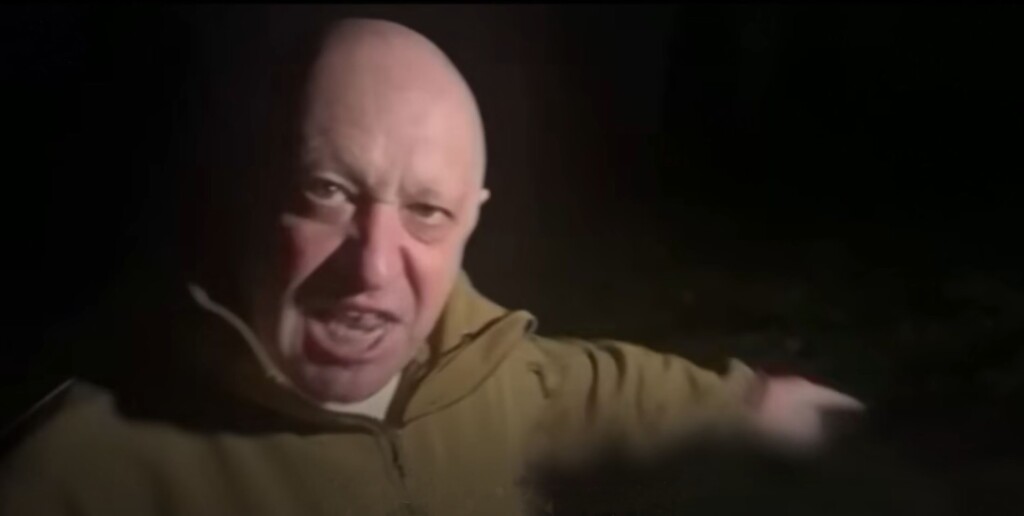
Prigozhin and his Wagner Group, who suffered at least 20,000 casualties in Bakhmut, would lead a coup attempt—publicly calling out Putin, something no other figure close to him has done before. Shooting down several Russian aircraft and killing 13 pilots, the mercenaries came within 200 KM of Moscow without a fight and cheers from civilians. Longtime Belarusian dictator Alexander Lukashenko mediated the coup—saving Putin from a potential fate Tsar Nicholas II faced—for now.
What Comes After?
The Wagner mutiny has exposed the cracks in Putin’s Orwellian system. A 25,000-strong, well-trained mercenary organization had moved more tactfully and organized a comprehensive plan towards the Kremlin that the Ministry of Defense could not respond to.
Cutting off Rostov and Voronezh, the PMC temporarily cut off the two main Russian logistical hubs to their forces in Ukraine. The military was unable to respond as the majority were in the occupied areas of Ukraine. If they withdrew to help the Kremlin, the Ukrainian Armed Forces could’ve quickly advanced.
Putin’s state security apparatus, which he reorganized to consolidate long-term power, is now exposed. The silence of various governors, Duma members, and bloggers towards Wagner’s 24-hour advance shows that Putin isn’t as famous anymore as he claims to be. With growing discontent over the war, as Russian casualties continued to climb toward World War Two numbers, other hardliners could now call out the faux Tsar without repercussions.
The minimal security force along the Russian borders is ripe for Ukraine, especially as their military intelligence has trained anti-Putin Russian legions to conduct cross-border raids. Hypothetically due to the slow response by Russia’s home guard and police, Ukraine now knows it could capture large swaths of Russian territory to bargain for the return of their occupied territories at will.
Putin’s credibility has now diminished. Civilians cheered on Prigozhin, who was the only man to bring Russia’s only two battlefield victories since mid-2022 with the capture of Soledar and Bakhmut. A warlord who is not afraid to criticize the higher echelons of the Russian kleptocracy, Prigozhin, a former personal chef of Putin, has now shown the cracks in his Big Brother system.
Putin’s Russia, which mirrored Orwell’s 1984 for two decades, is now showing weakness and a potential end—something the Russian autocrat never thought could happen to him. Nevertheless, in this version of Russia, it is essential to remember that the unfortunate change can only happen with the Inner Party—the oligarchs and warlords, as they have stamped the Proles/Russian citizens into supporting a perpetual strongman state. The scariest part about the cracks in Putin’s Orwellian system is that the conflict only occurred because his inner circle increasingly became discontent with the faux Tsar for not being brutal enough towards Ukraine.








COMMENTS