

Financial Architecture
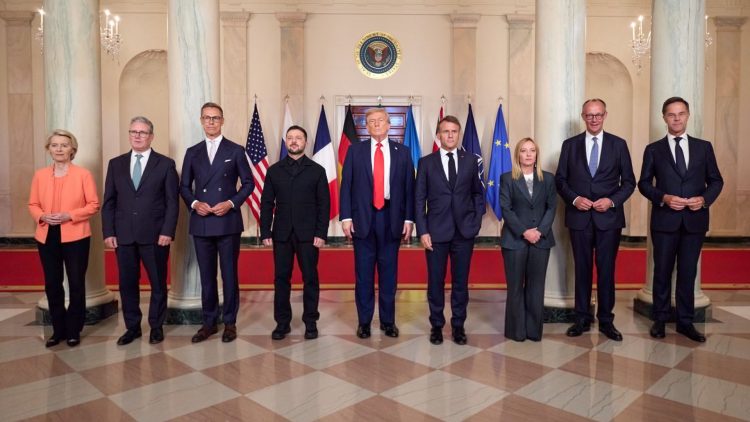
The €30.6 billion in EU support for Ukraine planned for 2025, including €18.1 billion from immobilized Russian assets, creates a financial framework that operates more like collective defense spending than traditional foreign aid. This arrangement makes EU economic stability partially dependent on Ukrainian security.
Legal Precedent
The Joint Security Commitments establish legal frameworks for automatic military assistance that increasingly resemble Article 5 triggers. While not technically mutual defense treaties, they create expectations and obligations that function similarly in practice.
Implications for US Involvement
Russia’s unwillingness to accept reasonable territorial compromises may paradoxically increase rather than decrease American military involvement in Ukraine.
Several dynamics support this assessment:
The Trump administration’s approach to European security, while emphasizing burden-sharing, has consistently supported increased European defense spending and capabilities. Poland’s massive military recapitalization with US-produced tanks, attack helicopters, and strike fighters is the most overt example. An EU that develops NATO-like defense capabilities for Ukraine aligns with long-standing US policy goals of European strategic autonomy. However, the deep integration of US and European defense industrial bases means that expanded EU military support for Ukraine automatically increases American involvement through technology transfers, joint production agreements, and intelligence sharing.
Furthermore, if the EU develops quasi-Article 5 commitments to Ukraine, the US may find itself indirectly committed through existing NATO obligations to EU member states. An attack on Ukraine that triggers EU collective defense mechanisms could activate US commitments to European allies, creating a backdoor NATO involvement that formal Ukrainian membership might not have achieved.
Historical Precedents: The Perils of Maximal Demands
A short walk down the halls of any military war college will remind us of the dangers of excessive territorial demands by failing aggressors. Two examples illustrate why Putin’s current approach may backfire:
Germany’s 1918 Brest-Litovsk Overreach – After forcing Russia out of World War I, Germany imposed the punitive Treaty of Brest-Litovsk, claiming vast territories including Ukraine, the Baltic states, and much of Belarus. Rather than securing German victory, these maximal demands tied down hundreds of thousands of German troops in occupation duties while alienating potential allies. The harsh terms strengthened Allied resolve and provided powerful propaganda about German war aims. Within months, Germany’s position collapsed entirely, and all territorial gains evaporated.
Japan’s 1941-1942 Expansion – Following Pearl Harbor, Japanese forces achieved stunning initial victories across the Pacific. However, rather than consolidating these gains and seeking a negotiated peace, Japan continued expanding toward Australia and India. These maximal territorial ambitions united previously divided Allied powers and convinced the United States that only a complete Japanese defeat was acceptable. The overextension ultimately enabled the Allied counter-offensive that destroyed Japanese power entirely.
Historical figures understood these dynamics well. Otto von Bismarck observed,
“Politics is the art of the possible, the attainable — the art of the next best.”
Similarly, Napoleon warned,
“I may lose a battle, but I shall never lose a minute”
—emphasizing that timing and moderation in victory often determine long-term success. Both leaders understood that excessive demands often transform tactical victories into strategic disasters.
The Momentum of Military Integration
The EU’s path toward de facto Article 5 commitments to Ukraine has developed its own institutional momentum that Russian pressure now accelerates rather than restrains. The European Defense Industrial Strategy, adopted in March 2024, explicitly includes Ukraine as a partner rather than merely an aid recipient. This integration creates constituencies across European defense industries with financial interests in continued military cooperation with Ukraine.
Moreover, the EU’s planned Defense Omnibus Simplification Proposal, which was unveiled in June 2025, aims to streamline legal frameworks for defense procurement and industry cooperation. Such reforms, initially designed to improve EU internal defense coordination, increasingly include Ukrainian partners, creating integrated supply chains that blur the lines between EU and Ukrainian defense capabilities.
The political psychology also matters. European leaders who initially hesitated to provide advanced weapons systems have gradually overcome previous red lines through incremental escalation. This process has created a political investment in Ukrainian success that makes abandonment increasingly difficult to justify domestically. Each new aid package creates expectations for continued support that operate independently of formal treaty obligations.
Strategic Implications
Russia’s refusal to moderate its territorial demands while insisting on permanent Ukrainian vulnerability is producing the opposite of its intended effects. Rather than weakening Western resolve, Putin’s maximalist approach is institutionalizing EU-Ukraine military cooperation in ways that may prove more durable than formal NATO membership.
The EU’s evolution toward quasi-Article 5 commitments to Ukraine represents a fundamental shift in European security architecture. Unlike NATO expansion, which required lengthy ratification processes and could theoretically be reversed, the EU’s approach creates economic, institutional, and political incentives for sustained military cooperation that operate below the threshold of formal treaty commitments while achieving similar practical results.
For the United States, this development presents both opportunities and risks. European assumption of greater responsibility for Ukrainian defense aligns with long-standing US policy goals. However, the deep integration of US and European defense systems means that expanded EU military support automatically increases American involvement through existing alliance structures.
Putin’s strategic error lies in misunderstanding how Western democratic institutions respond to existential challenges. Rather than gradually wearing down Western resolve through prolonged pressure, Russia’s unwillingness to accept reasonable territorial compromises is strengthening institutional commitments to Ukrainian independence that may outlast the current conflict by decades.
The historical lesson remains clear: aggressors who demand too much when their position is weakening often achieve far less than they might have gained through timely moderation. Russia’s current approach risks transforming a regional conflict into a permanent institutional commitment by the world’s largest economic bloc to contain Russian power actively. This outcome—an EU functioning as NATO’s eastern extension with quasi-Article 5 commitments to Ukraine—may prove to be Putin’s most counterproductive strategic achievement.
The irony is profound – by demanding that Ukraine remain outside NATO while simultaneously claiming vast territories Russia cannot fully control, Putin may be creating a security arrangement for Ukraine that proves more robust and threatening to Russian interests than NATO membership ever could have been.








COMMENTS