

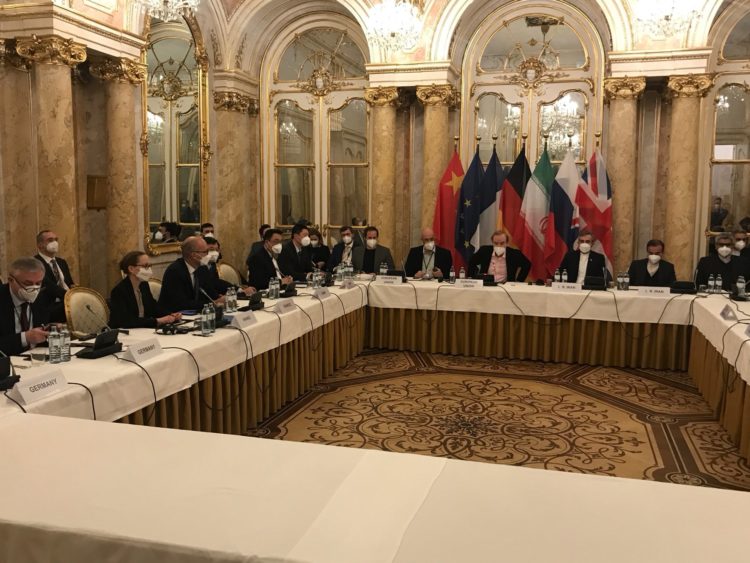
A pause in #ViennaTalks is needed, due to external factors.
A final text is essentially ready and on the table.
As coordinator, I will, with my team, continue to be in touch with all #JCPOA participants and the U.S. to overcome the current situation and to close the agreement.
— Josep Borrell Fontelles (@JosepBorrellF) March 11, 2022
“A pause in #ViennaTalks is needed, due to external factors,” wrote European Union Foreign Policy Chief Josep Borell in a tweet. “A final text is essentially ready and on the table.”
“The conclusion of the deal does not depend on Russia only,” said Russian envoy Mikhail Ulyanov.” There are other actors who need additional time and who have additional concerns, and they are being discussed.”
Iran’s Foreign Ministry believes that the pause in negotiations may create “momentum” to resolve the remaining issues.
“Pause in #ViennaTalks could be a momentum for resolving any remaining issue and a final return. Successful conclusion of talks will be the main focus of all,” Iranian Foreign Ministry Spokesperson Saeed Khatibzadeh said in a tweet.
What is the Iran Deal?
The Joint Comprehensive Plan of Action (JCPOA), more commonly known as the Iran Nuclear Deal, was hailed in the press as a agreement between Iran and the P5+1 (China, Germany, France, Russia, the United Kingdom, and the United States) that was signed in July 2015.
Under its conditions, Iran is to deconstruct its nuclear arms program and allow its nuclear facilities to be inspected by the International Atomic Energy Agency. In exchange, the West committed to lifting key economic sanctions on Tehran and the release of over $100 billion worth of frozen Iranian assets.
Supporters of the agreement said it would cull the possibility of Iran reviving its nuclear weapons program, thus reducing the possibility of an armed conflict between Tehran and its rivals. However, the deal almost collapsed in 2018 after then-President Donald Trump withdrew from the agreement and reinstated catastrophic oil and financial sanctions.
According to Trump, the deal lacked the ability to stop Iran’s ballistic missile development and its use of proxy warfare in the region. Furthermore, the sunset provisions would have allowed Iran to rebuild its nuclear program after a few years.
President Joe Biden announced the United States’ return to the deal in 2021 and offered to join European states in the first diplomatic exercise with Iran since Trump’s withdrawal.
Critics of the deal point to the fact that it does not prevent Iran from developing nuclear weapons as its provisions begin to expire in 2026, freeing Iran to proceed on an industrial scale.
The deal does not require Iran to submit to any time, anywhere inspecti0ns by the IAEA of their facilities and military sites where they have declared nuclear bomb research is being conducted. Iran is able to delay inspections for as many as 24 days, giving them plenty of time to sanitize their facilities before inspectors arrive. Iran is not considered to be faithfully upholding their end of the previous arrangement.
This deal gives Iran immediate and permanent benefits in exchange for temporary concessions. These benefits include the lifting of sanctions, unfreezing Iranian assets in the U.S., and allowing foreign companies to assist Iran with furthering their nuclear ambitions.
Finally, the “deal” is not a treaty that can be debated and ratified by the U.S. Senate. It exists as a kind of handshake deal with the current administration and Iran and can be rescinded by a future president as it is not binding on future presidents.
If you’re just tuning into SOFREP for the first time, click here to enjoy a free 2-month trial membership and be kept up to date on developments in Ukraine and elsewhere around the globe.








COMMENTS