

On the ground
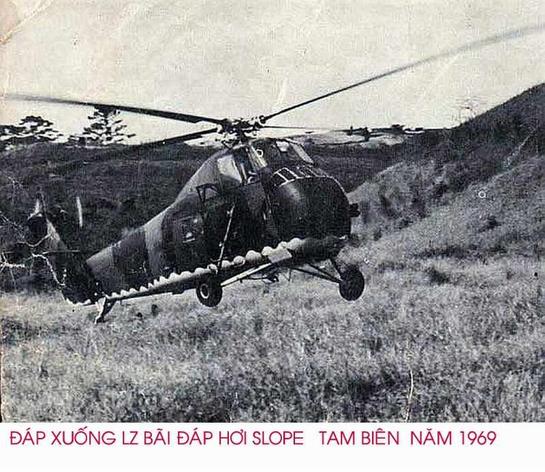
The H-34s dropped ST Louisiana on a ridge with a wooded knoll on one end, an open area around it, and jungle on the other side. Boggs headed the team toward the wooded knoll. Walton was next to the tail gunner for the team while Cunningham was behind Boggs in the formation. Because Walton was still pretty green, having only two or three missions under his belt, he kept his questions to himself. But he did wonder why they went to the knoll instead of the jungle.
Shortly after the team reached the wooded knoll, Boggs told Cunningham to give a team okay, which released all of the air assets assigned to that target. At that point, they hadn’t heard anything. When ST Louisiana moved farther up the knoll, Cunningham was amazed at what he saw. There were numerous booby-traps and punji pits set up, he assumed, for spike teams. Fortunately, the traps were old and the team could see each and every one. The team continued to move for a few more minutes before settling into a thickly wooded area on the knoll. Cunningham had difficulty making radio contact with the Covey that was flying several miles away from the area of operation. He finally made contact with an aircraft that had the call sign “Alexander” just as a NVA unit moved by on a trail that cut through the middle of the wooded knoll.
“You’re whispering. Why are you whispering?” Alexander asked.
While Cunningham whispered into his PRC-25, Walton checked out the wooded knoll. It was covered with dense jungle foliage. He observed the point man give a hand sign that there were NVA soldiers in the jungle at the opposite end of the short ridge near the team’s LZ. Walton was sitting at the end of the formation in the thick jungle vegetation with the tail gunner; they both were surprised to hear numerous NVA soldiers moving along the trail.
The noise got the tail gunner’s attention. He focused on the area to his right. Walton was sitting in front of him, with the remaining four team members spread out in front of the two of them. As the tail gunner continued to concentrate on the woods to the right, Walton looked past him and saw the bushes shake about ten feet away. One of the NVA soldiers was crawling up their back trail. As Walton swung his CAR-15 toward the enemy soldier, the NVA popped up, AK-47 tucked under his right arm. He had a big Cheshire cat grin on his face, knowing he had ST Louisiana dead to rights. The grinning soldier opened fire on full automatic while Walton was still turning.
Four of the NVA’s rounds struck the tail gunner, wounding him severely. Walton’s CAR-15 rounds hit the NVA soldier and drove his body backward into the jungle. With the threat temporarily at bay, he began to patch up the tail gunner. Walton dragged him six feet up the hill toward Boggs, got him stabilized, and started an IV (intravenous) drip of blood expander. Walton asked Boggs for permission to crawl back to the dead NVA to search for documents and anything of intelligence value. Boggs rightfully declined the offer. Moments later, the first NVA wave attack slammed into ST Louisiana. The six-man team repulsed it without taking any further casualties.
Fortunately for ST Louisiana, a flight of 101st Airborne Division gunships was diverted from a target in South Vietnam toward the A Shau Valley. The arrival of the 101st took the pressure off of the team for a few minutes as Boggs popped a smoke grenade and directed several gun runs around the team’s perimeter. Every time they flew past on a gun run, the NVA on the ridgeline would jump up and fire at them. Cunningham crawled to a knoll to get a better view because it was his first contact with the NVA. The dirt in front of his face exploded several times from enemy rounds. Cunningham suddenly thought maybe this wasn’t such a good idea, so he backed up. Really fast. After a few more close gun runs, the helicopters had expended all of their ordnance and returned to their base of operations at Phu Bai. Cunningham jokingly asked the 101st gunners if they could just come on down and pull them out. They declined, saying the extraction choppers were on the way.
Napalm between the legs
A few minutes later, Cunningham was told the single-engine A-1E Skyraiders (Spads) were on station. Boggs had asked for a napalm run. Walton was sitting next to Cunningham, on his right, and had just finished patching up the last of the tail gunner’s four wounds. Both men were near a clearing. Boggs directed the napalm run, which struck the ground at the far end of the open area and moved toward ST Louisiana on the knoll. Walton didn’t think anything about it.
Off in the distance he could see the Spad making its run, saw the canister come loose from the aircraft and tumble toward the earth. After the napalm canister hit the ground and exploded, its forward momentum carried a one-foot hunk of burning metal up the knoll and over the open area toward Walton and the team. It stopped right between Walton’s feet. He sat there staring at the burning metal between his legs for several long seconds. Cunningham was amazed at how close the napalm had come without any of it landing on him, even though he and Walton were just a few feet apart.
The napalm run forced the NVA to pull back momentarily, but another wave of NVA soon assaulted the team to Cunningham’s left. No one else on the team was wounded. Boggs became concerned about the vacant tail gunner position becoming a vulnerable spot, so he ordered Walton to crawl back to where he had killed the first NVA. As Walton moved out in a low crawl, a Vietnamese team member moved into his position next to Cunningham.
Walton moved to the other side of the perimeter. He had crawled about eight feet, down a slight slope, when a second NVA wave attack hit the team from Bogg’s side near the point. Again, ST Louisiana held. As another wave of NVA moved toward the team, Boggs began to yell to his men that they were being overrun. From his position, only eight feet away, Walton couldn’t see Boggs or Cunningham or the Vietnamese team member who had filled the slot he had vacated. The jungle vegetation was so thick he could only see one or two feet around him. In fact, the foliage was so thick, Walton would see the leaves move first to announce an incoming enemy soldier.
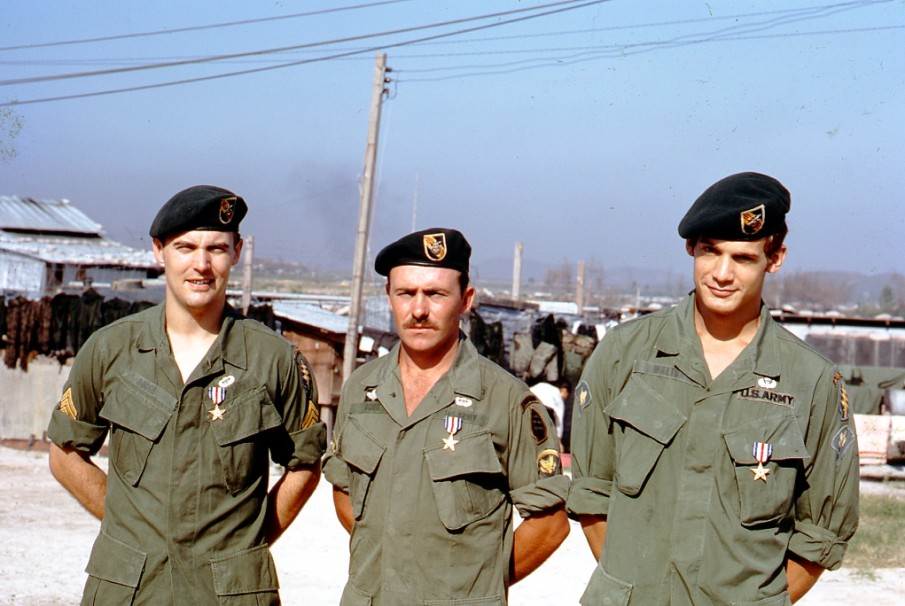
(Featured image courtesy of Charles Borg. From left: ST Louisiana Team Leader Wilbur “Pete” Boggs, Charles Borg, and John T. Walton at FOB 1 in the fall of 1968 after receiving Silver Stars for valor. Boggs’ and Walton’s awards were for valor stemming from the Aug. 3, 1968 mission in the A Shau Valley. Borg received his valor award from a separate, unrelated mission in Laos.)








COMMENTS