

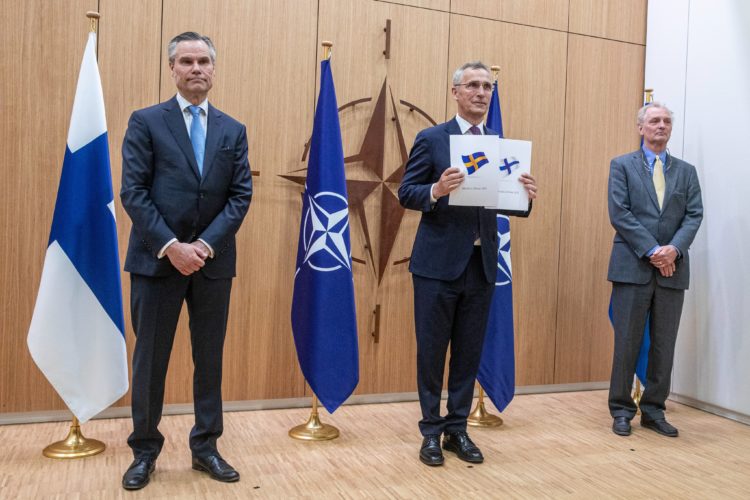
Turkey’s initial resistance meant that the 30-member alliance would not have the consensus necessary to progress the application process. In a meeting with their fellow NATO ambassadors, Turkey’s representatives said they still needed more time to discuss issues related to Sweden and Finland.
“Nato expansion is only meaningful for us in proportion to the respect that will be shown to our sensitivities,” Turkish President Recep Tayyip Erdogan said.
Turkey has provided a list of grievances against the two Nordic countries, primarily concerning allegations of funding and granting asylum to members of the Kurdistan Workers’ Party (PKK) who have been in armed conflict with the Turkish government.
A Turkish official said that although Ankara has pulled the hand brake on the application process, it does not intend to stop the accession of Stockholm and Helsinki to the alliance.
“We’re not saying they can’t be Nato members,” the official said. “Just that we need to be on the same wavelength, the same page, about the threat that we’re facing.”
“We want to reach an agreement . . . The sooner we can reach an agreement, the sooner the membership discussions can start,” they added.
Despite the initial setback, NATO ambassadors still believe that Turkey will soon find a compromise that will allow the expansion of the alliance.
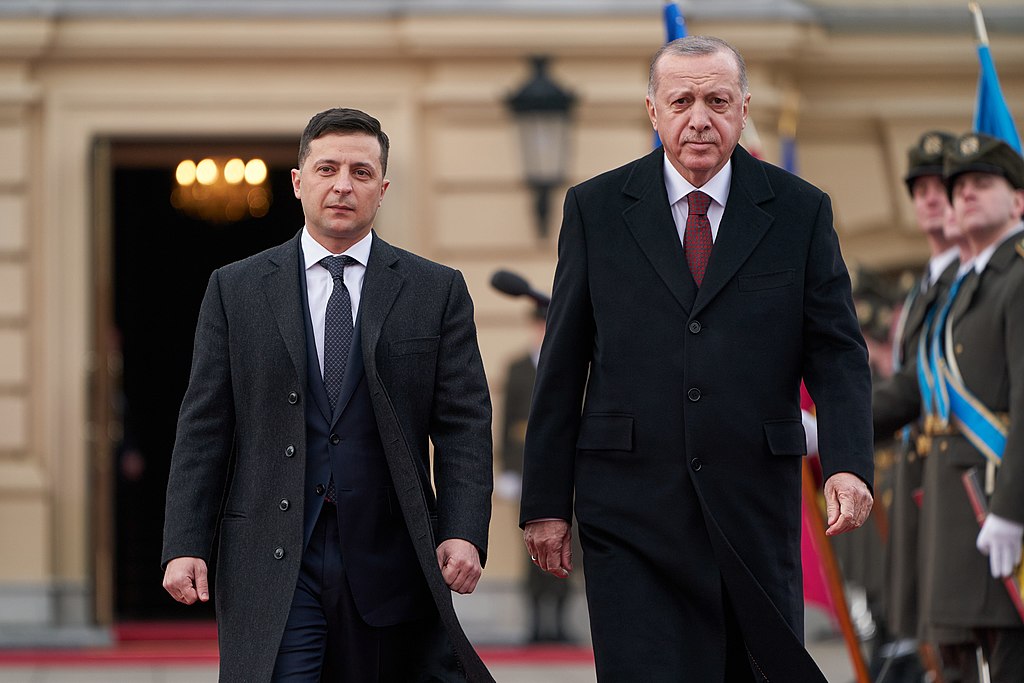
Croatia has also expressed its non-approval of Sweden and Finland’s membership in NATO. Croatian President Zoran Milanovic stated that he would instruct their permanent representative to NATO to vote against Sweden and Finland’s membership.
“As far as I’m concerned, let them join NATO… but until the issue of the election law in BiH (Bosnia and Herzegovina) is solved, until the Americans, the English, the Germans, if they can and want to, force (Bosniak officials) to change the election law in the next six months and give Croats their fundamental rights, the Sabor must not ratify anyone’s accession to NATO,” the Croatian President said.
“For me, that’s a vital national interest of the Croatian state, nation, and people, that BiH be a functioning state,” he added.
Croatia is referring to the electoral issues of Bosnia and Herzegovina, where the Croatian Democratic Alliance Bosnia and Herzegovina (HDZ BiH) ‘s Dragan Čović was defeated by current Croat Member of the Presidency of Bosnia and Herzegovina Zeljko Komsic, who was backed by Bosniak voters, thus resulting to Bosnian Croats not recognizing him as their legitimate leader. This is because Bosnia and Herzegovina have a complicated electoral system of having a tripartite presidency, where one member of the presidency is elected directly from the territory of the Serbs, one from the Bosniak territory, and one from the Croat territory.
How Long Before Finland and Sweden Get Into NATO?
With the governments of Sweden and Finland formally submitting their request to join NATO, the question is, how long will it take for the countries to get into the alliance? Even without the delays caused by Turkey and Croatia, the application could take several months.
The alliance does not have a formal membership application process, but it does rely on a consensus or an agreement of all existing members that will allow prospective nations in the group to join. Such an agreement will be based on an applicant’s ability to meet the alliance’s criteria.

According to NATO, these criteria include a “functioning democratic political system based on a market economy; fair treatment of minority populations; a commitment to resolve conflicts peacefully; an ability and willingness to make a military contribution to NATO operations; and a commitment to democratic civil-military relations and institutions.”
Assistant professor in international relations at the University of Waterloo Alexander Lanoszka is confident that the two nations will meet these criteria saying, “Finland and Sweden have long met the basic requirements for being in NATO, not least because of the strength of their democratic institutions and strong civilian control over their militaries.”
“As such, the process for joining should be speedier and thus smoother than what might have been the case with those countries that were under communist rule during the Cold War,” Lanoszka added.
NATO is greatly incentivized to accommodate Sweden and Finland’s application, given their strategic location relative to Russia. Having the two new members will expand the alliance’s border far north and strengthen its position in the Baltic region. The alliance will also greatly benefit from Finland’s border with Russia, the longest in the world at some 820 miles (1,340 kilometers) long.









COMMENTS