

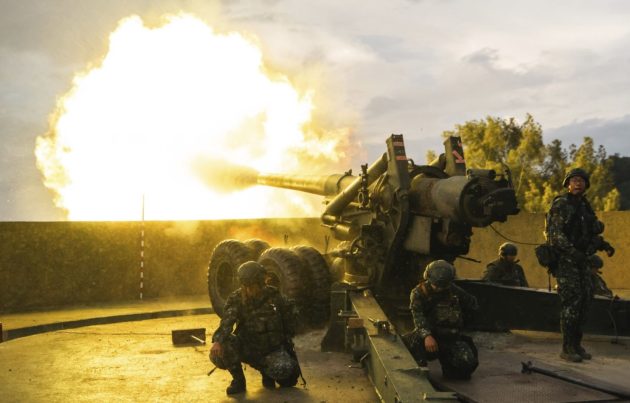
China’s Joint Sword exercises show what Taiwan must be prepared to counter. China conducts missile strikes, naval operations, air sorties, and cyber activity under unified theater commands. These commands merge sensors and shooters into a fast kill chain that can detect, pass data, and strike within minutes (Center for Strategic and International Studies, 2024). Compared to this standard, Han Kuang 2025 demonstrated stronger service level performance but limited progress toward a single integrated joint force.
Whole-of-Society Defense: Building National Resilience
Whole-of-society defense matters for Taiwan because a military alone cannot survive a Chinese attack. Modern war collapses the line between front and rear, and Taiwan can only endure if government, civil society, and the private sector function together. Whole-of-society defense refers to a national system where state agencies, local governments, private companies, and individual citizens sustain essential functions during conflict, including shelters, stockpiles, transport networks, energy grids, hospitals, and emergency communications (Brookings Institution, 2025). President Lai Ching te formalized this approach through the Whole of Society Defense Resilience Committee and directed that national defense planning integrate civilian roles across training, stockpiles, infrastructure, energy security, and medical readiness (Executive Yuan, 2025). Han Kuang 2025 offered the clearest test of whether Taiwan can turn this concept into real capability.
The reserve system showed how wide Taiwan’s readiness gap remains. Han Kuang mobilized 22 thousand reservists, the largest number in the exercise’s history, and activated the 260 Infantry Brigade as a full unit (Taiwan News, 2025). Yet the exercise also exposed the limits of the reserve force. Most reservists trained under short conscription cycles that did not produce reliable combat skills, and many receive only occasional refresher training (Global Taiwan Institute, 2023). Equipment shortages persist, including basic rifles and anti-armor systems needed for live training, and significant portions of the reserve force lack the gear needed for sustained operations (Defense News, 2025). Mobilization still relies on manual notification and local coordination, which cannot scale to support the 1.66 million registered reservists in a conflict that would unfold within days (Global Taiwan Institute, 2024). These gaps show that reserves cannot yet support whole-of-society defense in a real crisis.
Civilian integration during Han Kuang showed progress and limits. The Urban Resilience Exercise linked all counties and cities in coordinated evacuation and communication drills between 7/15 and 7/18 (Focus Taiwan, 2025). Local governments tested shelter procedures, hospitals ran emergency protocols, power plants practiced damage control, and major retailers assisted with public guidance and first aid. These actions demonstrated that Taiwan can organize nationwide drills under controlled conditions. However, the exercise provided only short duration simulations. Real conflict would require sustained resilience under conditions of disrupted communications, damaged infrastructure, and unpredictable attack cycles. Han Kuang proved that Taiwan can coordinate a civilian response. It did not prove that society can sustain continuous operations during prolonged conflict.
Government agencies and civil society groups are trying to fill the capability gaps that Han Kuang exposed. The All-Out Defense Mobilization Agency manages reserves, civil defense, and resilience planning, but its authority depends on cooperation from other ministries and private actors rather than formal command power (Armed Forces Reserve Command, 2025). Civil society groups such as Kuma Academy have trained tens of thousands of citizens in first aid, evacuation, and disinformation awareness, reflecting growing public interest in national defense (Business Insider, 2025). These programs improve awareness but cannot replace an integrated national system. Participation remains uneven, training standards vary, and instruction is not fully synchronized with government procedures.
The national resilience fund has the potential to strengthen whole-of-society defense if applied consistently. The 150 billion New Taiwan dollar program aims to expand shelters, reinforce critical infrastructure, and improve logistical networks for emergency response (Taipei Times, 2025). These investments can raise societal resilience if implemented across multiple years and integrated into long-term defense planning. If funding weakens or becomes a one-year effort, stockpiles will expire, shelters will degrade, and communication networks will not keep pace with modern threats.
Recommendations: Move Beyond Han Kuang
Han Kuang 2025 is only a snapshot. The real question is what Taiwan must fix to turn rehearsal into real readiness. The exercise showed progress, but war will test the institutions behind it. Taiwan’s next steps require stronger command structures, usable reserves, steady sustainment, clear legal authority, and a coordinated defense of the information space.
First, Taiwan needs a unified territorial command that brings the Ministry of National Defense, the All-Out Defense Mobilization Agency, and local governments under one structure. At present, these actors operate separately, and civil groups lack legal authority. A territorial command with regional posts would allow military and civilian forces to mobilize together and respond within hours. Ukraine offers a clear example. Its Territorial Defense Forces operate through regional headquarters that coordinate brigades with civilian authorities, improving speed and clarity in crisis response (International Centre for Defence and Security, 2022). Finland demonstrates similar benefits. Its government issued a national decree establishing regional cooperation groups for civil defense, appointing coordinators to integrate rescue services, defense forces, municipalities, and health agencies into one system (Government of Finland, 2024). Taiwan needs an equivalent structure to ensure unified action.
Second, Taiwan’s reserve force must shift from paper numbers to functional territorial units. Mobilization today is slow, and equipment shortages limit capability. Reservists should be assigned to fixed units in their home counties and linked directly to regional commands. Estonia provides a clear benchmark. Estonia organizes its reservists on a territorial principle, assigns them to defined wartime positions, and maintains a mobilization registry of more than 230,000 individuals with clear assembly locations (Ministry of Defence Estonia, 2025). Estonia’s broader security posture emphasizes routine training and local accountability, strengthening readiness at the community level (International Centre for Defence and Security, 2025). Taiwan’s 2025 Quadrennial Defense Review acknowledges equivalent gaps and calls for improved equipment and longer recall training (Taiwan Ministry of National Defense, 2025).
Third, Taiwan must rebalance its defense spending toward sustainment. Personnel costs and high-end platforms dominate the budget, while ammunition, fuel, and maintenance remain underfunded. Taiwan’s current stockpiles cannot support prolonged operations. Redirecting procurement toward sustainment would deepen ammunition reserves, expand distributed fuel storage, and pre-position repair and medical supplies. Sweden offers a strong model. Sweden’s Total Defence Bill allocates long-term funding for military and civilian sustainment and directs government agencies to build grain reserves, adopt rotating stock systems, and partner with private industry for storage (Government of Sweden, 2025). The Han Kuang 41 Exercise Report reached similar conclusions, emphasizing the need to integrate civilian logistics and disperse stockpiles more effectively (Taiwan Ministry of National Defense, 2025).
Fourth, Taiwan needs a legal structure that gives the All-Out Defense Mobilization Agency clear authority to coordinate resources and integrate civil groups. Civil defense organizations today operate without legal protection or defined roles. A national Readiness Act should formalize cooperation among ministries, local governments, the military, and civic organizations. Taiwan has already begun this work. The Office of the President established the Whole of Society Defense Resilience Committee to coordinate continuity of government, strategic stockpiles, civilian training, and infrastructure preparedness (Taiwan Office of the President, 2024). Ukraine illustrates the importance of law. Its Territorial Defense Forces were transformed into a distinct branch through legislation that established clear regional command chains (Jamestown Foundation, 2025). Taiwan needs comparable legal authority.
Fifth, Taiwan must integrate civilian cyber capacity and disinformation defense into its national security plan. China has increased digital attacks and information manipulation, and Taiwan’s response remains fragmented. Taiwan needs a unified cyber and information defense network linking the Ministry of Digital Affairs, regional commands, telecommunications providers, and civil fact-checking organizations. Redundant communication systems such as low-orbit satellites, cross-network roaming, cloud backups, and public alert systems are essential. The Whole of Society Defense Resilience Committee has already initiated this effort by developing emergency communication infrastructure and digital resilience programs (Taiwan Office of the President, 2024). These measures must be institutionalized and incorporated into reserve training.
Conclusion: Exercises Alone Do Not Win Wars
Han Kuang 2025 showed that Taiwan can simulate war but has yet to institutionalize readiness for it. The drills are no longer mere theater, yet their gains will fade unless command, reserves, and civilians are bound by real structures of trust and responsibility.
As a Taiwanese who has served in uniform, and whose family lives under the shadow of this threat, I see the urgency plainly: our task is not to perform preparedness, but to become prepared before it is too late. China’s greatest success is keeping Taiwan asleep. The hardest thing is to face what everyone knows but refuses to say: the threat is real, and time is running out. The question is no longer how to perform defense. It is whether Taiwan will finally wake up and prepare for it.
References:
Brookings Institution. (2025). Whole-of-society resilience: A new deterrence concept in Taipei.https://www.brookings.edu/articles/whole-of-society-resilience-a-new-deterrence-concept-in-taipei/
Global Taiwan Institute. (2025). Taiwan’s military shows new areas of focus in a more ambitious Han Kuang. https://globaltaiwan.org/2025/08/2025-han-kuang-exercise/
International Institute for Strategic Studies. (2023). The military balance 2023. https://www.iiss.org/publications/the-military-balance/the-military-balance-2023/
Jamestown Foundation. (2025). Evolving missions and capabilities of the PLA Rocket Force: Implications for Taiwan and beyond. https://jamestown.org/evolving-missions-and-capabilities-of-the-pla-rocket-force-implications-for-taiwan-and-beyond/
McKinney, J. M., & Harris, P. (2024). Deterrence gap: Avoiding war in the Taiwan Strait. U.S. Army War College Strategic Studies Institute. https://press.armywarcollege.edu/monographs/964
U.S. Department of Defense. (2024). Military and security developments involving the People’s Republic of China: Annual report to Congress. https://media.defense.gov/2024/Dec/18/2003615520/-1/-1/0/MILITARY-AND-SECURITY-DEVELOPMENTS-INVOLVING-THE-PEOPLES-REPUBLIC-OF-CHINA-2024.PDF
Australian Army Centre of Excellence. (2023). Air defence in the Falklands War – Part 1. https://cove.army.gov.au/article/air-defence-falklands-war-part-1
Center for Strategic and International Studies. (2024). How is China responding to the inauguration of Taiwan’s president: Joint Sword 2024 A military exercise. https://chinapower.csis.org/china-respond-inauguration-taiwan-william-lai-joint-sword-2024a-military-exercise/
Taiwan News. (2025). Taiwan to integrate C5ISR into future Taiwan Dome air defense system. https://www.taiwannews.com.tw/news/6225283
The Diplomat. (2025). Strategic implications of Taiwan’s 2025 Han Kuang exercise.https://thediplomat.com/2025/07/strategic-implications-of-taiwans-2025-han-kuang-exercise/
U.S. Army Air Force School of Advanced Military Studies. (2021). Linking sensor to shooter: The future of air ground integration. https://www.alssa.mil/News/Article/2667778/the-future-of-air-ground-integration-linking-sensor-to-shooter-in-the-deep-fight/
Armed Forces Reserve Command. (2025). All-out defense mobilization. https://afrc.mnd.gov.tw/AFRCWeb/Content_en.aspx?MenuID=6305&MP=2
Business Insider. (2025). China’s military threats grow. So does Taiwan’s civilian training.https://www.businessinsider.com/taiwan-civilian-defense-kuma-training-china-invasion-risk-preparation-2025-9
Defense News. (2025). Taiwan’s military reform is failing where it matters most. https://www.defensenews.com/opinion/2025/06/13/taiwans-military-reform-is-failing-where-it-matters-most/
Executive Yuan. (2025). President Lai presides over fourth meeting of Whole-of-Society Defense Resilience Committee. https://ocacnews.net/article/401940
Focus Taiwan. (2025). Nationwide urban resilience drills set for July 15–18: MND. https://focustaiwan.tw/politics/202507010011
Global Taiwan Institute. (2023). Taiwan’s military force restructuring plan and the extension of conscripted military service. https://globaltaiwan.org/2023/02/taiwan-military-force-restructuring-plan-and-the-extension-of-conscripted-military-service/
Global Taiwan Institute. (2024). Taiwan contemplates reforms to its military reserve forces. https://globaltaiwan.org/2022/04/taiwan-contemplates-reforms-to-its-military-reserve-forces/
Taipei Times. (2025). NT$150 billion of special budget key to whole-of-society resilience.https://www.taipeitimes.com/News/taiwan/archives/2025/07/03/2003839684
Taiwan News. (2025). Taiwan says Han Kuang 41 includes record 22,000 reservists. https://www.taiwannews.com.tw/news/6142690
Government of Finland. (2024). Government issues new decree to specify cooperation in preparedness for civil defence. https://valtioneuvosto.fi/en/-/1410869/government-issues-new-decree-to-specify-cooperation-in-preparedness-for-civil-defence-in-wellbeing-services-counties
Government of Sweden. (2025). Total Defence Bill 2025–2030. https://www.government.se/government-policy/total-defence/defence-resolution-2025-20302/
Government of Sweden. (2025–2026). Total Defence Policy. https://www.government.se/government-policy/total-defence/
International Centre for Defence and Security. (2022). Ukraine’s territorial defence on a war footing. https://icds.ee/en/ukraines-territorial-defence-on-a-war-footing/
International Centre for Defence and Security. (2025). Estonia’s robust security posture. https://icds.ee/en/estonias-robust-security-posture-dispelling-the-is-narva-next-narrative/
Jamestown Foundation. (2025). The territorial defense system of Ukraine: New innovations but incomplete approach. https://jamestown.org/the-territorial-defense-system-of-ukraine-new-innovations-but-incomplete-approach/
Ministry of Defence Estonia. (2025). Estonian Defence Forces. https://mil.ee/en/exercise-hedgehog-2025/
Taiwan Ministry of National Defense. (2025). Han Kuang 41 Exercise Report.https://www.mnd.gov.tw/English/Publish.aspx?title=News%20Channel&SelectStyle=Defense%20News%20&p=84753
Taiwan Ministry of National Defense. (2025). Quadrennial Defense Review 2025. https://www.mnd.gov.tw/NewUpload/%E6%AD%B7%E5%B9%B4%E5%9C%8B%E9%98%B2%E5%A0%B1%E5%91%8A%E7%B8%BD%E6%AA%A2%E8%A8%8E(QDR)/%E6%AD%B7%E5%B9%B4%E5%9C%8B%E9%98%B2%E5%A0%B1%E5%91%8A%E7%B8%BD%E6%AA%A2%E8%A8%8E(QDR).files/%E6%AD%B7%E5%B9%B4%E5%9C%8B%E9%98%B2%E5%A0%B1%E5%91%8A%E7%B8%BD%E6%AA%A2%E8%A8%8E(QDR)-114/2025QDR%E8%8B%B1%E6%96%87%E7%89%88.pdf?utm_source=substack&utm_medium=email
Taiwan Office of the President. (2024). Whole-of-Society Defense Resilience Committee framework. https://english.president.gov.tw/Page/670
—
** Editor’s Note: Thinking about subscribing to SOFREP? You can do it now for only $1 for your first year. Pull the trigger on this amazing offer HERE. – GDM








COMMENTS