

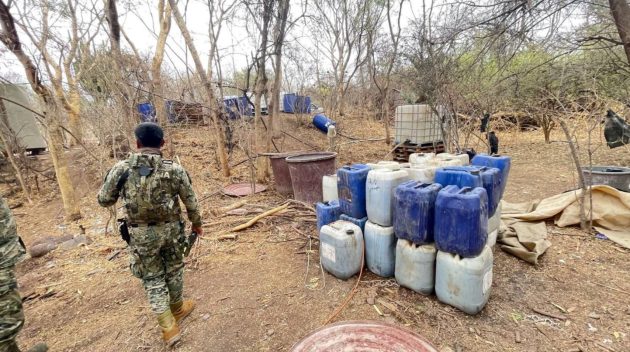
The cartels fight without uniforms, hide among civilian populations, exploit the protections of democratic legal systems, and recognize no international laws of war. They weaponize corruption, targeting everyone from street cops to cabinet ministers. They adapt faster than bureaucracies can respond, shifting routes when interdiction increases, changing products when markets shift, and modifying tactics when strategies evolve. Chinese chemical companies openly advertise fentanyl precursors on the internet, often attempting to evade law enforcement by using re-shippers, false labels, fraudulent postage, and concealed packaging, according to the US Department of Justice. This is not the warfare of Westphalia I was taught at the War College, but something far more complex and resistant to conventional military solutions.
The human toll makes this asymmetric conflict impossible to dismiss as just a metaphor. According to the Centers for Disease Control, in 2023, 105,007 drug overdose deaths occurred, which equals a major terrorist attack every three days, or the 9/11 death toll repeated each month. Opioids contributed to about 80,400 of roughly 106,700 deaths in 2021, with synthetic opioids other than methadone—mainly fentanyl—involved in around 70,600 cases. These are not just numbers. They are sons and daughters, mothers and fathers, brothers and sisters—veterans, police officers, miners, lawyers, and day laborers—dying at rates that dwarf combat casualties from any conventional war America has fought since World War II.
The Pattern of Undeclared Wars
The absence of a declaration of war against drug trafficking organizations is not merely a technical oversight. Still, it reflects the profound difficulty democracies face in categorizing and responding to these hybrid threats. Congress has never declared war on cartels, yet military resources flow to the fight. Soldiers deploy to support operations that look remarkably like combat but are legally defined as law enforcement assistance. This ambiguity serves political purposes, allowing administrations to escalate or de-escalate involvement without the constitutional constraints that formal warfare would impose.
This pattern extends well beyond narcotics. The United States has not formally declared war since World War II, yet American forces have engaged in sustained combat operations across the globe. The Authorization for Use of Military Force, passed after September 11, 2001, provided legal justification for operations against Al Qaeda, the Taliban, and “associated forces” – a category elastic enough to encompass groups that did not exist when the authorization was granted. Operations against ISIS in Iraq and Syria, Al Shabab in Somalia, and various Al Qaeda affiliates across Africa and the Middle East all proceeded without specific declarations of war.
President Harry S. Truman’s leadership during the Korean War is marked by his swift decision to commit U.S. forces without requesting a formal declaration of war from Congress. Following North Korea’s armed invasion across the 38th parallel on June 25, 1950, Truman acted quickly in response. Reportedly, when informed of the invasion, Truman declared, “By God, I’m going to let them have it!”
These conflicts share fundamental characteristics with the war on drugs. They target non-state actors who control territory without claiming statehood, who blend with civilian populations, who exploit the seams between domestic law enforcement and international military action, and who prove remarkably resilient to conventional military pressure. They represent a character of warfare in which the capture of a capital or the signing of a surrender document cannot measure victory.
Political Warfare: Accountability Without Declaration
The magnitude of American deaths from imported drugs creates political pressures that traditional warfare frameworks cannot accommodate. When more Americans die from synthetic opioids in a single year than perished in the entirety of the Iraq and Afghanistan wars combined, the impulse to respond with military force becomes almost irresistible. Yet the enemy remains maddeningly diffuse—Chinese chemical manufacturers operating legally within their jurisdiction, Mexican cartels that function as parallel governments, Venezuelan officials profiting from transit routes while their country collapses, money laundering networks spanning continents, and distribution cells embedded in American communities.
The political dimensions of undeclared wars have become increasingly prominent and contentious. Declarations of war require congressional majorities to accept responsibility for their votes, creating clear political accountability. Undeclared conflicts allow for diffusion of responsibility, with presidents claiming authority as commander-in-chief while lawmakers criticize operations without formally constraining them. This arrangement suits both branches when politically convenient but undermines democratic accountability and constitutional governance.
The war on drugs exemplifies these political dynamics. It allows politicians to appear tough on crime without accepting responsibility for militarizing law enforcement or acknowledging the strategic futility of supply-side interdiction. Recent military strikes against alleged drug boats near Venezuela illustrate this pattern perfectly—dramatic action justified by fentanyl deaths despite limited evidence the vessels carried synthetic opioids or that such interdiction meaningfully impacts flows primarily coming through Mexico. It permits the deployment of military assets and tactics in ways that would be controversial if honestly described. It creates constituencies dependent on continued funding—from prison systems to defense contractors—that lobby for perpetuation regardless of outcomes.
Moreover, the designation of conflicts as “wars” when they lack formal declarations reveals the rhetorical power of wartime framing. Wars on drugs, terror, poverty, or cancer invoke national emergency, justify extraordinary measures, and suppress dissent as unpatriotic. Yet without the constitutional processes that declarations entail, these wars become instruments of executive power largely unchecked by legislative deliberation. The language of war combined with the reality of undeclared, open-ended conflict creates a dangerous hybrid that undermines both effective policy and democratic governance.
War’s Character Transformed
The scale of American casualties makes the political pressure for action understandable, even as it complicates strategic clarity. More than a million Americans dead over four decades represents losses that exceed American combat deaths in every war since 1945 combined. These deaths occur not on foreign battlefields but in homes and hospitals across the nation, making them simultaneously more immediate and more difficult to conceptualize as warfare. The enemy wears no uniform, carries no flag, and consists of a complex network spanning from Chinese chemical plants to Mexican laboratories to Venezuelan transit routes to American street corners.
The international implications compound these domestic concerns. When the United States treats drug trafficking as warfare, it justifies military involvement in other nations’ internal security matters. Venezuela’s weak governance and corrupt institutions create opportunities that trafficking organizations exploit, but military strikes against vessels in international waters raise questions about proportionality, legality, and effectiveness that declarations of war would force Congress to confront. When operations against terrorist groups proceed without declarations, it normalizes the projection of force based on executive determination rather than legislative authorization.
The transformation of war’s character, from declared conflicts between nation-states to undeclared operations against networked non-state actors, represents one of the most significant strategic challenges facing democratic societies. The old models provided clarity: wars began with declarations and ended with treaties, combatants wore uniforms and respected civilian immunity, victory was achievable and recognizable. The new character of conflict offers none of these certainties.
Why Does This All Matter?
The war on drugs, perpetual yet never formally commenced, asymmetric yet consuming vast resources, and devastating in its human toll yet politically untouchable, illustrates why traditional frameworks fail. Over a million American deaths in forty years create moral imperatives that transcend constitutional niceties. Yet those very constitutional processes exist precisely to channel such imperatives into effective strategy rather than reflexive action. The conflict demonstrates how wars can persist for decades without congressional declaration, how military force can be employed across multiple theaters—from Chinese ports to Mexican laboratories to Venezuelan waters—without clear legal authority, and how the language of war can justify actions that the reality of war would constrain.
As nation-states confront transnational cartels producing industrial quantities of synthetic opioids from Chinese precursors, terrorist networks that morph faster than bureaucracies can respond, failed states that become trafficking corridors, cyber threats that recognize no borders, and other hybrid challenges, the question of how democracies authorize and conduct operations becomes increasingly urgent. The character of war has undeniably changed. Whether the constitutional and political frameworks governing warfare can adapt remains dangerously uncertain. Until they do, wars will remain perpetually undeclared, perpetually asymmetric, perpetually deadly, and perpetually political—fought in the shadows of democratic accountability where neither victory nor defeat need ever be acknowledged, even as the casualties mount to numbers that would have horrified previous generations faced with conventional enemies they could see, fight, and ultimately defeat.
—
Alex Vohr is a retired Marine Corps Colonel and combat veteran. He served as a commanding officer, Director of the USMC School of Advanced Warfighting, and as the J4 for US Southern Command. He is the author of Speed Kills and is currently the President of One LNG, a Texas-based energy company.
—
** Editor’s Note: Thinking about subscribing to SOFREP? You can support Veteran Journalism & do it now for only $1 for your first year. Pull the trigger on this amazing offer HERE. – GDM








COMMENTS