I thought I was the only foreigner in this part of the world who had spent real time behind an ISR drone screen. The work is not glamorous. It involves long hours watching movements most people never notice, interpreting small details that decide whether men live or die. You learn how to read patterns. You learn how to tell the difference between someone guessing with a drone and someone who knows exactly what they are doing.
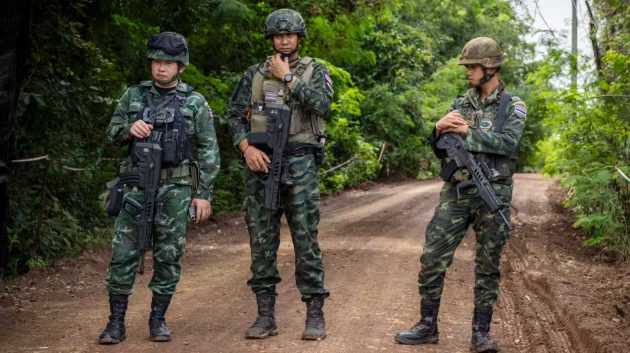
That background is the only reason the reports from Thailand made sense to me. The Thai Second Army publicly announced that FPV suicide drones have been striking Thai positions along the Cambodian frontier. They mentioned coordinated spotting, precise hits, and, according to soldiers on the ground, chatter in English during the attacks. That detail matters. This is not the kind of battlefield where you expect English coming through the air.
Something has changed on this border.
Thailand and Cambodia have clashed before, usually over the predictable mix of history, maps, and temple claims. This time the nature of the fight feels different. FPV drones operated at this level point toward imported skill. That raises a simple question. Who benefits from bringing foreign hands into a small border war?
Anyone familiar with Cambodia’s northwest already knows the answer. The frontier is not governed in any normal sense. It is shaped by casinos, scam compounds, trafficking networks, and local power brokers who operate with little oversight. Foreign technicians are brought in to run cyber schemes. Trafficked workers are forced into online crime. Private security groups guard buildings that do not appear on official maps. It looks like a state on the surface, but the real authority sits in a network of business interests and criminal markets that stretch across entire provinces.
A system like that can absorb foreign operators easily. It can train them, hide them, and pay them without leaving a trace in any official ledger. If an FPV team needed a place to operate, Cambodia already has the perfect environment. Nothing needs to be built. All of it exists behind mirrored glass and neon. That is the difference between the two sides. Thailand fields an actual military. Cambodia fields a political economy that treats violence and corruption as routine.
Open source information gives shape to the problem. Satellite imagery from early December shows fresh impact craters inside Thailand consistent with BM-21 rocket fire from Cambodian positions. Geolocated videos show Thai mechanized units quietly reinforcing defensive areas, not preparing for an offensive. Footage from across the border reveals FPV frames that match foreign designs used in Ukraine and Russia, down to the antenna placement and custom flight controllers. None of this proves who is flying them, but it shows that someone brought a template and the knowledge to make it lethal.
Into this landscape steps a new geopolitical clock. A recent report in Nation Thailand notes that the United States is preparing to intervene diplomatically. President Donald Trump has already signaled he is ready to call both prime ministers. Washington wants a ceasefire soon and is willing to pressure both sides if they fail to meet the timetable. Analysts warn that if the war drags on, the United States could tighten military support for Thailand and alter its stance toward Cambodia. In the worst case, mismanaged diplomacy could turn a small fight into a larger proxy conflict.
This gives Thailand a narrow window to secure key areas, establish a demilitarized buffer, and send a clear political message that it wants stability. Cambodia, by contrast, behaves as if escalation serves its interests. It treats border unrest the way it treats its interior economy. Instability is not a liability. It is a currency.
Watching from Phuket, the situation feels familiar in ways I would rather forget. I have seen border wars born out of neglect, corruption, and outside manipulation. I have seen how they grow when no one takes responsibility for the periphery. Thailand does not deserve that future. It has handled this conflict with discipline and caution. Cambodia has answered with denials, improvisation, and the same networks that have hollowed out its interior for years.
The difference between the two countries is difficult to ignore. Thailand is a functioning state with a real chain of command. Cambodia has a military uniform wrapped around a collection of patronage systems and criminal markets. These are not equivalents. Thailand is defending a border. Cambodia is defending an economy built on impunity.
Already have an account? Sign In
Two ways to continue to read this article.
Subscribe
$1.99
every 4 weeks
- Unlimited access to all articles
- Support independent journalism
- Ad-free reading experience
Subscribe Now
Recurring Monthly. Cancel Anytime.










COMMENTS