

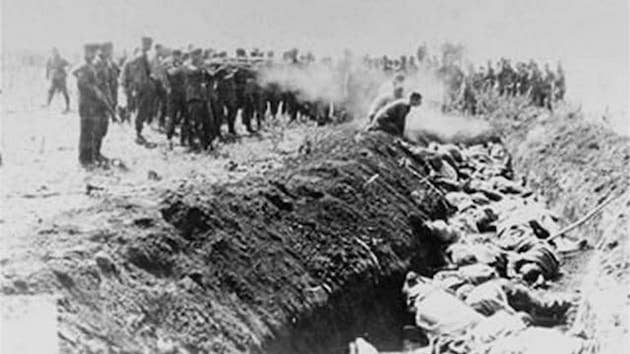
After the gauntlet, the Jews were led to a grassy area and ordered to strip. Anyone who hesitated had their clothes ripped off them and was beaten again. It was then that the Germans led them to Babi Yar. A truck driver remembered the scene in detail.
“Once undressed, they were led into the ravine which was about 150 meters long and 30 meters wide and a good 15 meters deep… When they reached the bottom of the ravine they were seized by members of the Schutzpolizei and made to lie down on top of Jews who had already been shot… The corpses were literally in layers. A police marksman came along and shot each Jew in the neck with a submachine gun… I saw these marksmen stand on layers of corpses and shoot one after the other… The marksman would walk across the bodies of the executed Jews to the next Jew, who had meanwhile lain down, and shoot him.”
Then their money, valuables, jewelry were gone through by the Germans in search of loot.
In the Einsatzgruppe Operational Situation Report No. 101, the Nazis, notoriously detailed that 33,771 Jews were killed at Babi Yar on September 29 and 30.
Survivor Dina Pronicheva wrote in her account.
“It was dark already…They lined us up on a ledge which was so small that we couldn’t get much of a footing on it. They began shooting [at] us. I shut my eyes, clenched my fists, tensed all my muscles, and took a plunge down before the bullets hit me. It seemed I was flying forever. But I landed safely on the bodies. After a while, when the shooting stopped, I heard the Germans climbing into the ravine. They started finishing off all those who were not dead yet, those who were moaning, hiccuping, tossing, writhing in agony. They ran their flashlights over the bodies and finished off all who moved. I was lying so still without stirring, terrified of giving myself away. I felt I was done for. I decided to keep quiet. They started covering the corpses over with earth. They must have put quite a lot over me because I felt I was beginning to suffocate. But I was afraid to move. I was gasping for breath. I knew I would suffocate. Then I decided it was better to be shot than buried alive. I stirred but I didn’t know that it was quite dark already. Using my left arm I managed to move a little way up. Then I took a deep breath, summoned up my waning strength, and crawled out from under the cover of earth. It was dark. But all the same, it was dangerous to crawl because of the searching beams of flashlight and [because] they continued shooting at those who moaned. They [could] hit me. So I had to be careful. I was lucky enough to crawl up one of the high walls of the ravine, and straining every nerve and muscle, got out of it.”
But the Germans weren’t done at Babi Yar yet. During 1942-43, mental patients of the Pavlov Psychiatric Hospital, gypsies, Soviet POWs, communist officials, and other “undesirables” were led to the ravine to meet the same fate that the Jews had. By the time the Soviets retook Kyiv in the 1944 offensive, the death toll at Babi Yar had reached an estimated 120,000.
As the Germans began retreating in 1943, they tried to erase the evidence of their atrocity.
Three hundred prisoners from the Syretsk concentration camp, which was located near Babi Yar, were led to the ravine. There, they were ordered to excavate the bodies and drag them out. The bodies were then cremated. The headstones from the Jewish cemetery were laid down and wood was stacked on them. The bodies, up to 2,000 at a time, were then piled high and set on fire with gasoline. The ashes were sifted for bones which had to be pulverized to erase any evidence of the murders. The gruesome affair took six weeks.
After the war, Paul Blobel, in charge of Sonderaktion 1005, was convicted at the Einsatzgruppen Trial. He executed by hanging in 1951.








COMMENTS