

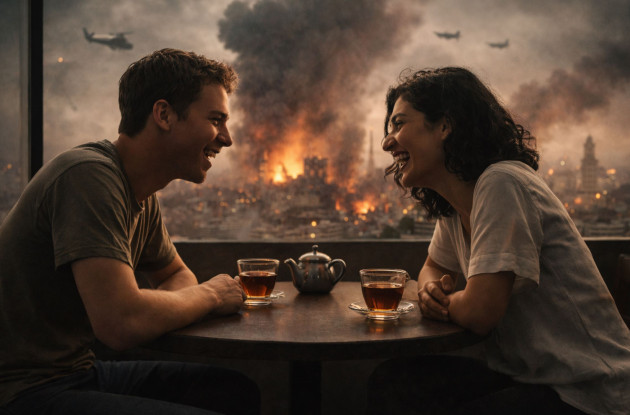
And the biggest misconception? That Iranians are Arabs. They’re not. That they hate Americans. They don’t. That the people and the government are the same thing.
They’re not.
Sound familiar?
Because that distinction, between a people and their government, is exactly what we ask the rest of the world to extend to us. Every time American foreign policy does something controversial, we say, “Don’t judge the American people by the American government.” We expect that grace.
These students described Iranians doing that better than we do.
The professor in the lecture, who has traveled extensively in the Middle East, confirmed it. He described Palestinian Arabs meeting his Jewish friend wearing a Star of David and saying, “Oh, you’re Americans? We hate your government. But you guys? Come have tea.” He found the same thing across the Muslim world. People who could hold the distinction between a government and its citizens in their minds with a clarity that most Americans struggle to replicate.
And here’s the other parallel nobody’s talking about. The students explained that religious Iranians aren’t necessarily pro-government, and secular Iranians aren’t necessarily anti-government. One student said she had deeply religious friends who opposed the regime and secular acquaintances who didn’t. The divide isn’t belief versus non-belief. It’s more complicated than that.
Replace “Iranian” with “American” and “Muslim” with “Christian,” and you’re describing the United States in 2026. Religious Americans aren’t automatically aligned with one party. Secular Americans aren’t automatically aligned with the other. The binary is a fiction. In both countries.
And then there’s the generational piece.
The students were clear: the younger generation in Iran is more open, more tolerant, and more globally aware. One said 90 percent of young Iranians would never harbor hatred toward people from other countries. But older Iranians, especially those shaped by the revolution? Some carry prejudices they can’t let go of.
Now replace that with America. Older Americans shaped by decades of “Axis of Evil” rhetoric see Iran as a monolith of hostility. Younger Americans, the ones actually interacting with Iranians on social media and in university classrooms, see individuals. The generational divide over how we view “the other side” is nearly identical in both countries.
Both countries have old guard holding historical grudges. Both countries have a younger generation trying to move past them. And both countries have media ecosystems that profit from making the other side look as threatening as possible.
One student put it perfectly. He said he reads the American headlines about Iran, then reads the Iranian headlines about America, and they say the exact opposite things. “The truth is the average.”
That might be the most honest assessment of geopolitical media I’ve ever heard.
I’m not writing this to tell you whether Operation Epic Fury is right or wrong. That’s not my lane, and it’s not the point.
I’m writing this because somewhere in Tehran, there’s a mother telling her daughter, “Trust us. We know how to take care of ourselves.” And somewhere in Texas, there’s a guy reading a headline that says “Iran demolished” without ever having heard a single Iranian voice that wasn’t filtered through a government spokesperson or a cable news chyron.
Most of the people on the other side of those headlines would welcome you into their home, pour you tea, and refuse to let you pay for it three times before finally accepting.
They are not their government. Just like you are not yours.
Arda’s friends back in Tehran told him they’re numb. “There’s a possible chance of war, but they’re just doing their own things. It’s a lose-lose. If it happens, it’s bad. If it doesn’t happen, it’s bad. They’re just going to enjoy right now. They don’t know what’s going to happen tomorrow.”
Tomorrow came on February 28th.
I don’t have a policy prescription or a partisan take. I have three students in a classroom who described a people that most Americans have never actually heard from. And a war that is being waged, right now, against the infrastructure of a government that its own citizens already separated themselves from long ago.
So, my thought that keeps circling back? If the younger generation in Iran doesn’t reflect its government’s hostility toward America… and the younger generation in America doesn’t reflect its government’s hostility toward Iran… then the people being asked to fight this war, on both sides, are the ones who least believe in the reasons for it.
Old men start wars. Young people fight them. That’s not new. But when the young people on both sides would rather share a meal than a battlefield… it’s worth asking who exactly this war is for.
Dina said something else during that lecture that I can’t stop thinking about. She said every time it happens, every escalation, every round of strikes, the same thought returns:
“Am I going to have all of my family and friends still after this is over? Or is somebody going to be missing?”
That’s not a political statement born of old men deciding to fight one another. That’s a daughter.
And if you can’t hear the humanity in that, no headline was ever going to help you.
—
About the Author
I don’t try to change minds… just deepen them. – Tegan Broadwater
Tegan spent 13 years with the Fort Worth Police Department, including two years assigned to the FBI working deep undercover inside a violent Crip organization. That operation, detailed in his book Life in the Fishbowl, resulted in 51 convictions. He has since founded Tactical Systems Network, an armed security & protection firm primarily staffed by veterans, is a creative writer and musician, and hosts The Tegan Broadwater Podcast. All book profits benefit children of incarcerated parents. Learn more at TeganBroadwater.com








COMMENTS