

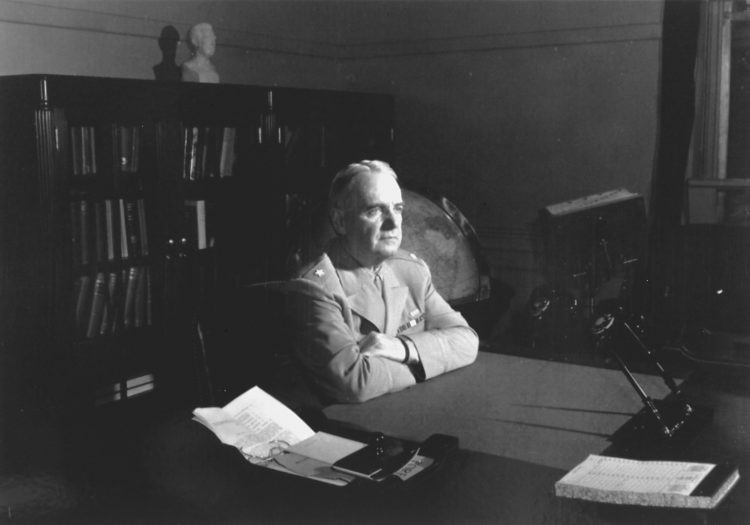
The OSS was intended to coordinate espionage activities behind enemy lines for all branches of the United States Armed Forces. Other OSS functions included the use of propaganda, subversion, guerrilla warfare, and post-war planning.
OSS in wartime
From the CIA’s OSS history, the State Department cut the OSS out of one of the biggest intelligence realms right away.
“The Department of State and the armed services arranged a Presidential decree that effectively banned OSS and several other agencies from acquiring and decoding the war’s most important intelligence source: intercepted Axis communications. Donovan protested, but his complaints fell on deaf ears. The result was that OSS had no access to intercepts on Japan (codenamed MAGIC) and could read only certain types of German intercepts (called ULTRA by the Allies). Other edicts also limited OSS’s scope and effectiveness. The FBI, G-2 and ONI, for instance, stood together to protect their monopoly on domestic counterintelligence work. OSS eventually developed a capable counterintelligence apparatus of its own overseas—the X-2 Branch—but it had no authority to operate in the Western Hemisphere, which was reserved for the FBI and Nelson Rockefeller’s office of the Coordinator of Inter-American Affairs.”
At the peak of war operations in late 1944, the OSS had grown to more than 13,000 personnel. The CIA history pages further break down OSS personnel as follows:
“General Donovan employed thousands of officers and enlisted men seconded from the armed services, and he also found military slots for many of the people who came to OSS as civilians. US Army (and Army Air Forces) personnel comprised about two-thirds of its strength, with civilians from all walks of life making up another quarter; the remainder were from the Navy, Marines, or Coast Guard. About 7,500 OSS employees served overseas, and about 4,500 were women (with 900 of them serving in overseas postings). In Fiscal Year 1945, the office spent $43 million, bringing its total spending over its four-year life to around $135 million (almost $1.1 billion in today’s dollars).”
The Special Operations Branch was patterned after the British SOE (Special Operations Executive) and did their training at the British facility at Milton Hall. Together the two armies combined to make the famous “Jedburgh” teams that parachuted into occupied France prior to the D-Day invasion. They comprised 93 teams that each had two officers and an enlisted radio operator. William Colby, the future director of the CIA, was a Jedburgh in WWII, but perhaps the most famous of the Special Operations Branch was Virginia Hall, the famous “Limping Lady of the OSS.”
General Donovan’s “Glorious Amateurs” had developed into a professional organization that formed the backbone of the CIA and later the U.S. Army Special Forces. Donovan described the perfect OSS operatives as “PhDs who can win a bar fight.” The OSS wanted smart self-starters who could think on their feet.
William J. Casey, who was OSS in World War II and later director of central intelligence during the Reagan administration, remembered, “You didn’t wait six months for a feasibility study to prove that an idea could work. You gambled that it might work. You didn’t tie up the organization with red tape designed mostly to cover somebody’s ass. You took the initiative and responsibility. You went around the ends. You went over somebody’s head if you had to. But you acted. That’s what drove the regular military and the State Department chair-warmers crazy about the OSS.”
President Truman, who took over when FDR died in early 1945, hated Donovan and the OSS. Donovan’s plan to keep a peacetime intelligence service was filed away but ignored. The OSS was disbanded on October 1, 1945.
Two year later Truman approved a new organization called the Central Intelligence Group (CIG). The National Security Act of 1947 turned the CIG into the Central Intelligence Agency, intended to perform many of the missions that General Donovan had advocated for his proposed peacetime intelligence service. The CIA became what General Donovan had initially proposed. Donovan may have been ignored by Washington, but not by the CIA. They still regard Donovan as “the founding father of United States intelligence.” The CIA headquarters at Langley, Virginia has a statue of Donovan in the lobby.
Modern-day CIA and the U.S. Special Operations Command owe a great deal of their legacy to the OSS and to General Donovan. They still employ some “PhDs that can win a bar fight.”
Images courtesy of U.S. Army








COMMENTS