

What you get instead is a psychological duel that never announces itself as one.
En algunos países ya se estrenó la película “Nuremberg”, sobre los juicios a los líderes nazis después de la Segunda Guerra Mundial.
¿Cómo crees que será la película?, ¿Qué opinión te merecen esos juicios? pic.twitter.com/GpZYtiRwEM— Historia Naval 2GM (@SgmNaval) February 17, 2026
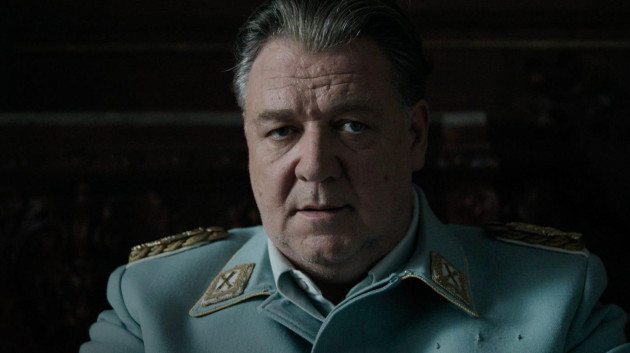
Crowe’s Göring: Heavy, Calculated, and Always Working the Angles
Crowe made a decision here, and it carries the whole film.
He doesn’t play Göring as a villain in the theatrical sense. No snarling, no chest-pounding rage. That would be too easy. That would let the audience off the hook.
Instead, he leans into control.
The physical transformation is the first thing that hits. He’s heavier, softer, almost indulgent in appearance. The uniform looks like it belongs to a man who once held power and still thinks he does. His portrayal of Göring carries a kind of smug fatigue, like someone who has already rehearsed every possible outcome.
But the real shift is in how Crowe moves through a scene.
He listens. He studies. He adjusts.
This version of Göring is dangerous because he’s persuasive. He flatters Kelley. He jokes with him. He offers just enough openness to keep the conversation alive, while never giving away anything that matters.
You get the sense that every word is placed with intent.
That tracks with history. Göring was known for dominating early courtroom exchanges, turning prosecution into performance when he could.
Crowe doesn’t exaggerate that. He lets it sit there, quiet and effective.
And that’s what makes it uncomfortable.
Malek’s Kelley: Professional Distance, Slowly Eroded
Malek plays Kelley like a man trying to stay upright in a room that tilts a little more each day.
At the start, he’s clinical. Observant. Detached. He takes notes, asks questions, and keeps a careful distance between himself and the subject.
That distance doesn’t hold.
The film shows it slipping in increments. A longer pause than necessary. A question that feels more personal than procedural. A moment where Kelley seems less like an evaluator and more like someone trying to reconcile two conflicting truths.
On one hand, Göring is responsible for mass death on a scale that resists comprehension.
On the other hand, he is sitting right there, speaking clearly, reasoning, joking, existing as a human being.
That tension starts to wear on Kelley.
Malek doesn’t play it as a dramatic collapse. It’s quieter than that. More like a steady pressure that never fully releases. By the end, Kelley looks less certain, less anchored. Göring remains as confident as ever.
Historically, that trajectory lands close enough to the truth to carry weight. Kelley did conclude that these men were not insane. And he did not walk away from that conclusion unchanged.
The film uses that reality without overexplaining it.
The Supporting Cast: Law, Memory, and the People in the Room
The courtroom itself is less a stage and more a pressure chamber.
Michael Shannon as Robert H. Jackson brings a different kind of energy to the screen. Not explosive, but precise. His role is to translate moral outrage into legal argument, which is harder than it sounds. Early missteps in handling Göring are shown without apology, and that’s one of the film’s smarter choices. It resists the urge to turn the prosecution into flawless heroes.
Then there’s the translator, Howard Triest, played by Leo Woodall. A Holocaust survivor, now tasked with giving voice to the men responsible for what he lived through.
That’s where the film tightens the screws.
Triest sits close enough to hear every word, to carry it across languages, to make sure nothing is lost in translation. And what he finds is not madness. It’s coherence. Logic. Structure.
The horror isn’t that these men are incomprehensible.
It’s that they aren’t.
Historical Authenticity: Where the Film Holds the Line
Nuremberg gets the big things right.
The psychological evaluations are real. Kelley’s interactions with Göring are grounded in documented accounts. The early courtroom dynamics, including Göring’s attempts to dominate proceedings, align with the historical record.
The film also handles the use of concentration camp footage with restraint. When it appears, it shifts the tone immediately. Whatever intellectual distance the audience has built up collapses in a matter of seconds.
That part feels honest.
The broader decision to try these men in a courtroom rather than execute them outright is also treated with the gravity it deserves. This was not inevitable. It was a choice, and a controversial one at the time.
The film understands that and explains it to the viewer.
Where It Bends the Truth
But it is still a film, not a textbook.
Timelines are compressed. Conversations are tightened. Some character dynamics are shaped to serve narrative flow rather than strict historical sequence.
Kelley’s arc, in particular, is streamlined. The long-term consequences of his experience are hinted at rather than fully explored. That’s a trade-off. You get focus, but you lose some depth.
Göring’s family and personal context are also presented in ways that feel slightly softened. Not inaccurate, but curated. Enough to humanize, not enough to distract.
If you’re looking for a comprehensive account of the trials, this isn’t it. There are plenty of good documentaries for that.
If you’re looking for a film that captures the essence of what it felt like to sit in that room, Nuremberg gets closer than most.
The Turn: When the Film Stops Letting You Observe
The first half of the film allows the viewer a certain distance.
You watch. You listen. You analyze.
Then it shifts.
The introduction of real footage from the camps breaks whatever rhythm you’ve settled into. It’s abrupt, and it’s supposed to be. The conversations you’ve been watching, the careful language, the psychological sparring, all of it gets dragged back to the reality it’s orbiting.
That’s the moment the film stops being comfortable.
It doesn’t escalate into spectacle. It tightens its circle.
From that point on, every word carries more weight because you know exactly what sits behind it. The horror is all too real.
The Surprise: No Clean Ending
There’s no cinematic release here.
Göring does not break down in some dramatic confession. He does not offer closure. He remains what he is, controlled, smug, defiant, and self-assured to the end.
And then he cheats the system.
His suicide before execution lands without flourish. No swelling music. No grand statement. Just a final act of control from a man who understood power better than most.
It leaves a gap.
Justice is served, but not completely.
The film doesn’t try to fill that gap.
The Message: The Banality of Evil
If Nuremberg has a thesis, it’s this:
The men responsible for the worst crimes of the 20th century were not operating outside the bounds of humanity. They were operating within them.
That’s not a comforting idea. It’s not supposed to be.
The film pushes against the instinct to label these figures as monsters and move on. Because if they’re monsters, then they’re separate. Contained. Not relevant to anything outside their time.
But if they’re human, then the capacity for what they did doesn’t disappear with them.
It lingers.
In systems. In decisions. In people who believe they are acting rationally, even when the outcome is anything but.
The film doesn’t lecture you on this. It just keeps putting you in the room until you start to feel it.
Final Assessment: Not Clean, Not Easy, But Revealing
Nuremberg isn’t built to entertain in the traditional sense.
It’s slow in places. Uneven in others. It leans heavily on conversation when some viewers will want more movement, more structure, more resolution.
But that’s also why it works.
It refuses to simplify something that shouldn’t be simplified.
Crowe delivers one of his more controlled, unsettling performances in years. Malek holds the center well enough to carry the psychological weight, even if his approach won’t land for everyone. The supporting cast does the quiet work of grounding the story without pulling focus.
What you’re left with isn’t a sense of closure.
It’s a realization.
That the line between order and atrocity is not guarded by madness. It’s guarded by choices. And those choices are often made by people who believe they are thinking clearly.








COMMENTS