

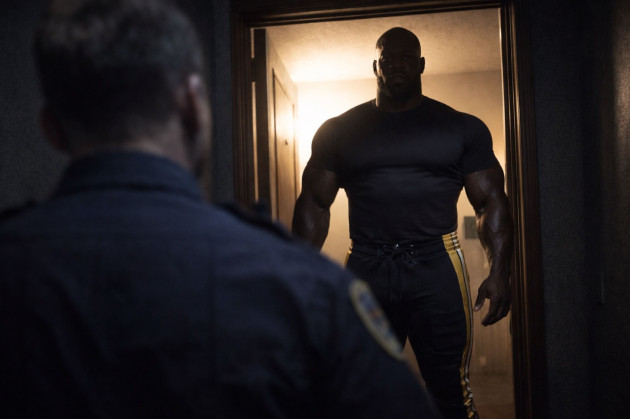
But standing next to this linebacker? He looked like a medium.
Sarge rolled up, took one look at the situation, and walked right past us. Didn’t ask for a briefing. Didn’t hesitate. Just casually stepped up to the door like he was delivering cookies.
And then… he spoke. Calmly. Casually.
“Look, we’ve got a job to do. I know you don’t want to deal with this, and honestly, I don’t either. But we didn’t start this mess, you did. Now we are gonna step inside, and if this ends up in some kind of fight, I know it’s not gonna go well for us. I’ll give you that.”
He paused. Let that sit.
“But if we go down that road, here’s what’s gonna happen. I’m not gonna try to win a fight against you. I know I can’t. But one thing I’m gonna do… the only thing… is try to break your fucking knees.”
The linebacker’s expression shifted. Just slightly.
“I don’t care how bad you beat me,” Sarge continued. “If I end up in the hospital, that’s fine. But I’m gonna make sure, no matter how bad an ass whoopin’ I take, your knees will at least be broke. It ain’t personal. That’s just what I gotta do.”
Silence.
What we didn’t know, and what our sergeant absolutely did know, was who this man was. He knew the guy’s history. Knew what a career in the NFL does to a body. Knew that this man had probably already had surgeries, already dealt with pain, already watched teammates lose their mobility and their quality of life to knee injuries.
Sarge wasn’t threatening violence. He was threatening to take the one thing this man couldn’t afford to lose.
The linebacker dropped his head and took a long, slow breath. Then he turned around. Put his hands behind his back. Turned his head to us and said five words I’ll never forget:
“You can’t tell nobody.”
We took him in without incident. No fight. No injuries. No use of force report.
I learned more in that sixty-second exchange than I had in a 7-month academy.
They trained us to de-escalate. And when that didn’t work, they trained us to fight. How to control. How to subdue. How to never quit when things go south.
But Sarge? He trained me for something else.
De-escalation isn’t meek. It’s not about speaking quietly, backing down, or hoping the other guy calms himself. It’s about reading the room. Finding the leverage. Understanding what someone values more than winning… and making them choose.
Physically, we’d have eventually subdued him. I mean, the guy assaulted a woman. We weren’t leaving without him, but… it wouldn’t have been neat. Hell, I cherished a good scrap, but this was gonna send someone to the hospital.
But Sarge saw something we didn’t. He saw a man who’d already given his knees to the game and wasn’t about to give what was left of them to a domestic beef.
That’s strategy. That’s calculation. That’s knowing the difference between winning a fight and solving a problem.
The academy teaches you to handle the situation in front of you.
Thirty years on the job teaches you to see the situation behind it.
I’ve carried that lesson ever since. Not every problem is a nail. Not every solution is a hammer. And sometimes, the most powerful thing you can say isn’t a command.
It’s the choice you give someone… that they realize they’ve already made.
───────────
Tegan Broadwater spent 13 years with the Fort Worth Police Department, including two years assigned to the FBI working deep undercover inside a violent Crip organization. That operation, detailed in his book Life in the Fishbowl, resulted in 51 convictions. He has since founded Tactical Systems Network, an armed security & protection firm primarily staffed by veterans, is a creative writer and musician, and hosts The Tegan Broadwater Podcast. All book profits benefit children of incarcerated parents. Learn more at TeganBroadwater.com








COMMENTS