

Lesson: The Enemy of Your Enemy Is Still Your Enemy
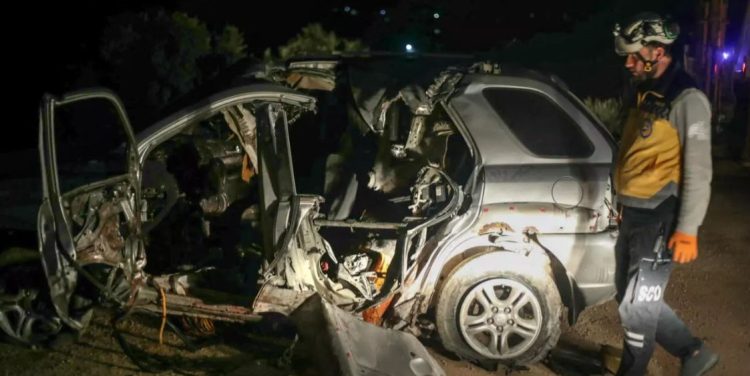
Yesterday, we took out two Libyans—Abu Abdul Rahman al-Libi and Fadlallah al-Libi, both military commanders within the al-Qaeda-affiliated Hurras al-Din—in a strike in Syria. But here’s the interesting part: ever since Abu… pic.twitter.com/0zIPiSzN91
— Sarah Adams (@TPASarah) February 17, 2025
Presidential Commendation
Following the successful U.S. airstrike in Syria, former President Donald Trump took to his Truth Social platform to congratulate the American forces involved. In his statement, Trump acknowledged the significance of the operation, stating, “U.S. forces conducted a precision airstrike against a member of al-Qaeda in Syria this weekend. The terrorist leader was working with al-Qaeda across the region.”
He further commended CENTCOM Commander Gen. Michael Kurilla and the U.S. warfighters for their efforts, saying, “Congratulations to CENTCOM Commander Gen. Michael Kurilla, and the U.S. warfighters who dealt justice to another Jihadi threatening America and our allies and partners.”
Trump’s comments highlight the strategic importance of eliminating high-level terrorist figures and reinforce his administration’s firm stance on counterterrorism.
Hurras al-Din: A Persistent Threat
While recent U.S. airstrikes have dealt significant blows to Hurras al-Din, national security experts warn that the group remains a persistent threat. It is stressed that these setbacks do not eliminate the ongoing danger posed by the al-Qaeda-affiliated organization.
Hurras al-Din continues to pose a risk due to its deep ties to al-Qaeda, which grant it access to experienced operatives and valuable resources. Despite officially dissolving in January 2025, the group still operates in secret across Syria, showing its ability to survive under pressure. Their ideological commitment to jihad remains strong, as seen in their recent calls for Palestinian Islamist groups to escalate their insurgency against Israel.
Additionally, Hurras al-Din has a history of adapting and rebuilding after losses, even when facing opposition from other militant factions and Syrian government forces. With the fall of the Assad regime in December 2024, there is also concern that power vacuums in Syria could provide the group with new opportunities to regroup and expand its influence.
Experts warn that underestimating groups like Hurras al-Din could have severe consequences. They emphasize the need for continued counterterrorism efforts and vigilance in the region to prevent the group from regaining strength and launching future attacks.
Ongoing Counterterrorism Efforts
The U.S. Central Command (CENTCOM) and the Trump administration continue to prioritize counterterrorism operations in 2025, focusing on eliminating threats through direct military action. Recent operations have targeted key terrorist leaders and disrupted their networks to prevent future attacks.
CENTCOM has carried out several successful missions in the early months of 2025 in addition to the February 15th strike. Just a day earlier, on February 15, Iraqi forces—supported by CENTCOM—launched an airstrike against ISIS. Prior to these strikes, a senior Hurras al-Din operative was taken out in Syria on January 30. Additionally, from December 30, 2024, to January 6, 2025, CENTCOM and Iraqi forces conducted a series of strikes against ISIS strongholds in the Hamrin mountains of Iraq.
President Trump’s counterterrorism strategy emphasizes taking the fight directly to terrorists, isolating them from their sources of support, and modernizing U.S. counterterrorism capabilities. The administration prioritizes capturing or eliminating high-value targets and cutting off their financial resources rather than addressing the deeper causes of radicalization. The approach aims to reduce the capacity of terrorist organizations to launch attacks against the U.S. and its allies.
Additionally, the Trump administration is integrating counterterrorism efforts with immigration policy, though the effectiveness of this approach remains under debate. Meanwhile, CENTCOM continues to strengthen military partnerships in the region. Exercises like Eagle Resolve 2025, which wrapped up on January 23, focused on integrated air and missile defense, cybersecurity, and counterterrorism operations. These efforts reinforce the U.S. commitment to maintaining security and stability in the Middle East.
Wrap Up
The elimination of senior al-Qaeda leaders in Syria marks a significant milestone in the ongoing global fight against terrorism. It sends a clear message that the U.S. remains vigilant and proactive in its efforts to protect its citizens and interests worldwide.
As CENTCOM Commander Gen. Michael Kurilla stated, “We will continue to relentlessly pursue terrorists in order to defend our homeland and U.S., allied, and partner personnel in the region.
**Note: This article is based on information available as of February 20, 2025.








COMMENTS