

WW3 Re-imagined
NATO states are now rearming at a pace not seen since the Cold War. Even Australia has joined in, recently transferring 49 M1A1 Abrams tanks. Across allied capitals, the message is unambiguous: this is not just Ukraine’s fight. It is the central front in a broader struggle that may ultimately define the 21st-century global order.
This is a war between systems, not just states. On one side, BRICS-aligned autocracies, with Beijing backing, are betting that the West will grow fatigued, fractured, and self-doubting. On the other side, NATO and its partners are adapting—painfully, slowly—but with resolve. The global order that emerged after World War II is being stress-tested in real time, not only with weapons, but with ideas.
World War I didn’t look like World War II. So why should World War III? This war isn’t just missiles and tanks. It is semiconductor supply chains, drone footage on Telegram, and diplomatic influence from Buenos Aires to Bamako. The terrain is global. The stakes are civilizational. And Ukraine is the flashpoint—the place where narrative and kinetic force converge with devastating clarity. Holding the line here is about far more than a border. It is about whether the 21st century is shaped by coercion or consent.
And that matters, because so is Russia. Moscow hasn’t declared full mobilization, but it hasn’t needed to. Its war economy is ugly, efficient, and designed to survive, but not forever. Western sanctions have cut deep, but not deep enough. Energy revenues are down 16%, yet the Kremlin is still financing the war. It can likely keep going through 2026 but long term speculations are a matter of fierce debate.
That doesn’t mean Russia is winning. It means they’re still in the fight. And they believe Ukraine’s manpower gap will be their opening. Ukraine has exhausted the volunteer phase. Mobilization videos show men dragged into vans, their screams filmed and shared online. What remains is a draft fueled by fear, not patriotism. It’s not sustainable.
The Current State of Affairs
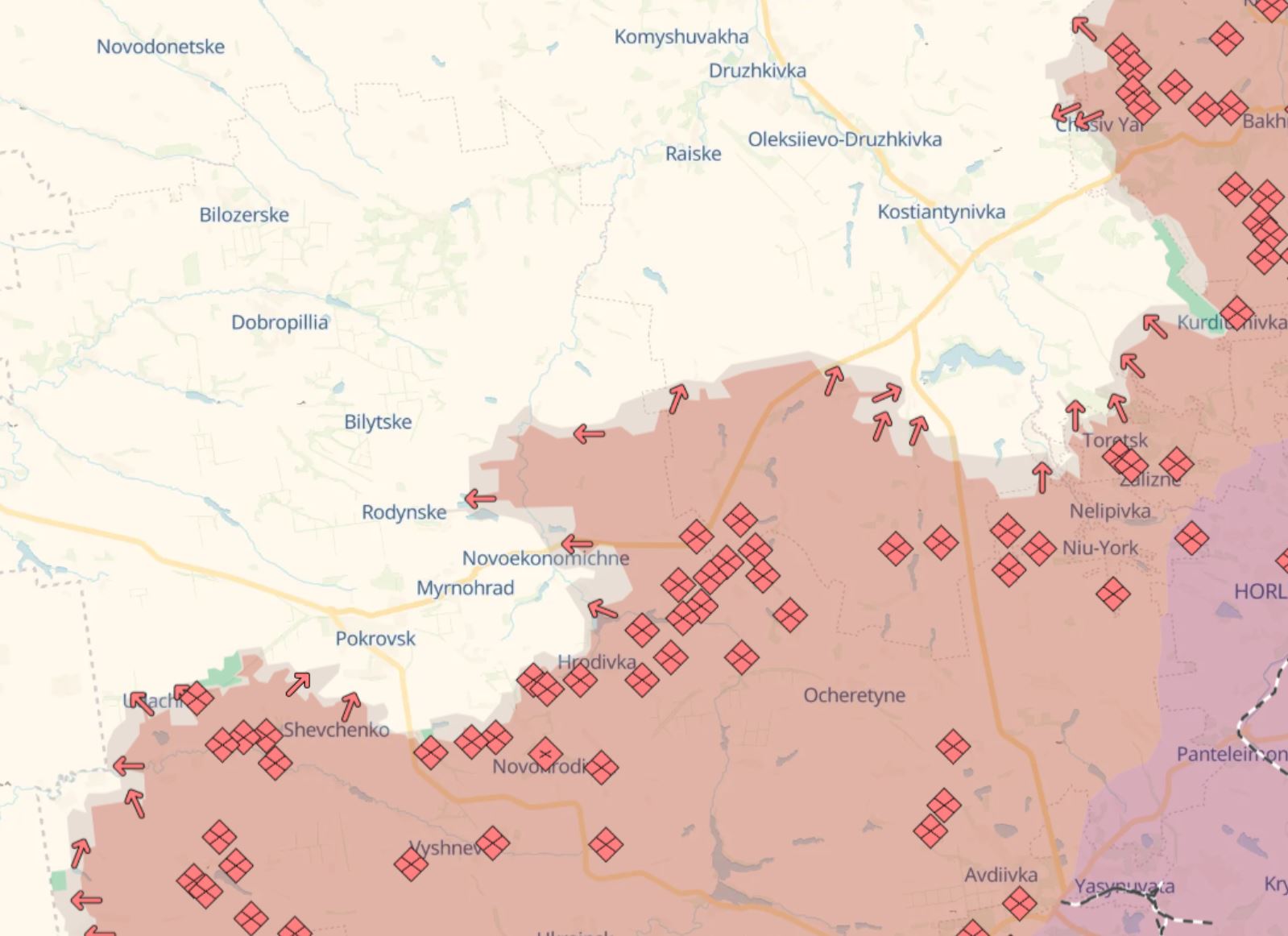
But then again, neither is Russia’s fantasy of a breakthrough. Russia’s summer 2025 push has intensified, and Pokrovsk is now on the verge of falling. Russian forces have advanced to within 2 kilometers of the city center, with sustained pressure from glide bombs, FPV drones, motorcycle dragoon assault squads, and massed artillery. Ukrainian brigades defending the area are overstretched, and while reinforcements have been dispatched, local officials have begun evacuating civilians, signaling a grim acknowledgment of the battlefield reality.
Kostiantynivka remains under threat as well, with Russian units probing its flanks, though the tempo there has slowed due to logistical constraints.
While Russia may be gaining ground in certain sectors, its advances come at staggering cost. Ukraine has adopted what I call an Integrated Drone Attrition strategy—a defense-in-depth model that fuses FPV drones, aerial ISR, fixed-wing surveillance, and electronic warfare into a layered kill zone. Every approach is surveyed. Every armored column is pre-registered. Russian forces are bleeding heavily to claim villages that barely qualify as dots on a map.
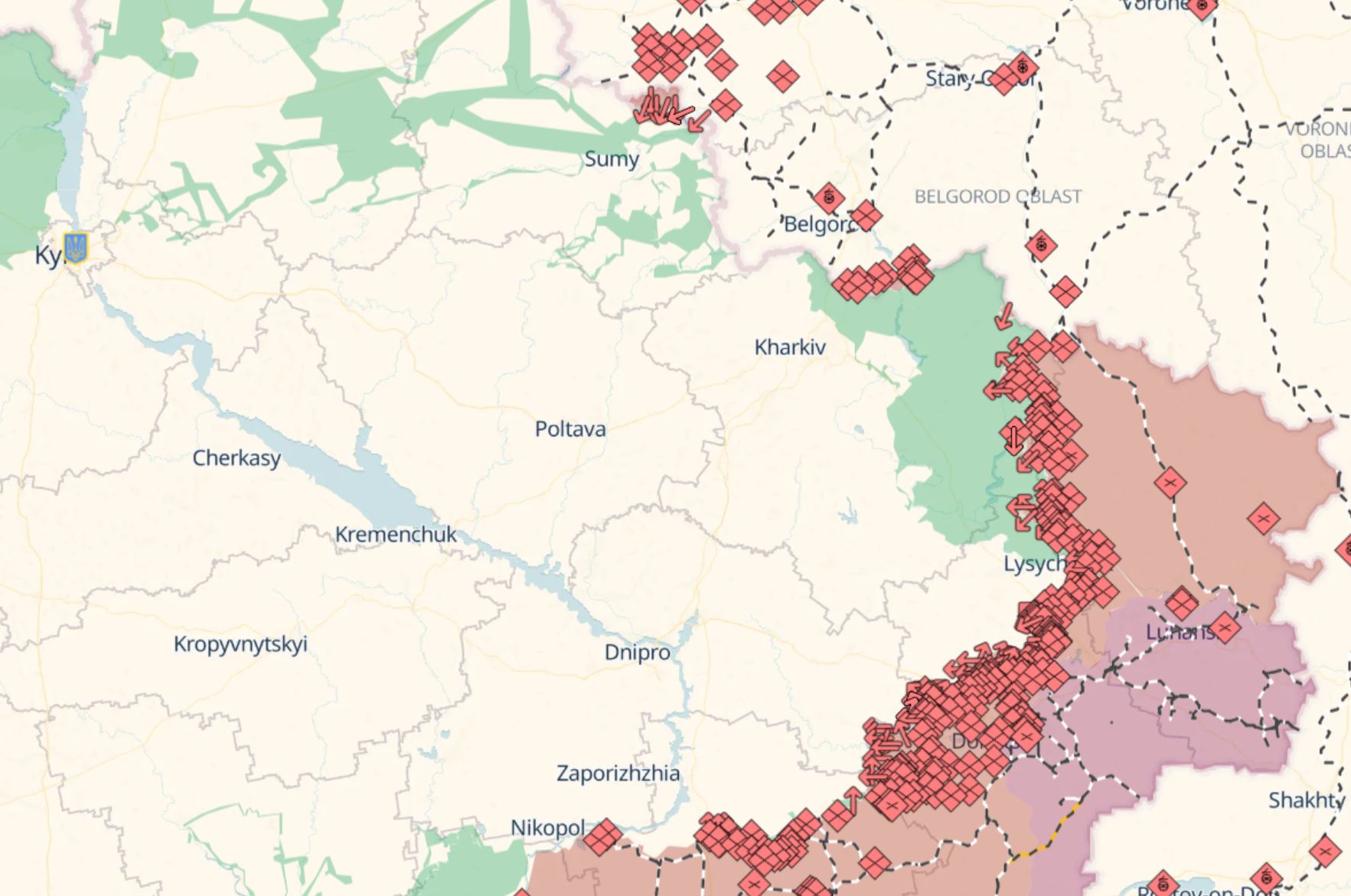
Ukraine may not be winning in the traditional sense, but it is making Russia bleed for every wheat field it tries to seize. This is not a war of sweeping breakthroughs. It is a war where Russia, far from being the conqueror of civilizations, is reduced to a razer that stumbles and hemorrhages at the edge of any settlement larger than a few goats and a babushka with a bottle of Kvass. In Kharkiv, the situation remains precarious but more stable; Russia has not made significant territorial gains, but its strikes on infrastructure and persistent feints are forcing Ukraine to divert resources from other fronts.
No Easy Peace, No Final Line
Russia’s near-certain capture of Pokrovsk marks more than a tactical victory. It signals a strategic shift. For the first time since the early months of the invasion, Moscow is poised to take a regionally significant Ukrainian city. This is not merely symbolic—it’s a material blow to Ukraine’s defensive posture in Donetsk oblast and a potential morale shock across the wider front. Far from stalling, Russia’s summer 2025 campaign appears increasingly successful, applying pressure not only on the battlefield but in the global perception of momentum. It reinforces the Kremlin’s message that time and blood are on their side, and it challenges the West to treat this not as a slow war, but as one with real inflection points and consequences.
Meanwhile, the shadow war rages. Ukrainian special operations have struck deep into Russian territory: assassinations, factory fires, rail sabotage. Russia retaliates with sleeper agents, cyberattacks, and attempted destabilization campaigns across the former Soviet bloc. In Georgia, pro-Kremlin factions are on the move. In Africa, French-backed and Russian-backed militias clash in proxy battles. This war doesn’t end with a peace treaty. It metastasizes.
Inside Russia, generals keep dying in mysterious circumstances. Inside Ukraine, every successful assassination is a reminder: the war is global, hybrid, and unending. The shooting may one day stop, but the conflict won’t. What Ukraine needs is a military stalemate and a political, intelligence, and economic advantage.
Let’s also be clear: regime change in Kyiv was Russia’s goal. It failed. That failure has symbolic and strategic value. Ukraine exists. It fights in its own name. It bleeds and rebuilds. That alone is a defeat for Putin.
The Cost of Conviction
The war has changed my understanding of victory over time. There were moments when the human suffering was so stark it eclipsed any sense of purpose. Friends killed. Comrades torn apart by shrapnel—once full of swagger and conviction, now forced to live with a colostomy bag and only two working limbs. I carry a degree of guilt and disillusionment. I’ve asked myself whether it was all worth it. Was I just cheering on death from the sidelines of an unending grind?
But my resolve has sharpened, not in spite of that suffering, but because of the time I spent reflecting on it. After the NYT scandal, I underwent intensive psychiatric rehabilitation, and I still reflect on it daily. That period forced a reckoning—not with my convictions, but with the cost. I emerged with fewer illusions, but more clarity. This war is ugly. But some things still have to be fought for, even if the price is unbearable.
And to be clear: I stand by what I said about Chosen Company. They did, in fact, kill prisoners of war. I denounce those actions unequivocally.
Still, Ukraine will not reclaim all of its territory. Some of it is already lost. And insisting otherwise is fantasy—a fantasy that drains resources and lives. Holding the current line through 2026 is not defeat. It is the foundation for whatever comes next.
A frozen conflict is not capitulation. It is consolidation. It allows for rebuilding, retraining, and rearming. It shifts the war from territory to tempo. Russia wants to force Ukraine into uncomfortable terms. Ukraine wants to avoid collapse. Both are still far from achieving either.
Western pundits who call for the collapse of the Russian Federation should be careful what they wish for. A failed nuclear state is not a victory condition. It is a nightmare: warlords with tactical nukes, generals with nothing to lose, chaos from Poland to the Bering Strait. That is not strategy. That is delusion.
What matters now is clarity. Strategic patience. Political realism. And support that doesn’t hinge on fantasies of regime change or parades in Sevastopol.
No Room for Fantasy—Only Real Aid
This support must be more than rhetorical. Despite the billions in Western aid packages, many frontline units still rely on direct funding for drones, night vision, communications gear, and even basic resupply. These peer-to-peer transactions often blitz past layers of government bureaucracy—because as you can imagine, going from Uncle Sam, a bureaucratic monster in its own right, to a post-Soviet institution still riddled with legacy inefficiencies, things take time. And let’s be real: corruption is still a factor. Direct veteran-led initiatives bypass that gridlock and get critical aid into the hands of soldiers days, not weeks, faster. I don’t weigh endorsements lightly, but I have seen the impact these grassroots veteran-led initiatives can have. I was helped by volunteers who came through when the system didn’t—they delivered drones, spare parts, and the kind of hands-on support that never shows up in a State Department spreadsheet.
One such effort is led by Preston Stewart, a U.S. veteran who has consistently supported Ukrainian units with integrity and clear purpose. His initiative, Preston for Ukraine, delivers verified, targeted support directly to the soldiers who need it most. If you’re looking for a way to help that cuts through bureaucracy and gets gear to the front, I recommend supporting his efforts. Alternatively, feel free to reach out to me on X, and I’ll connect you with a legitimate warfighter.
We need more than slogans. We need sustained material support at the ground level—and the veteran community is uniquely positioned to deliver it.
Ukraine is still here. That’s not nothing. In this war, that’s everything.
What Will Not Be
I do not know where the final lines will be drawn. But I know where they will not be. They will not include a Russian Kharkiv—or ‘Kharkov,’ if you go by the Kremlin’s terms. They will not include Dnipropetrovsk flying a Russian flag. They will not include Russians storming Kyiv.
At some point, NATO will draw a line. Until then, Ukraine is drawing it in blood. This war is ugly. It is tragic. And my friends have paid the price for it. My good friend Joel Stremski paid the ultimate sacrifice, holding a trench line as Russian troops overran it. His death will not be in vain.
War is ugly. The human condition is flawed. Humanity is a word invented by a species ashamed of its history. But we will not be ashamed of our aid to Ukraine. And perhaps, even Donald Trump now understands that.








COMMENTS