



This is #gostomel right now. Where my aunt is. The situation is dire. You can see the destroyed “Mriya” airplane in the background. It used to be one the biggest aircrafts in Ukraine.
.#ukraine #UkraineRussiaWar #UkraineRussianWar #StandWithUkraine️ pic.twitter.com/bJMRe1RqxV
— Rita Armstrong🇺🇦 (@saint_rebel) March 3, 2022
The Dream and Its Groundbreaking Design
The development of the Antonov-225 Mriya began in the 1980s under lead designer Viktor Tolmachev. Only one unit of the aircraft was ever completed. It was initially developed to airlift Buran-class orbiters and Energiya carrier-rockets during the time of the former Soviet Union. Think of it as the USSR’s equivalent to the Shuttle Carrier Aircraft.
With such a heavy task, the aircraft needed the capacity to match its intended load. As a result, it became such a huge aircraft and was subsequently recognized as the world’s heaviest aircraft. According to the Antonov official website, its massive body is powered by six massive turbofan engines and boasts a maximum take-off weight of 1,410,000 lbs.
Furthermore, the Ukrainian Dream has a maximum payload of 551,155 lbs and a maximum volume of 12,916.68 sq. ft. (1,200 CBM) which can be loaded both inside the craft or in the case of the aborted Russian space shuttle, on top of it. It also boasts a wingspan of 290 ft., the largest of any operational airplane today.
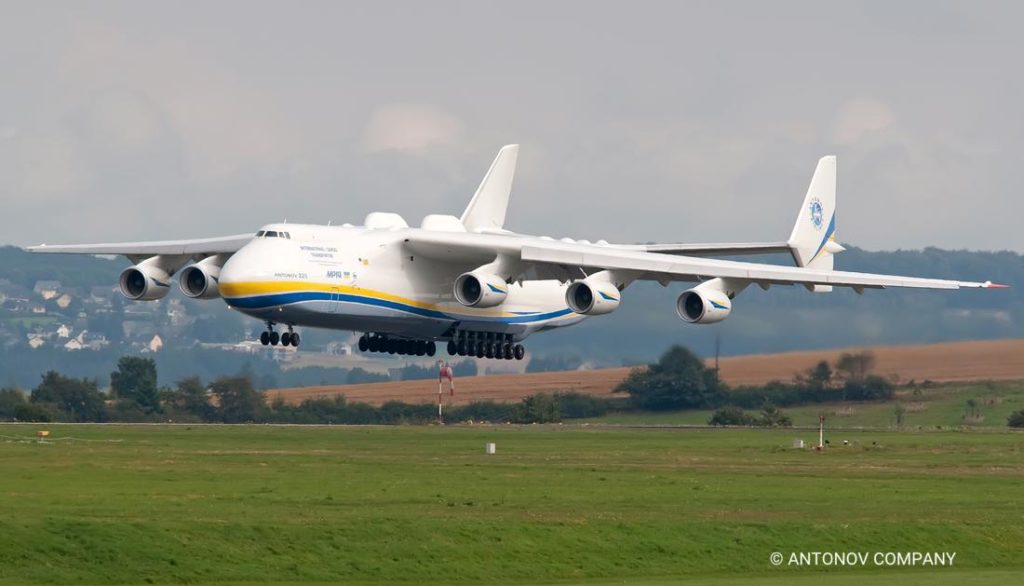
Taking from the AN-124 design, the AN-225 has fuselage barrel extensions added fore and aft of its wings. It uses the nose gear from AN-124-100, which gives it the ability to ‘kneel,’ making loading and unloading of cargo much easier. However, unlike the AN-124-100, which had its cargo door and ramp at the rear-end, the design for the Mriya empennage was modified from a single vertical stabilizer to a twin tail equipped with swept-backed oversize horizontal stabilizers. This set up the airplane to carry sizeable, heavy, external cargo, which typically leads to disruption of the airflow around a traditional tail.
The cargo compartment can also be pressurized, expanding the transport capacity of the aircraft. It is also equipped with cargo handling equipment, combined with the front cargo doors and its integrated ramp, maximizing loading and unloading efficiency.
Dreaming For The Skies: Mriya Setting Records
The AN-225 made her first flight on December 21, 1988, from the factory aerodrome in Svyatoshyn to be flown under the command of Captain Oleksandr Galunenko. After it had been used to transport the Buran shuttle orbiter and the Energiya carrier rocket, it continued its service for the Soviet space program until 1991. During that time, it established several aviation records with at least 110 under its belt in March of 1989. The aircraft also appeared in the 1989 38th Paris International Aerospace Show in France. After the collapse of the Soviet Union, the Antonov-225 was left unused for almost a decade.
The Mriya made its comeback in 2001 under Antonov Airlines as its superheavy cargo plane. The plane set 124 world records that same year, with another 214 domestic altitude, speed, and weight-to-altitude records. It’s been widely used to transport pipe-laying machines across Europe, deliver large wind turbines from China to Denmark, ship electric turbines across Latin America, and has also served several humanitarian missions across the globe. One good example of this was during the aftermath of the 2010 Haiti earthquake when it was drafted to deliver relief supplies and was also used to transport medical supplies during the COVID-19 pandemic.
With its world-renowned records and, of course, its sheer size, aviation enthusiasts around the world will miss the AN-225 and its colossal contribution to aviation history. The Ukrainian government has vowed to restore the behemoth aircraft to flying condition after the war in their country is over.
If you’re just tuning into SOFREP for the first time, click here to enjoy a free 2-month trial membership and be kept up to date on developments in Ukraine and elsewhere around the globe.








COMMENTS