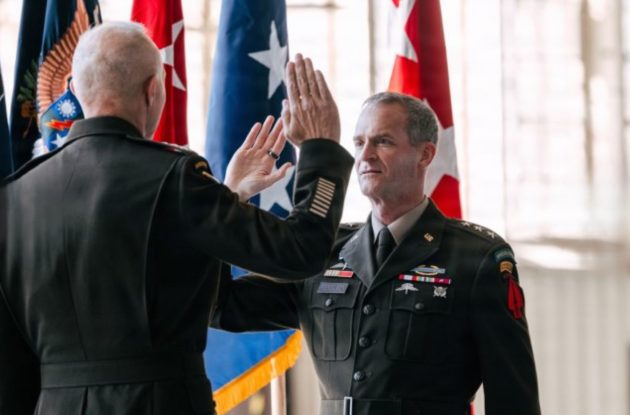
When Lt. Gen. Lawrence “Gil” Ferguson strode into the hangar at United States Army Special Operations Command on November 24, 2025, and accepted the colors, this “army within an army” passed into new hands. The ceremony was presided over by Randy A. George, Chief of Staff of the Army, and attended by heavy hitters from across government — including the Director of National Intelligence and the head of United States Special Operations Command (USSOCOM), Frank M. Bradley.
George, looking each bit the steward of America’s military future, swore in Ferguson and promoted him to lieutenant general on the spot. He praised Ferguson’s decades in Special Forces and noted that one of the main reasons he was tapped for this job was a demonstrated blend of humility, character, and combat-proven leadership.
When Ferguson grasped the USASOC flag, the more than 30,000 soldiers, support troops, and secretive specialists under the command had a new wrinkle in their chain of command — and perhaps a renewed rhythm under a leader who knows the darkness well.
The man in command: Who is Lt. Gen. Ferguson
Ferguson is not some bureaucratic interloper. His record reads like a who’s-who of ARSOF: two decades smacking around at the pointy end as a Special Forces officer, with commands at nearly every echelon — from small detachments all the way up to the command of 1st Special Forces Command (Airborne).
In his remarks after taking command, Ferguson acknowledged the seriousness of the job: he vowed to guard the legacy of Army Special Operations Forces (ARSOF) and ensure that the force stays lethal, adaptable, and worthy of the reputation that precedes it.
Passing the torch — from Braga to Ferguson
Ferguson takes over from Jonathan P. Braga, who relinquished command in September 2025 after four years at the helm. Braga’s tenure marked a stretch of near-constant global operations, as USASOC — in the words of his own congressional testimony — carried out more than half of all U.S. Special Operations deployments.
In his farewell, Braga likened his team to the storming Rangers of Normandy under Col. James Rudder, pathfinders carving a route for the Joint Force across the globe. By the time the colors passed to Ferguson, the “jersey” had been soaked in sweat and dust. The question now: will the new captain wear it cleaner — and sharper — than he found it?
USASOC: from 1989 to today — a legacy of shadows and steel
USASOC traces its origins to December 1, 1989, when four Special Forces soldiers emerged from a UH-1 helicopter above Fort Bragg, delivered orders in hand, and formally activated the command. That made USASOC the Army’s sixteenth major command and designated it the Army Service Component of USSOCOM.
Long before that, however, the seeds of ARSOF were sown in World War I, World War II, and later conflicts. Institutions such as U.S. Army John F. Kennedy Special Warfare Center and School helped sustain psychological-warfare, unconventional-warfare and civil-affairs capabilities. Through Vietnam, the Cold War, and the post-9/11 wars, the Army refined its special-ops forces, eventually consolidating them under USASOC’s command and control — a move many generals of the 1980s argued was overdue.
Today, USASOC commands a sprawling enterprise: Special Forces Groups (Green Berets), Rangers, Aviation, Psychological Operations, Civil Affairs, and other specialized units. Its mission remains to organize, train, equip, administer, mobilize, deploy and sustain Army SOF for global missions.
The role — and weight — of the USASOC commander
As commander, Ferguson will report to USSOCOM, under the oversight of Bradley. Operationally, he’s responsible for ensuring all the ARSOF units are ready to deploy worldwide — from counterterror raids to foreign-internal defense to humanitarian missions. USASOC is the largest component of USSOCOM, making its CG one of the most consequential generals in the U.S. military.
Already have an account? Sign In
Two ways to continue to read this article.
Subscribe
$1.99
every 4 weeks
- Unlimited access to all articles
- Support independent journalism
- Ad-free reading experience
Subscribe Now
Recurring Monthly. Cancel Anytime.
He must balance readiness and modernization. He must manage not only elite operators but also the supply lines, training pipelines, and institutional memory that allow ARSOF to punch above its weight. Under his watch, USASOC must remain a scalpel when circumstances call for subtlety — but a sledgehammer when they require blunt force.
What this means for ARSOF and the future of USASOC
Ferguson’s ascent comes at a critical moment. Global competition and strategic uncertainty demand irregular-warfare expertise, lightning-fast deployment, and strong alliance work. Under Braga, USASOC maintained a grueling operational tempo, splitting time across nearly 80 countries, often simultaneously.
With Ferguson, the ARSOF community gets a commander forged in those same fires — a leader who has walked in the boots of the operators he now leads. If he plays it right, USASOC could sharpen into a leaner, meaner tool for the Army and the Joint Force, preserving institutional excellence while embracing adaptation.
This is not merely a change of command. It is a reset of the internal compass for the Army’s shadow warriors.
The future may demand unconventional answers, and with Ferguson at the helm, USASOC will be ready to deliver.
—
** Editor’s Note: Thinking about subscribing to SOFREP? You can do it now for only $1 for your first year. Pull the trigger on this amazing offer HERE. – GDM










COMMENTS