

Economic Realities and Strategic Constraints
Iran‘s restrained response must also be understood within the context of its economic vulnerabilities and the cumulative impact of decades of sanctions. The Iranian economy has been severely weakened by international sanctions, internal mismanagement, and the costs of supporting proxy networks across the region. The nuclear strikes have likely damaged not only Iran’s nuclear capabilities but also its economic infrastructure, given the dual-use nature of many nuclear facilities.
The regime faces a stark choice – invest its limited resources in rebuilding its nuclear program and supporting proxy networks or focus on addressing the mounting economic pressures that threaten domestic stability. Popular discontent in Iran has been simmering for years, fueled by financial hardship, political repression, and the perceived waste of national resources on foreign adventures. The regime’s silence may reflect a calculation that further escalation could trigger the kind of domestic unrest that poses an existential threat to its survival.
“Every gun that is made, every warship launched, every rocket fired, signifies in the final sense a theft from those who hunger and are not fed, those who are cold and are not clothed.” – Dwight D. Eisenhower, Supreme Commander Allied Expeditionary Force, 1945
Moreover, Iran’s proxy networks themselves face significant constraints. Hezbollah is dealing with domestic political and economic crises in Lebanon, Hamas has been severely weakened by its conflict with Israel, and various Shia militias in Iraq face pressure from their own governments. The “Axis of Resistance” may be more fractured and less reliable than Tehran initially calculated, forcing the regime to reconsider its reliance on proxy warfare as a primary strategic tool.
The Search for Internal Enemies
The Iranian regime’s historical pattern following major security failures involves intensive internal investigations and purges designed to identify and eliminate perceived threats to the system. The current period of external moderation likely corresponds to a period of internal turbulence as the security apparatus searches for scapegoats and potential dissidents who might have contributed to the intelligence failures that enabled the nuclear strikes.
Iran’s Ministry of Intelligence (MOIS) and the IRGC’s Intelligence Organization are likely conducting comprehensive reviews of personnel with access to sensitive nuclear facilities and information. This process typically involves interrogations, surveillance, and preventive arrests of individuals deemed potentially disloyal to the regime. The scope of these investigations may extend beyond government and military personnel to include scientists, engineers, and contractors involved in the nuclear program.
The regime’s paranoia about Western and Israeli intelligence penetration has deep historical roots, stretching back to operations like the Stuxnet cyber-attack and various assassinations of nuclear scientists. The success of the June strikes has likely intensified these fears and triggered a comprehensive security review that may take months or even years to complete. During this period, the regime is likely to maintain a low external profile while focusing on consolidating internal security.
Regional Dynamics and Proxy Network Limitations
The silence of Iran’s proxy networks reveals important limitations in Tehran’s regional strategy and the autonomous nature of these relationships. While Iran has invested billions of dollars in supporting groups like Hezbollah, Hamas, and the Houthis, these organizations maintain their own strategic calculations and priorities that may not always align with Tehran’s interests.
Hezbollah, for instance, faces significant domestic pressure in Lebanon not to provoke further conflict that could devastate the already fragile Lebanese economy and infrastructure. Hamas, despite its ideological alignment with Iran, has its own complex relationship with other regional powers and may be reluctant to escalate tensions that could further alienate them from the Palestinian civilian populations. Even the Houthis, while remaining more responsive to Iranian direction, face their own military and political constraints in Yemen.
This divergence between Iranian interests and those of proxy groups suggests that the “Axis of Resistance” is, and has always been, a loose coalition of convenience rather than a tightly controlled strategic network. Iran’s current silence reflects a recognition that its proxy networks cannot be relied upon for significant escalatory responses and that direct confrontation with the United States and Israel carries unacceptable risks.
Conclusion: Strategic Patience or Strategic Weakness
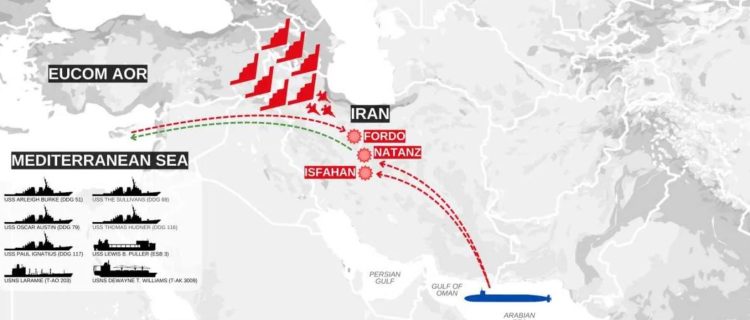
The Iranian regime’s subdued response to both US and Israeli-led strikes represents either a calculated strategic patience or a recognition of fundamental weakness, and quite possibly both. The Islamic Republic finds itself in an unprecedented position – its nuclear program has been severely damaged, its proxy networks have proven unreliable, and its domestic situation remains fragile.
The current silence should not be interpreted as permanent capitulation, but rather as a tactical retreat while the regime reassesses its strategic options and consolidates its domestic position. Iran’s historical pattern suggests that it may be preparing for a longer-term response that attempts to avoid direct confrontation while rebuilding its capabilities and exploring alternative approaches to regional influence.
However, the extended nature of this silence, combined with the reluctance of proxy networks to act decisively on Iran’s behalf, suggests that the Islamic Republic is undergoing a fundamental strategic reassessment. The revolutionary regime that once proclaimed its intention to export its ideology across the region may be evolving into a more conventional state actor focused primarily on survival and domestic consolidation.
This transformation, if it continues, could have profound implications for regional stability and international relations. A more cautious, inward-looking Iran might contribute to regional de-escalation. Still, it could also indicate that the current regime is vulnerable to internal challenges that could ultimately prove more destabilizing than external confrontations. The world watches and waits to see whether Iran’s current silence represents strategic wisdom or a temporary pause before a more dramatic response unfolds.








COMMENTS