

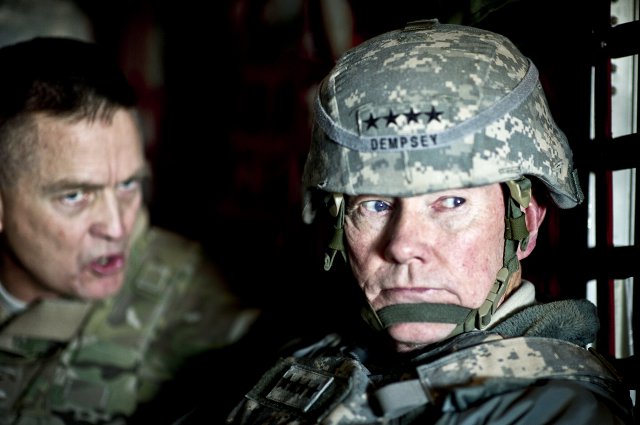
This option uses lethal force to strike targets that enable the regime to conduct military operations, proliferate advanced weapons, and defend itself. Potential targets include high-value regime air defense, air, ground, missile and naval forces as well as the supporting military facilities and command nodes. Stand-off air and missile systems could be used to strike hundreds of targets at a tempo of our choosing. Force requirements would include hundreds of aircraft, ships, submarines, and other enablers. Depending on duration, the costs would be in the billions. Over time, the impact would be the significant degradation of regime capabilities and an increase in regime desertions. There is a risk that the regime could withstand limited strikes by dispersing its assets. Retaliatory attacks are also possible, and there is a probability for collateral damage impacting civilians and foreigners inside the country.
This option could potentially cost hundreds of billions of dollars, but it would also lower the risk to U.S. and Allied soldiers. There is one problem, and that is the “possible” collateral damage that could ensue with these airstrikes. This is another one of those areas where we could potentially turn friends into enemies if the strikes are not precise, and even then, it is impossible to know unless we have direct eyes on target. Which, if the targets were sensitive and high enough risk, we could potentially have small clandestine SOF operating to fulfill such duties. I wouldn’t be surprised if these teams were already in place.
3. Establish a No-Fly Zone
This option uses lethal force to prevent the regime from using its military aircraft to bomb and resupply. It would extend air superiority over Syria by neutralizing the regime’s advanced, defense-integrated air defense system. It would also shoot down adversary aircraft and strike airfields, aircraft on the ground, and supporting infrastructure. We would require hundreds of ground and sea-based aircraft, intelligence and electronic warfare support, and enablers for refueling and communications. Estimated costs are $500 million initially, averaging as much as a billion dollars per month over the course of a year. Impacts would likely include the near total elimination of the regime’s ability to bomb opposition strongholds and sustain its forces by air. Risks include the loss of U.S. aircraft, which would require us to insert personnel recovery forces. It may also fail to reduce the violence or shift the momentum because the regime relies overwhelmingly on surface fires—mortars, artillery, and missiles.
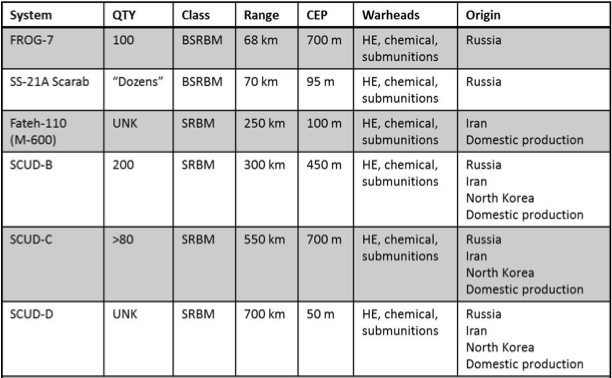
This option appears to increase the threat to U.S. and Allied forces, but would cause greater damage to Assad’s military forces. But, as General Dempsey stated, Assad prefers to use mostly surface fires such as mortars, artillery and missiles. These tactics could potentially cause little damage to Assad’s overall strategies and tactics. For this to really have any affect on the enemy it would surely need to be coupled with option two, to help eliminate ground and air assets.
4. Establish Buffer Zones
This option uses lethal and nonlethal force to protect specific geographic areas, most likely across the borders with Turkey or Jordan. The opposition could use these zones to organize and train. They could also serve as safe areas for the distribution of humanitarian assistance. Lethal force would be required to defend the zones against air, missile, and ground attacks. This would necessitate the establishment of a limited no-fly zone, with its associated resource requirements. Thousands of U.S. ground forces would be needed, even if positioned outside Syria, to support those physically defending the zones. A limited no-fly zone coupled with U.S. ground forces would push the costs over one billion dollars per month. Over time, the impact would be an improvement in opposition capabilities. Human suffering could also be reduced, and some pressure could be lifted off Jordan and Turkey. Risks are similar to the no-fly zone with the added problem of regime surface fires into the zones, killing more refugees due to their concentration. The zones could also become operational bases for extremists.
This is one of the more risky options for the potential of high loss of human life and a safe haven for extremists to train and operate. One thing that needs to be realized is that no matter what involvement the U.S. has, it will eventually have to deal with the extremists groups that have positioned themselves among the secular opposition. Unfortunately I do not see a solution to eliminating these national security threats while simultaneously helping the civilian and secular opposition. If one such strategy could be realized, it would be a massive victory for not only the U.S., but the beginning of the re-stabilization of the region.
5. Control Chemical Weapons
This option uses lethal force to prevent the use or proliferation of chemical weapons. We do this by destroying portions of Syria’s massive stockpile, interdicting its movement and delivery, or by seizing and securing program components. At a minimum, this option would call for a no-fly zone, as well as air and missile strikes involving hundreds of aircraft, ships, submarines, and other enablers. Thousands of special operations forces and other ground forces would be needed to assault and secure critical sites. Costs could also average well over one billion dollars per month. The impact would be the control of some, but not all chemical weapons. It would also help prevent their further proliferation into the hands of extremist groups. Our inability to fully control Syria’s storage and delivery systems could allow extremists to gain better access. Risks are similar to the no-fly zone with the added risk of U.S. boots on the ground.
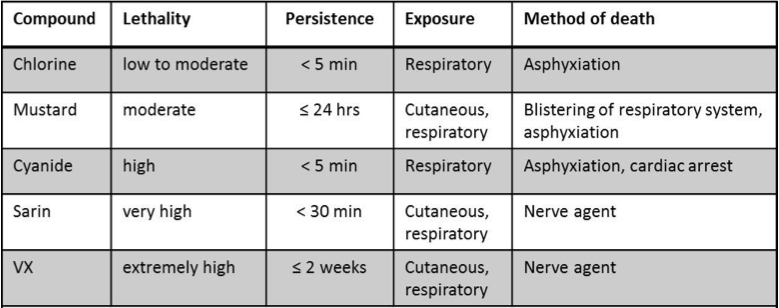
This is the scary part and probably the biggest reason why we will eventually place SOF on the ground at some point in the very near future. The U.S. will not allow chemical weapons to fall into the hands of Islamists. If we are in control of the situation and this fight is regulated by the awesome resource capabilities of the U.S. military, then chemical weapons will not fall out of our reach. Although some could argue they are currently in the not-so-steady hands of a tyrant, and the security of this nation must stand above all doubt. I tend to agree.
General Dempsey concluded his letter by stating:
I know that the decision to use force is not one that any of us takes lightly. It is no less than an act of war. As we weigh our options, we should be able to conclude with some confidence that the use of force will move us toward the intended outcome. We must also understand risk-not just to our forces, but to our other global responsibilities. This is especially critical as we lose readiness due to budget cuts and fiscal uncertainty. Some options may not be feasible in time or cost without compromising our security elsewhere. Once we take action, we should be prepared for what comes next. Deeper involvement is hard to avoid. We should also act in accordance with the law, and to the extent possible, in concert with our allies and partners to share the burden and solidify the outcome.
I foresee the U.S. using a combination of 1-5, and soon. This conflict will not be short, but with the lessons that we have learned from Iraq and Afghanistan, it hopefully can be successful.
In closing, I will leave you with this:
When I was serving, I knew that whatever the mission was, I was going to do my damnedest to make sure my buddy next to me survived and I came home safe. But, I also knew that it didn’t matter what the mission was, it was going to happen with or without me.
What I am getting at is this: whether the mission had some subversive political agenda or we were just trying to make the world a better and safer place, I signed on that line and swore an oath to this country, the constitution, and my fellow man. If troops are sent to Syria, some of them may disagree with why we are going, but when they get there, they are going lay their lives on the line for the mission, their buddy next to them, and the United States of America.
(Featured Image Courtesy: Defense.gov)








COMMENTS