
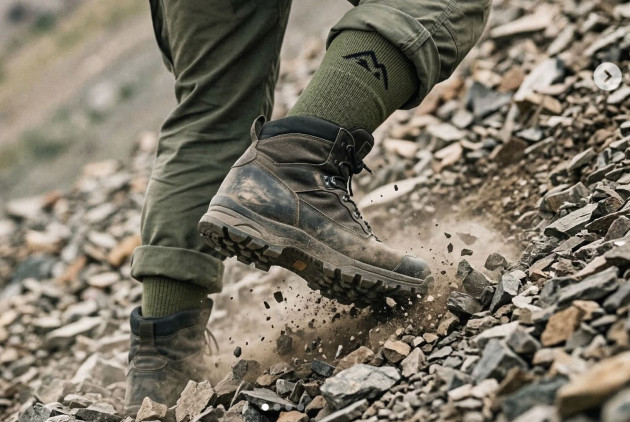
You’re a few miles in to your first real ruck at the Special Forces Q Course.
By mile six, everything still feels fairly fine.
By mile ten, your feet are negotiating terms of surrender.
Heat builds first. Then sweat. Then friction. It’s slow, quiet, and relentless. Inside a heavy leather boot, there’s nowhere for that moisture to go. It just sits there, cooking your skin like a rotisserie chicken under a grocery store heat lamp.
Soft tissue breaks down. Hot spots turn into blisters. And when you finally peel those boots off, the smell tells you and everyone around you exactly how bad things got.
That’s not bad luck. That’s a hostile environment you’ve been walking in all day.
The Problem Only Smart People Fix
Most guys will spend real money on boots, then throw on whatever socks were cheapest in a six-pack.
Not smart.
Cotton. Thick. Useless once it gets wet.
It doesn’t breathe. It doesn’t regulate. It absorbs sweat, holds it against your skin, and turns your boot into a damp, grinding mess. You can tough it out for a while, sure. But you’re not winning anything. You’re just letting your feet take unnecessary damage.
The truth is simple. Your boots are only half the system.
What you put between your skin and that leather determines how the day ends and how much pain you’ll be in that night.
Climate Control, Not Cushioning
Forget the idea that socks are just padding. They’re not.
The real job is climate control.
High-density merino wool works like a regulator. It pulls moisture off your skin before it becomes a problem, spreads it out, and lets it evaporate. Instead of a soaked sock, you get a dry, stable environment inside the boot.
Cold weather, it holds warmth where you need it. Hot weather, it vents heat and keeps things breathable. No drama, no gimmicks, just steady performance across conditions.
That’s the difference you’re getting with merino wool socks for hot weather. Dry skin doesn’t break down. Wet skin does. Everything else is secondary.
This is where Hywell starts separating itself from the pack. They didn’t build these to look comfortable in some catalog photo. They built them for guys putting in long hours in bad conditions, where small failures stack up fast.
Field Hygiene Is Not Optional
Here’s the part people ignore until it gets bad.
Odor isn’t just unpleasant; it’s a warning sign. Warm, wet boots create the perfect breeding ground for bacteria. Cotton feeds it. Synthetic blends don’t do much better.
Merino wool pushes back.
It naturally resists the growth of odor-causing bacteria, which means your feet aren’t just drier, they’re cleaner. At the end of the day, when the boots come off, you’re not hit with that wall of stale air that tells you your gear failed you hours ago.
It’s a small thing until it isn’t. Then it becomes the difference between showing up ready the next day or dealing with damage control.
Built Like It’s Meant to Be Used
There’s a certain honesty in gear that’s meant to take a beating.
Hywell heavy-duty boot socks aren’t built for light use or occasional wear. They’re built for repetition. Long shifts. Miles on your feet. Days when you don’t get the luxury of stopping just because something feels off.
You notice it in how they hold up. You notice it in how your feet feel at the end of the day. And once you’ve run them through enough real-world tests, it’s hard to go back to anything else without feeling the downgrade.

The Part Most Companies Won’t Say Out Loud
Anybody can talk about performance.
Very few will stand behind it when it counts.
Hywell does.
That’s why the 10-Year Warranty hits different.
It’s not a marketing line. It’s a statement. A decade of coverage on something that gets used, abused, soaked, dried, and worn down day after day means they’re not guessing about durability. They’re betting on it.
And that should tell you everything you need to know.
Fix It Before It Becomes a Problem
Most foot issues don’t show up all at once. They build quietly, step by step, inside a boot that’s turning against you.
You can ignore it and deal with the consequences later.
Or you can fix the environment now.
Because once your feet go, everything else follows.
And there’s nothing tough about making your day harder than it needs to be.








COMMENTS