

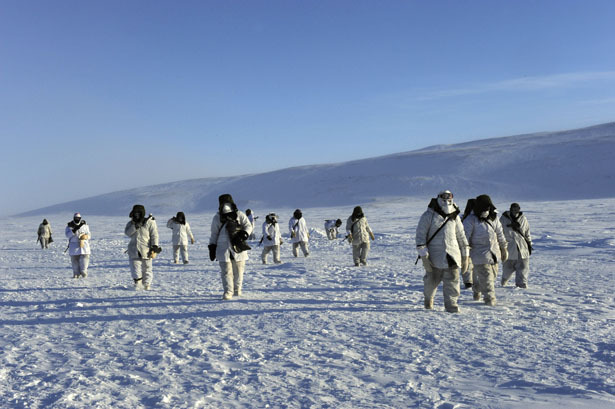
Even a platoon of Polish paratroopers from the Polish Army 6th Airborne brigade based in Krakow, Poland are taking part in RAFALE BLANCHE. They were parachuted from a C-17 Globemaster alongside A Company of the 3rd BN Royal 22nd Regiment, my old unit. A few years ago, we had Gurkhas with us in an exchange training. They would come here to learn the basics of Winter Warfare and then we’d go to Borneo to learn the basic of jungle warfare. It is through exchanges that NATO soldiers gain more expertise and become more well-rounded.
As I could read on Defence Watch:
“Exercise participants will practice winter survival skills; conduct long range patrolling; navigate in rural and urban settings; secure helicopter landing pads; and complete a parachute drop in cold weather conditions. Soldiers will also have the opportunity to meet with residents of the region and showcase the army equipment being used during the weekend of February 1-2.”
But will those exercises survive the massive budget cuts underway in the Defence? I surely hope so, as being ready to intervene at brigade level in a Winter Warfare scenario is crucial for Canada, one of the biggest Arctic countries on this planet.
The Importance of Being Ready for Winter Warfare
That brings me to the importance of winter warfare. The Canadian Forces (CF) are one of the most advanced militaries in the world when it comes to fighting during the winter time. As an Arctic country, it is their responsibility to protect their citizens and the land against any outside or inside threat in any weather conditions. Normal winter conditions last for about 3-4 months in the southern part of the country and are almost permanent up in the Great North.
While we are called upon to deploy everywhere in the world, I am glad to see that the CF are once again refocusing on those winter exercises. We sure need a strong foreign policy to keep our border tight and secured but we also need to be able to fully operate on our home turf.
With the opening of the Northwest Passage, as I wrote in one of my articles here on SOFREP, it is only normal that the Canadian soldiers are able to quickly react to any threat or domestic situations during the winter time, which is almost permanent up there.
The Canadian Forces is the only member of NATO to outfit all its personnel with arctic survival equipment; this is in addition to all Canadian Forces equipment being able to operate effectively in arctic conditions with minimal changes. This clearly shows Canada’s preparedness to operate during winter.
Training American Soldiers
The United States military sends soldiers almost every year to come and train in our weather conditions. This is a great opportunity for these soldiers to gain precious experience and share it with their home unit.
The North American continent has the largest unprotected border in the world and NORAD is a successful organisation that keeps it secured from outside threats as well. It is only normal, in my opinion, that we share some of our knowledge with our closest ally so they can also operate in those extreme conditions alongside us.
I will cover this more deeply in part 2 of the article.
Lessons Learned from Afghanistan in a Winter Warfare Scenario
There is a way to incorporate the lessons learned from Afghanistan into Winter Warfare training scenarios to make them more realistic and challenging. For example, the road sweeps. As an advisor to the Afghan National Army in 2009, we were doing daily road sweeps to keep Highway 1 secured against IEDs and possible ambushes.
In exercices such as RAFALE BLANCHE, where a part of the training is done in urban environment involving civilians, soldiers could be tasked to keep the road secured to protect both the civilians and the convoys by conducting daily sweeps.
Another example would be to cordon and search areas. It was a very usual thing that was done in Afghanistan as we would do soft knocks on a certain number of compounds everyday to tag them as safe.
In a domestic operation scenario, such as a natural disaster, soldiers could be called to go from house to house to do a quick survey about the needs of the home owners and their current state of health. There is also a possibility that crime could be committed so by having experience of doing soft knocks in Afghanistan, the soldiers could find those criminals without alerting the neighbours and transfer them to the Law Enforcement officers.
Conclusion
This is only a quick introduction of the next few articles I will write. In part 2 I will concentrate on the soldier’s training and their jobs. I will also talk about how NATO should learn from our experience in Winter Warfare through more exchanges like we have recently started to do. I will also present you A Company of 3rd BN Royal 22nd Regiment, my old unit, who are paratroopers, as I cover what their role is in Winter Warfare.
In part 3, I will get into a more political side of the importance of being able to protect our own country while keeping a strong foreign policy.








COMMENTS