

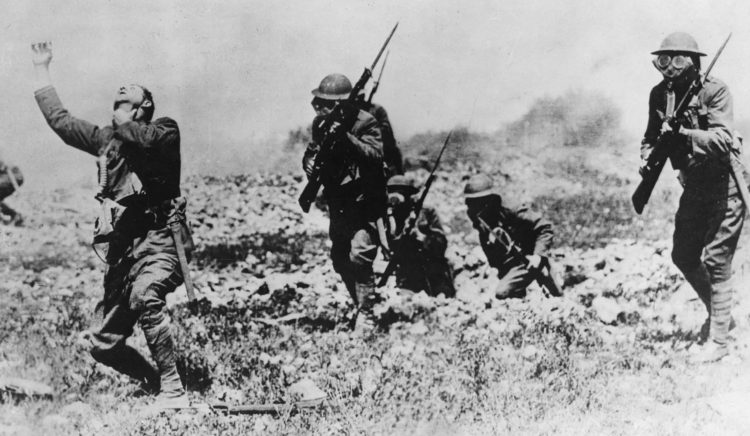
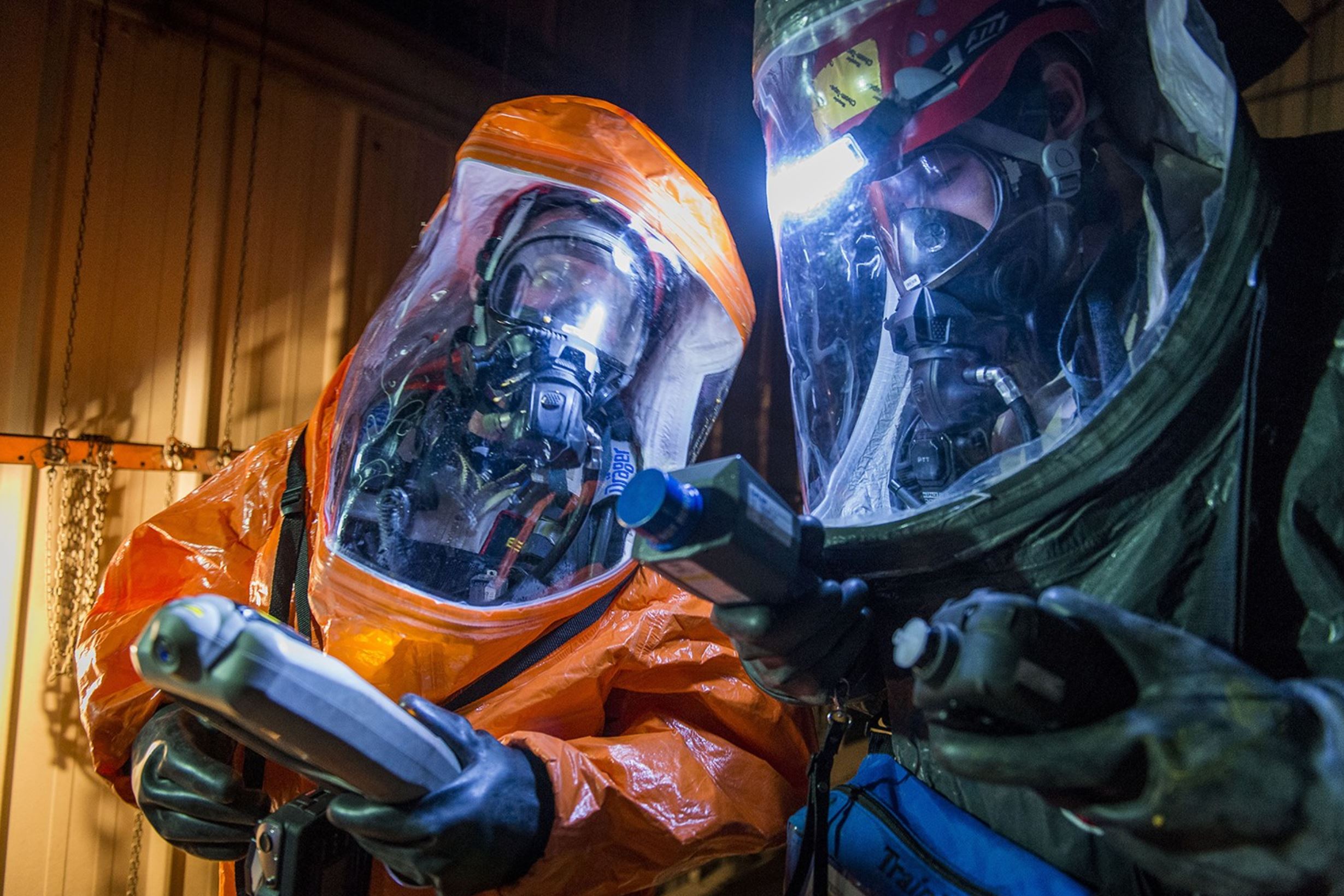
Most modern masks rely on skintight negative pressure isolation. A few allow crew members to plug into positive‑pressure systems that force filtered air into the mask, blowing contaminants away. But for the average soldier these are heavy, complex and require power, which adds weight to an already burdened soldier.
Riot Reality: Portland and Chicago
During the recent Portland and Chicago ICE riots, reporters and camera crews-many with beards or several days stubble-were heard coughing and gagging, describing the tear gas as “overwhelming.” These reactions were widely interpreted as proof of gas potency—but from a chemical survivability standpoint, they were indicators of seal or filter failure.
Military-grade protective masks are engineered to allow soldiers to operate for extended periods in environments saturated with lethal agents. When properly fitted and paired with appropriate functioning filters, these masks prevent exposure to chemical irritants entirely. It’s not that the wearer “wouldn’t feel much”—it’s that they wouldn’t feel anything. No burning eyes, no coughing, no panic. The only detectable scents should be the neutral interior of the mask itself and, occasionally, the faint odor of activated charcoal from the filters.
If symptoms are present—burning, gagging, or even the detection of gas odor—it means the seal has failed, the filters are compromised, or the mask was improperly donned. In a riot zone, that’s discomfort. In a battlefield chemical strike, that’s fatal [9]. If civilian misunderstandings of gas exposure reveal anything, it’s how quickly people forget the basics of chemical survivability. On the battlefield, that forgetfulness is deadly—as Ukraine has shown.
Ukraine: 9,000+ Chemical Incidents
In Ukraine, the use of chemical agents by Russian forces has been documented over 9,000 times [3–5]. These include tear gas grenades dropped from drones, improvised chemical munitions, and banned agents like chloropicrin. The OPCW has confirmed repeated violations of the Chemical Weapons Convention [4]. Dutch and German intelligence agencies report a standardized, widespread deployment of chemical weapons by Russian forces [5]. This isn’t a fringe threat. It’s a doctrinal shift. Our near-peer adversaries have normalized chemical warfare in violation of multiple treaties. And Ukraine isn’t the only warning sign. On the Korean peninsula, the threat is even more concentrated.
North Korea: Chemical Warfare Is Not Hypothetical
North Korea has positioned 170mm self-propelled artillery and 240mm multiple-launch rocket systems capable of saturating urban zones like Seoul within minutes [6,7]. RAND testimony before Congress confirms that North Korea’s chemical and biological weapons capabilities are real and operational [6].
This means every soldier must be able to:
– Shave in the field—daily if needed and follow SOP routines
– Perform negative pressure seal checks—before exposure, after donning, and during prolonged wear
– Maintain mask integrity under duress—including sweat, movement, and environmental stressors
From Trenches to Today: Legacy Doctrine Meets Modern Mandate
The evolution from WWI trench hygiene to Cold War defense, and now to 21st-century prepping doctrine, reveals a consistent Protective mask truth: seal integrity is survival.
Recently, the Secretary of War released a directive reaffirming what NBC-trained personnel have long taught: troops must train to fight in a chemical environment [8]. The directive mandates:
– Chemical warfare training for all troops
– Proper mask fitting and documentation
– Routine negative pressure seal checks
– Banana oil testing using isoamyl acetate—if the wearer smells the banana scent, the seal has failed [8,10]
Banana oil testing, once used in Cold War-era drills, remains a gold standard for verifying mask fit under stress [10]. Combined with negative pressure checks and field shaving SOPs, they form the backbone of chemical survivability. This isn’t Political or media hype. It’s military doctrine. A beard is a breach point, and survivability demands discipline and daily seal rituals that ensure that a soldier is able to get a proper seal of their protective mask.
From the trenches of Ypres to the streets of Mariupol, the lesson has not changed: the mask only works if the seal holds, and the seal only holds if the face is clean. A beard may project strength, but in a chemical battlefield, it is weakness. In modern war, the beard is not a badge of strength—it is a breach point. The seal is survival, and survival is clean‑shaven.
Author Bio:
Hansel Rayner, PA-C, is a nationally recognized adrenal provider, NBC school–trained medical professional, and founder of Central Georgia Adrenal and Reproductive Endocrinology. He served in private practice in Tooele, Utah, during the destruction of legacy chemical weapons at Dugway Proving Ground and the Tooele Chemical Agent Disposal Facility, where he supported hospital readiness for chemical exposure events.
References
1. Nam H, Kang J, Lee C, Kim S. The effect of hair and beard on the airtightness of gas masks: A quantitative study using SMARTMAN. *J Adv Mil Stud*. 2024;7(1). doi:10.37944/jams.v7i1.236.
2. Jones S. *World War I Gas Warfare Tactics and Equipment*. Oxford: Osprey Publishing; 2007:30–31.
3. CBS News. Russia ramps up use of banned chemical weapons in Ukraine. July 4, 2025. https://www.cbsnews.com/news/russia-ramps-up-use-banned-chemical-weapons-ukraine
4. Atlantic Council. Russia accused of escalating chemical weapons attacks against Ukraine. July 10, 2025. https://www.atlanticcouncil.org/blogs/ukrainealert
5. Al Jazeera. Russia expanding Ukraine chemical weapons use, allege European spy agencies. July 4, 2025. https://www.aljazeera.com/news/2025/7/4/russia-expanding-chemical-weapons-use-in-ukraine-say-european-spy-agencies
6. Parachini JV. Assessing North Korea’s Chemical and Biological Weapons Capabilities and Prioritizing Countermeasures. Testimony before the House Foreign Affairs Committee. RAND Corporation; January 17, 2018. https://www.rand.org/pubs/testimonies/CT486.html
7. Kim JH. Why North Korea’s Artillery Threat Should Not Be Exaggerated. *Modern War Institute*. November 15, 2024. https://mwi.westpoint.edu/why-north-koreas-artillery-threat-should-not-be-exaggerated/
8. Department of Defense. DoD Directive 5101.17E: Roles and Responsibilities Associated with the Recovery of Chemical Warfare Material. Change 3, May 9, 2022. https://www.esd.whs.mil/Portals/54/Documents/DD/issuances/dodd/510117p.pdf
9. Task & Purpose. Do beards actually break the seal of gas masks? May 19, 2022. https://taskandpurpose.com/news/military-beards-break-gas-mask-seal/
10. First Division Museum. The Fog of War: Gas Attacks. Accessed October 2025. https://www.fdmuseum.org








COMMENTS