

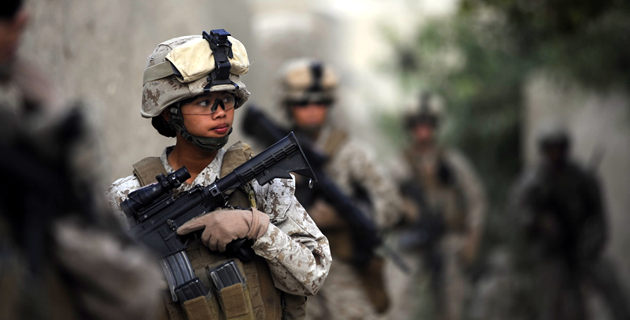
I am glad to see women go through IOC because it generates data. The course is built to push limits and simulate how bad circumstances can become. No one should experience absolute exhaustion for the first time in combat. I would imagine the data being gathered includes how well the women perform compared to their male counterparts, the dropout rates of both, the injury rates and other similar metrics.
Research data is only statistically significant though if there are enough participants. The one or two women that currently volunteer per course are not enough. To date, several women have enrolled and have either been injured or disqualified, along with other male counterparts. Many more women need to go through the training. This will not only give better data, but it will also give women more chances to experience what the Marine Corps does at its very core: infantry.
Uncertainty and Risk Associated with Women in Combat Arms Roles
What can help us answer the question of combat effectiveness and readiness better than actual research of women who want the opportunity? Sure, women have integrated with infantry battalions, logistics convoys, and mentoring teams for a decade, but they did not replace men who carried heavy loads over a long distance to fight and return the same way. Data allows us to validate the risk involved with changing a system that has worked for hundreds of years.
Uncertainty and risk. These are at the heart of so many industries, ventures, and wars throughout history. Does the uncertainty of winning and the risk of loss overcome the benefits of the action? Uncertainty can be measured by our ability to predict the future. Risk is measured in the potentially negative outcomes of an action or decision. The decision at hand is: “does integrating women into traditional combat roles affect combat effectiveness and readiness, and if so, how?”
Nothing is more important than the answer to “how” these are affected. We can further this dialogue by gathering data on how women perform during training, and by analyzing after action reports about their performance in combat for the last decade. Ultimately the decision must be made both quantitatively and qualitatively. According to General Amos, the Marine Corps will not integrate women into combat roles unless 1) there are sufficient numbers of women to make it worth the effort, and 2) until we have considered the impact on the Marine Corps’ warfighting capability.
Combat Requirements
Now we get to the meat of the issue: the fact that combat has requirements. If this is true – and it is – then it only makes sense that all candidates have the same training requisites.
Combat is not forgiving. I have had male Marines that were physically or mentally unable to accomplish a task due to extreme exhaustion or from being overwhelmed, but they kept going anyway. Combat is the same for everyone. Either you can kill the other person or you or a buddy dies instead. That’s it.
Therefore, if a woman has every opportunity that a man has, should she also have every requirement. Period. And that is exactly what the Marine Corps is in the midst of defining. Combat has physical, mental, and emotional requirements. Men are not superior to women, but each of us has different skills and abilities that we bring to the team.
If the requirement for men in the Marine Corps is to do pull-ups, why shouldn’t the requirement for women trying to enter combat units be the same? Fortunately, the Marine Corps is finally doing away with the flexed arm hang for female physical fitness tests. The Marine or soldier lying on the ground shot through the face is just as heavy to pick up for a man as for a woman. Leaders in the Marine Corps admit that standards for people in combat roles should have been developed long ago, and now they are making up for that by codifying what the requirements will be. I hope they make them up to combat standards and not just to help retention rates.
We should realize that the role of women in the Marine Corps is something that cannot be decided by data alone. There are several serious questions that need to be answered, and probably can only be answered within the context of a larger cultural perspective. When male Marines are given their military occupational specialty (i.e. their job), they cannot protest this assignment. Should women be given the right to refuse being assigned to a combat arms specialty like infantry if they are capable of executing those duties? And also – once women are integrated into combat units, should they also be eligible for the draft?
Regardless of the gender integration experiments in other nations, this debate will never end until we give it a try. So get women in the ranks now and collect data! But for every decision there must be one guiding question: are we stronger than we were and are the costs worth the outcome?
Photos and video used by permission from photojournalist, Rebecca Sell.








COMMENTS