BlackSea isn’t just pitching concepts—they’re rolling out a purpose-built, modular warship that looks ready to give the Navy the kind of flexible, mission-first workhorse it’s been asking for.
Read the full article for more on:
Important insights and detailed analysis
Expert commentary on current events
Breaking developments and updates
Updating summary...
BlackSea Technologies Modular Attack Surface Craft: A New Mission-First Unmanned Surface Vehicle for the Navy
Guy D. McCardle
Speed
1x
Listen
COMMENTS
BlackSea isn’t just pitching concepts—they’re rolling out a purpose-built, modular warship that looks ready to give the Navy the kind of flexible, mission-first workhorse it’s been asking for.
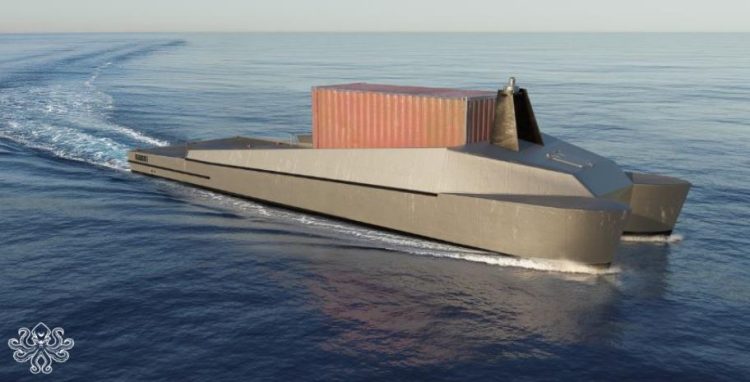
A modular catamaran built for tomorrow’s Navy, BlackSea’s MASC shows how containerized payloads can turn one hull into many missions at sea. Image Credit: BlackSea Technologies
BlackSea Technologies—people I’ve met recently at SOF Week 2025 and have the utmost respect for—just stepped up to the Navy’s plate with a family of Modular Attack Surface Craft (MASC) unmanned surface vessels built to answer Solicitation N00024-25-R6314. This isn’t some commercial hull with military paint; it’s a purpose-designed 66-foot aluminum catamaran meant to accelerate a transition to a distributed, survivable fleet.
Advertisement
I’d love to be able to show you more pictures of it in this story, but there just aren’t any additional available.
The Solicitation and the Solution
In July 2025, the Navy asked the maritime industry for a modular surface combatant craft that can swap containerized payloads to perform tasks from anti-surface warfare and strike to electronic warfare, mine countermeasures, and logistics. BlackSea’s entry was designed around those missions: roomy, powerful, and ready for hard work at sea.
Mission Driven Design
Where many builders may graft missions onto merchant hulls, BlackSea started with the mission and built out. The MASC offers space and power that read like a wishlist for modern naval needs: 67,200 pounds of payload capacity, 900 square feet of open deck, and 198 kWe of electrical power to feed sensors and weapons. Range is listed at 3,000 nautical miles at 10 knots with a self-deploying envelope to 10,000 nm, and a top speed of 25 knots for responsive, long-endurance operations.
Think of it as a pickup truck bed on a warship: open, modular, and able to accept whatever containerized payload you decide on for the day.
Advertisement
Mission Built, Out of the Box
With roughly twice the payload area and electrical capacity of similarly sized craft, the platform supports seven mission profiles without surgery: ASW, ASuW, Electronic Warfare/ISR, Logistics, Infrastructure Monitoring, Strike, and Mine Warfare (MCM/MIW). That kind of baseline flexibility is the difference between a toolbox and a single-purpose wrench.
“Our approach starts with the mission, not the platform,” Todd Greene, BlackSea’s deputy director of advanced technology, says.
Advertisement
“We designed a flexible, modular combatant that can evolve with the Fleet and be built at scale today, not years from now.”
Production Ready, Built on GARC
BlackSea isn’t promising a prototype someday—they’re leveraging their Global Autonomous Reconnaissance Craft (GARC) line in Baltimore, which is producing one craft per day. The company says it can deliver an integrated MASC prototype within six months and that the MASC shares 75 percent commonality with fielded GARC systems—critical for supply-chain resilience and rapid autonomy integration. That experience matters when timelines are tight.
I took the video above during SOF week 2025. It shows the BlackSea GARC in action. A gentleman to my right was controlling it with what looked very much like your typical video game controller. Video courtesy of the author.
Advertisement
Naval-Level Practicality
The hull uses slender twin aluminum hulls for low drag and stability, enabling safe launch and recovery of containerized payloads and lining up with existing shipyard skills. Propulsion comes from dual Volvo Penta D8-IPS600 units—simplifying assembly—and the architecture is natively compatible with the Navy’s Unmanned Maritime Autonomy Architecture (UMAA), which helps avoid vendor lock-in.
The Navy’s MASC effort folds prior Large and Medium USV goals into a single push for modular combatant crafts to distribute lethality across the Fleet. By combining proven autonomy, fielded production methods, and a purpose-built design, BlackSea’s MASC aims to deliver speed-to-fleet, operational flexibility, and scalability.
“Fleet modernization demands bold steps,” Chris Devine, BlackSea’s CEO, said. “With our MASC solution, the Navy can field a family of unmanned combatants that are mission-driven, production-ready, and built to scale.”
About Black Sea Technologies
BlackSea Technologies develops maritime systems and mission solutions from the surface to the seabed to give U.S. Naval and military forces asymmetric options for multi-dimensional conflicts.
I’m very much looking forward to seeing what they have up their sleeve next year for SOF Week.
Advertisement
What readers are saying
Generating a quick summary of the conversation...
This summary is AI-generated. AI can make mistakes and this summary is not a replacement for reading the comments.










COMMENTS