

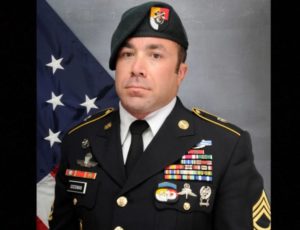
Goodman’s automatic activation device, known as a Cypres, did deploy correctly. The investigation report stated that, “in this case, the Cypres [device] worked properly, but because the reserve was most likely tangled around MSG Goodman’s body and equipment, it was ineffective.”
Because of the altitude involved, Goodman’s main canopy was found nearly a mile from his body, which was located about six miles from the intended drop zone. His equipment was scattered over a wide area as well.
The accident investigation was first obtained by the Army Times through the Freedom of Information Act. According to the investigation, Goodman, “most likely dipped his right shoulder” when he reached back, causing him to become destabilized and spin. Goodman was jumping with full combat equipment and breathing from an oxygen mask.
Goodman had complained of right shoulder pain before and during the jump. The shoulder pain was cited during the investigation and may have possibly played a role in what caused his shoulder to dip causing him to destabilize.
Goodman’s “main parachute and lines deployed around him and became entangled in his [night vision goggles] and even possibly other equipment,” the investigation found. As trained, he cut away from his main canopy and deployed his reserve chute, but that too became entangled all around him.
It is important to note that the Special Forces team was transitioning to a new style of parachute beginning on January 9.
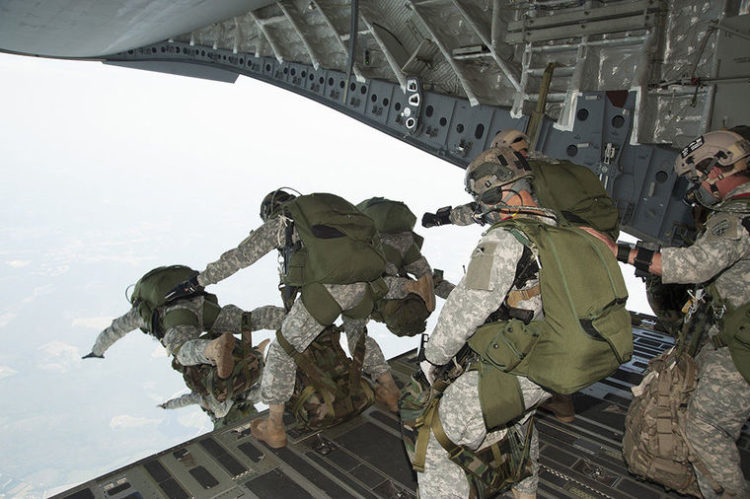
With the previous equipment, free-fall jumpers would pull a ripcord located on their right shoulder, which launches a spring-loaded pilot chute and deploys the main canopy. But during the training in Arizona, the Green Berets were being taught a different method that requires the jumper to reach down to the bottom of their chute and hand-deploy a pilot chute that they then throw into the wind.
The method is common among civilian skydivers. It is also regularly used by Military Free-Fall School instructors at Yuma Proving Ground, Arizona.
According to Colonel T.J. Rainsford, Army Special Operations Command (USASOC) spokesman, Army free-fall special operators are required to transition to this method, according to April 2019 training guidance cited in the investigation. The new method is ultimately safer and considered the “current industry standard.”
“It is a simple and secure deployment method and almost completely eliminates the possibility of a pilot [chute] hesitation during deployment,” Rainsford said to the Army Times, adding that it also helps standardize the deployment methods used by instructors and students.
However, the investigation highlighted a concern. The new method, which requires jumpers to reach back rather than simply grab the ripcord at their shoulder, could introduce range-of-motion issues for some individuals, especially if they destabilize during free-fall. And unlike civilian skydivers, special operations troops jump with a lot of gear that could easily cause the jumper to become destabilized.
When the military began the transition to this system, it produced slides for their training program. The slides were included in the Army Times piece which highlighted this exact issue.
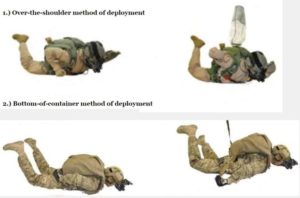
“While the use of a [hand-deployed pilot chute] system is safer, it does pose a greater risk to parachutists that cannot conduct a stable exit, stable free-fall, or maintain heading control throughout the deployment.”
Goodman had gone through the certification for the new method, including work in a wind tunnel at a private facility. He was certified by a free fall instructor with over 2,500 jumps. He had conducted 13 prior jumps with no issues before the night of January 13.
The Army’s investigation called for a working group to be formed. Its purpose is to discuss potential issues with transitioning to the new method, adjust the regulations as needed, and ensure that such accidents don’t repeat.
One of the recommendations that have been implemented is that regardless of the number of jumps an operator has, “If [a] jumper exhibits instability on more than three jumps, instructors/graders will begin monitoring [them] more closely and capturing feedback on camera, as well as provide written feedback.” That jumper then has to go through remedial training.








COMMENTS