

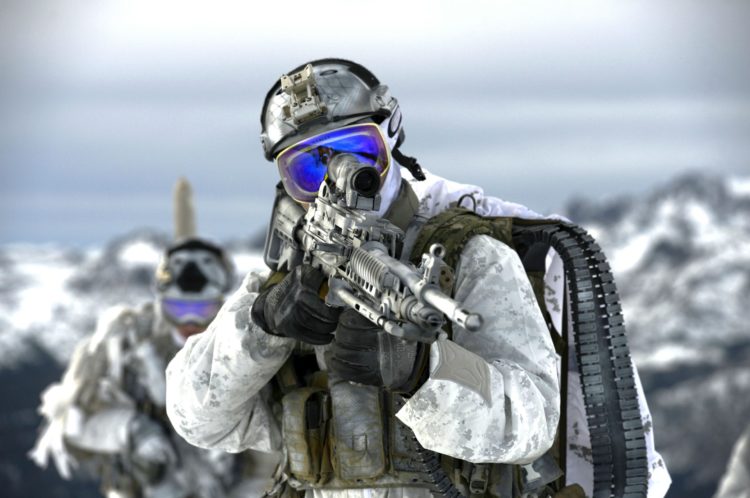
But even Navy SEALs like to have a good time, and Fru is quick to point out that, while exhaustion and stress are par for the course, it’s still probably one of the coolest jobs on the planet.
“Most people are aware of the camaraderie, the high-speed equipment/gear, the missions/operations, and all of that. They may not be aware that SEALs get paid to work out every single day, to dive and parachute, and to generally do fun stuff as part of the job. There are some sucky parts too, but for the most part, SEALs are paid to do stuff they love to do.”
Eventually, Fru left the SEALs to go to work for the CIA. While these two jobs may complement one another, being a SEAL didn’t guarantee him a spot in America’s most secretive intelligence service. Just like earning his SEAL Trident, Frumentarius had to start from scratch and prove he could hang in the very different world (and culture) that is The Agency. As Fru is the first to tell you, even SEALs can’t rest on their laurels.
“I had an academic background in international affairs that made it an appealing move for me. After getting to the Agency, I then tried to remember that I was in a different culture than the SEALs.
Some things I brought over with me, in terms of attitude and drive, but other things I had to leave behind (most of the ‘military’ culture). I ultimately made the transition successfully by working as hard as I could to be an effective CIA officer, knowing that my time in the SEALs was not something I could rest on. I had to earn my way at the CIA like everyone else.”
I asked Fru what his best tips are for current service members that want to pursue a career in an elite intelligence outfit like the CIA.
“Get a degree in a foreign language, economics, chem/bio/nuke, or international affairs/politics. If you can be proficient in a hard language (Chinese, Russian, Arabic, etc), even better.”
Just like being in the SEALs, working for the CIA has its benefits. For Fru, some of the coolest parts of serving in that capacity was getting to see the big picture, and playing a role in how it unfolded. Even so, a job with unique benefits also comes with unique challenges.
“CIA officers have to be choosy in their chosen targets of collection because CIA officers are supposed to acquire intelligence unobtainable through all other means. That’s the real challenge.”
Fru has since left the CIA behind as well, opting to switch to a different sort of service life that allows him to maintain a more regular lifestyle: that of a professional firefighter. Just like his previous gigs, saving lives and putting out fires can be extremely physically taxing. So I wanted to know how Fru had managed to stay so fit, active, and injury-free throughout all of his various roles.
“A commitment to self-care — physically, mentally, emotionally, health-wise — is paramount. You have to commit to eating somewhat healthy, taking care of your body through aerobic exercise, weight training, and stretching, and taking care of your emotional/psychological needs. That means finding something healthy that works as an outlet for you (shooting, slinging weights, running, reading, playing guitar, painting, whatever). You have to keep yourself on an even keel as best as you can because all of those jobs have immense stresses. They’ll occasionally overwhelm you, and you have to just reset yourself and continue to carry on.”








COMMENTS