

In terms of pure speed and thrust-to-weight ratio, there are some interesting observations to be made, as the J-20 is reported to be faster than the F-35, yet not as fast as the F-22 Raptor. The J-20 is listed as being able to operate at a max speed of Mach 2.0 and the J-31 is slated with speeds up to Mach 1.8. Speed for both the J-20 and J-31 are less than the F-22s Mach 2.25 speed, yet faster than the F-35s speed at Mach 1.6. The F-22 also has the most advanced thrust to weight ratio in the world, and is therefore able to maneuver, vector and out-run enemy air-to-air and air-to-ground missiles in ways that are likely to be unrivaled.
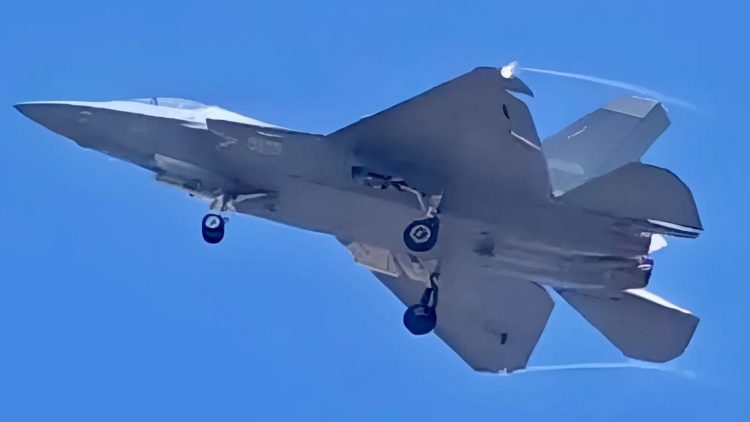
The structure also includes the kind of conformal, blended wing-body shape of many fifth-generation fighters, complete with rounded back end exhaust emissions. The F-35 and F-22, by contrast, have singular gradually sloped-horizontal wings. A shorter protruding, yet aligned or sloped wing, followed by longer wings, might represent an attempt to improve stealth performance. A dual-wing formation could, it seems, interrupt the speed of the aerodynamic airflow on each side, potentially better managing temperature.
J-35 vs F-35
There are not many specs or available information about China’s recently unveiled J-35 5th-gen stealth fighter, but the emergence of the aircraft’s photo does seem to offer some relevant information about its external configuration, and comments in the Chinese government-backed Global Times newspaper suggest the J-35 operates with a US F-35-like long-range sensing and targeting capacity.
The emerging J-35, and its J-31 ocean-launched prototype predecessor, do look quite similar to the US F-35, something a Chinese-government-backed newspaper specifically mentions. However, while the angles and contours of front parts of the fuselage, blended wing-body and inlets are arguably difficult to distinguish from a US F-35A, the Chinese J-35A has two engines, making it seem like more of a hybrid blend between the single engine US F-35 and dual engine F-22. The J-35’s external configuration does have an F-22-like front end as well, something not at all surprising given the longstanding discussion and documentation that the J-31 is a clear F-22 and F-35 copycat or “rip-off.”
Public press reports and even Congressional assessments (The US-China Economic and Security Review) suggest that indeed the PRC appears to have “stolen” some F-35 specs and designs.
Certainly the J-35 and its J-31 carrier-launched predecessor do appear to have stealth properties such as the absence or protruding external structures likely to generate a return rendering to radar systems. The smooth fuselage devoid of sharp angles are yet another indication of stealth. At the same time, the successful execution of operational stealth involves and intricate blend of a variety of factors less visible to the human eye, such as the presence of radar absorbing materials and the potential use of composite materials. Also, a photograph of the J-35 does not reveal the extent of its thermal management properties and ability to regulate the aircraft’s heat signature.
However apart from some observable stealth features of the J-35, the largest questions related to its relative ability to compete with a US F-35 pertain to other key variables such as computing, sensing, targeting and weapons. Aside from the singular question of stealth, the margin of difference between the J-35 and US-F-35 likely relates to sensing range, targeting and drone-like surveillance capacity. The F-35, while of course stealthy, is heralded for its ability to see, target and destroy enemy aircraft from standoff ranges where it is not itself detected.
Several years ago during a US Air Force Red Flag wargame and combat exercise, the US F-35 was able to see and destroy a group of 4th-generation aircraft at ranges where it remained undetected. This question of sensor range and image fidelity is a distinguishing element of the F-35, attributes made possible by advanced computing, sensing, targeting and weapons reach and precision.
Given these factors, the most significant characteristics of the J-35 published in the Global Times report relate to comments that the aircraft operates with a “first-detection,” “first-strike” capability enabling the jet to destroy enemies while remaining outside the detection range.
“The J-35A has significant advantages in terms of first detection, first strike, and securing operational advantages, Wang said. He elaborated that in combat against previous generations of aircraft, the J-35A can remain outside the effective detection range of the enemy, achieving one-way transparency of the battlefield situation and possessing overwhelming advantages that disrupt traditional air combat patterns,” the Global Times states.
The paper goes on to say that the J-35A can even achieve stand-off sensing overmatch against aircraft of its “same generation,” suggesting it is designed to rival the F-35 in targeting and long-range attack capability. Could this mean that the J-35 is engineered with sensing and targeting equivalent or superior to the US F-35s Distributed Aperture System and Electro-Optical Targeting System? The Chinese paper seems to suggest the J-35 has this kind of ability.
“In engagements with aircraft of the same generation, it can leverage its strong lethality and survivability, along with advanced coordinated tactics within formations, to obtain accurate situational information and establish a rapid and stable closed-loop kill chain against the enemy, thereby seizing the initiative,” the paper says.
This is arguably the most significant element of the Chinese essay on its J-35A, as it raises the question as to whether it has an F-35-like ability to leverage long-range precision sensing and attack from standoff ranges. There may be little to no way to verify this claim, however should the J-35 operate with sensing, computing and targeting comparable or superior to the US F-35, that will likely be cause for concern at the Pentagon.








COMMENTS