



I know a good analyst five to ten minutes after talking to any random person. I gravitate toward them. From my own experience you’ll be lucky if you get a good one. Very lucky. Try getting one out of my kung-fu grip. You need many of these cells augmented by a long tail of software and…
Value Added Small Analytic Cells: Coders
You need coders. Computer scientists. NOT IT dudes. Those are J6 guys. (Love the help desk dudes! (Had to say that to keep my shiznit running.) Uber-nerds supporting nerds. Guys and gals who prefer hexadecimal and binary 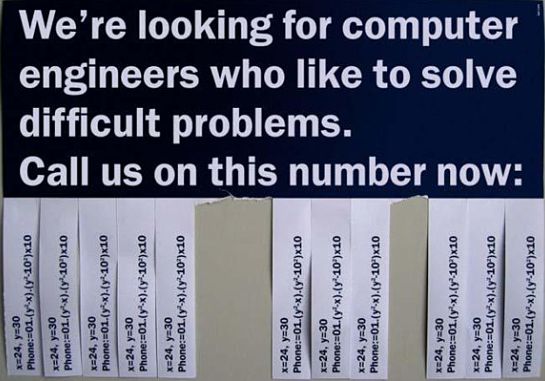 over the spoken word.
They are part of the cell of the analysts. Two to four coders per analytic cell. They bring the necessary computational expertise to the cell. They can code pre-processors. They can code scripts and API’s to force open source software to work with each other. They can disassemble a CPU at the logical and physical level. In addition to their expertise in this area, their insights into analysis from a computational standpoint have greatly benefited work in the past.
In particular, from a workflow management perspective; because coders… Uhh… are inherently lazy. Smart…but lazy. Put another way, any coder worth a damn will find the simplest and potentially most elegant way to write a code block because it will save time in the end.
Fourteen-Armed Starfish

To finalize this, you now have a fourteen-armed starfish. You need hundreds of these. Maybe thousands. Some of these starfish are working in groups. Some are working individually to support a specific unit. No JIC’s. If you get a VIP or DV in, you corral the cells into a briefing area and have them brief their stuff. The key to this is the “long tail” (Anderson 2006). You need industrial strength software. You need Pacific Northwest National Labs IN-SPIRE, FuturePoint’s Starlight, Semantica Pro, Palantir, Rapid Miner, Tableau, and Google Refine.
Some of these are actually free. IN-SPIRE is generally free to government customers. Rapid Miner is free. Google Refine is free. In fact, you can make the entire tail (if needed)…free. Gephi and or NodeXL are free social network analysis programs. Ontotext is an awesome semantic relationship engine.
Why spend thousands of dollars on Palantir when Gephi will do? I have no idea. The key is to let your analysts and coders decide. You have to trust and respect them to make the best decisions (in this aspect) for you. A good analyst will not seek every program under the sun to do the work you need done. They will seek the cost/benefit, maximizing utility and minimizing cost. That’s their part of their job anyway.
Sooo…Empty Chessboards
“Fixing” implies that something is broken. There is no fixing intel. Our intelligence community is focused almost exclusively on terrorism. Fail. To paraphrase Kanye West, imma let you finish an all…but empty chessboards is what needs to happen. We need to push the pieces off and start with a fresh game constructed around a 2013 reality. Not 1945 reality.
John Robb is probably the most prescient voice in our community. I can’t recommend his blog or book enough. Right now…Charlie or Tango is envisioning a UAV bot-net that supplies on-demand DDOS of a specific topographic area. It’s fucking cheap, and its real.
On the other end of the spectrum, in an interesting bit of irony, the PRC is attacking the US using US economics. Supply and demand is the weapon. This can be done if you have a command economy to fight a free market, particularly if you mobilize an entire nation toward the effort of attaining R&D at any cost. The PRC is undermining us at the one thing the US better than anyone else in: Joint operations. Kill joint C4, and you kill the your enemy’s greatest strength. How do you kill it? Steal the secrets to command and control. Networks. Military networks.
That war is being waged right now in a virtual environment and starts with a “sync ack” packet. Companies don’t want to tell the public this. The government doesn’t want to tell the public this. Remember that your economy is based on “fiat” or, loosely paraphrased, “a proposition.” The stability of our economy and government give value to our markets. If you are losing 40% of your R&D investment to another nation-state due to larceny, I’d say you need to start worrying. They like to refer to this entire process as the “Shashou Jian” strategy. Oh yeah…that’s right..they are telling you how they plan on ripping you off. All the way back in 1991.
Succinctly put, we have a national system to manage, identify, and reciprocate against violent extremist organizations and terrorism. Your chance of dying by a terrorist related event is less than being attacked by a shark. Yet there is a 50% chance that a 9/11 style event will occur again within the decade.
Given those figures you might assume our community is looking ahead. You would assume incorrectly. The intelligence community is not looking at the analytic future anymore. We are looking at the past and the present. Afghanistan and maybe some Africa. So much for a strategic pivot.
More importantly, every day more human behavior is added under the auspices of national security and intelligence. Anthropology, nuclear science, epidemiology, machining, engineering, computer science, etc…etc. Note, I said ‘human behavior.’ Intelligence isn’t and shouldn’t be “human intent guessers.”
That said…there is nothing that humans do, that is not their behavior. War? Human behavior. Drugs? Human behavior. Theft? Human behavior. Etc..etc..
From a positivist standpoint, observable and repeatable matters. As an analyst, I got news for you. I can’t process that aforementioned cognitive load. I need computers like bats need echolocation. I need Linux and Windows boxes and about fifteen computer screens. I also need decision makers to make some decisions.
Actions officers…take some action.
I’m an analyst…I will give you COA’s (courses of action). You gotta trust me to die/sleep at my desk/spend days without sleep/shit in a desk drawer/do anything to get you the best possible picture of your battlefield (which is the globe BTW), but for goodness sake…
Make. A. Decision.
Even if its not a COA. General officers…make strategy. Not “Operation Ivegotabigwang.” That’s not strategy. “Strategery” usually looks something like a joint campaign plan…only better. Do like the Chinese, and copy theirs! Rumor has it operational art is dead and so is strategy. Bad time time to die. We need it. Badly. Check out how the combined chiefs of staff used to manage their commanders. One page. Yet they had a strategy.
Deep Blue versus Garry Kasparov
From a fresh board, start with your knight…not your pawn. This means understanding the laws of thermodynamics and closed systems. Based on the second law of thermodynamics, closed systems will increase to maximal entropy.
In data and computational theory, entropy is defined as “a measure of the loss of information in a transmitted signal or message.” (Lexico Publishing, LLC, 2013) Our system of classification as overseen by CAPCO (Controlled Access Program Coordination Office) does not function effectively and is outdated. It is a closed system.
Today’s analyst is confined in a T-SCIF (Tactical-Secure Compartmented Information Facility) or SCIF. Information is fed to the analyst over government circuits. The circuits are classified. The analyst will occasionally have an unclassified circuit controlled by the USG.
Fail.
Use the starfish network. Start with a misattribution system, force analysts to start on the unrestricted internet, and then move up the chain of circuits from SECRET to TOP SECRET. Use sites like Data.gov, media, social media, open source data repositories. These are your first weapons of choice.
Then, when you run out of valid data…hack. Hack, hack, hack, hack, hax0r, hax0ring. Just do it. Do it now. Back Orifice, E-Bomb, DDoS, bot-nets, malwarez, warez, keygens, brute force, overclock CPU’s and shutdown the fan via killer poke.
If you can’t get it, shut it down.
Use the internet to scrape all your open source data and consider hax0ring as NTM (national technical means). Then when the scrape cycle has completed once, push it up. Push it up the classification ladder and cross-cue the data using the aforementioned tools with national technical means.
Think of the internet as the ocean, then the next level as your first catch, and then the last level the best of the catch. Then push it down. Take that and refine the scrape cycle. Use analytic methodologies.
Afterthoughts

Consider eliminating the classification system and using obfuscation on the low side. Create 50 different variations of the same message broadcast and then re-broadcast. Tell your receiver the correct variant. 20 ICBMs? Or five?
How can your enemy tell the difference? Which message is “real”? Use the media to hype up different variations of the right message. Yes, I mean actual traffic derived from different sources. Tell the NYT we have 20. Tell the Post we have eight. If you have 52 cards and all of them are aces with each containing a minor change, which ace is the true ace? How long would it take you to tell?
As it stands it may not be any different from the leak-ridden culture of one million cleared personnel you have now. Use the massive information barrage to your advantage and beat your enemy’s OODA loop. Open source warfare is not for the timid, and its encroaching on an entropic system that is archaic. Information always seeks to be free. More rebuttal to come?
End of Line.
Bibliography
- Anderson, Chris. 2006. The Long Tail?: Why the future of Business is Selling Less of More. New York: Hyperion.
- Flynn, Michael T. 2010. Fixing Intel: A Blueprint for Making Intelligence Relevant in Afghanistan. Voices From the Field. Center for a New American Security.
- Gladwell, Malcolm. 2008. Outliers: The Story of Success. New York: Little, Brown and Co.
- Lexico Publishing, LLC. 2013. “Entropy.” Dictionary.com. Accessed January 22.
- Zhongwen, Huo, and Wang Zongxiao. “Sources and Techniques of Obtaining National Defense Science and Technology Intelligence.” Kexue Jishu Wenxuan Publishing Co, 1991.
Some images courtesy of
- Joint Warfighting Center, and Joint Concept Development and Experimentation Directorate. 2006. Commander’s Handbook for an Effects-Based Approach to Joint Operations. Handbook. Suffolk, Virginia: Joint Forces Command.
This article previously published on SOFREP 01.25.13








COMMENTS