

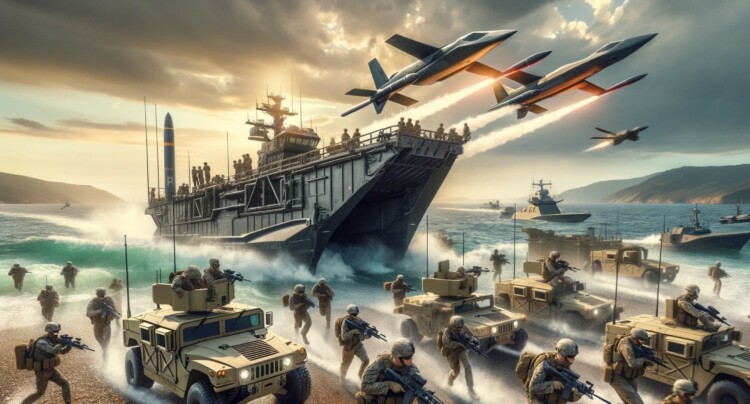
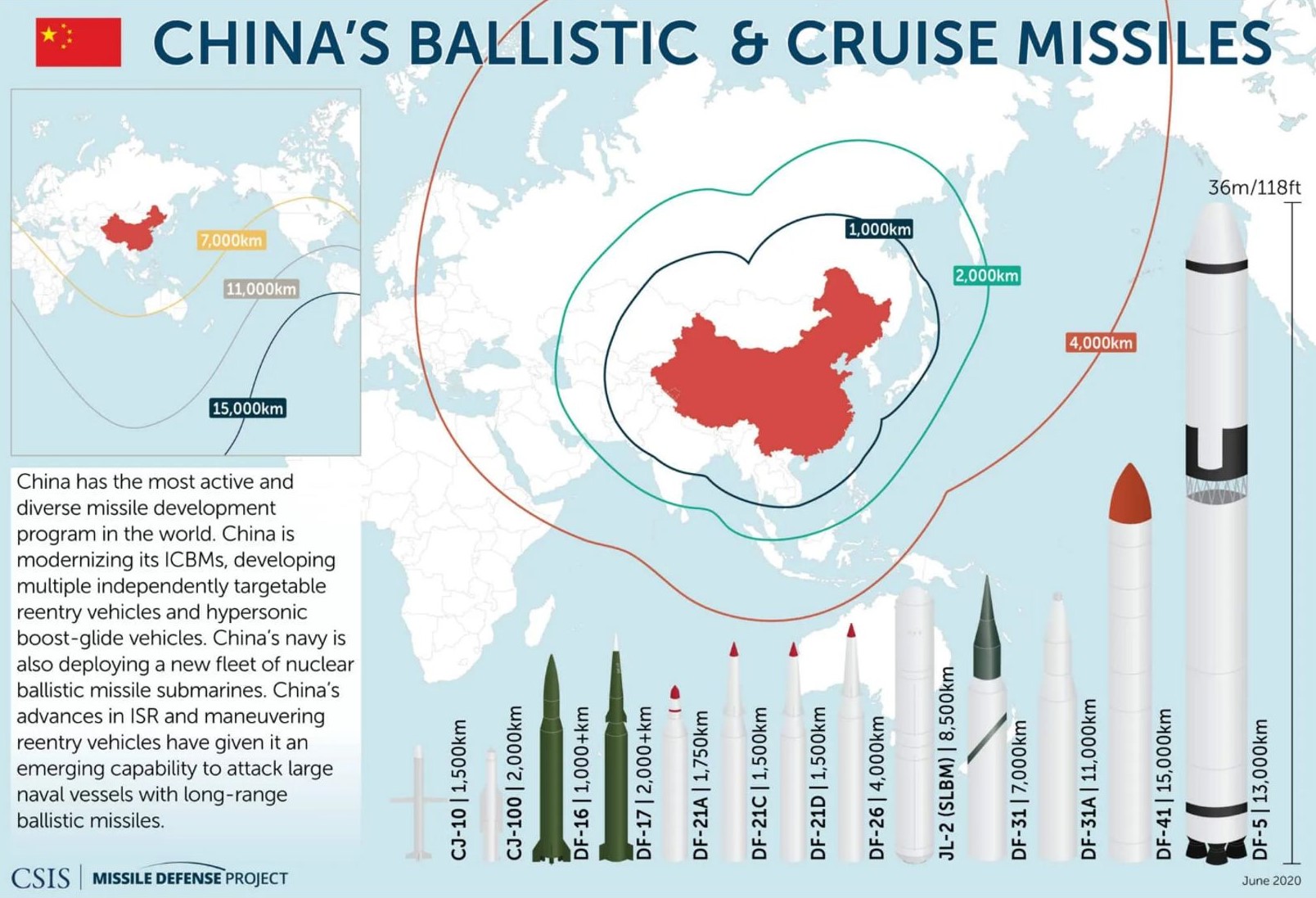
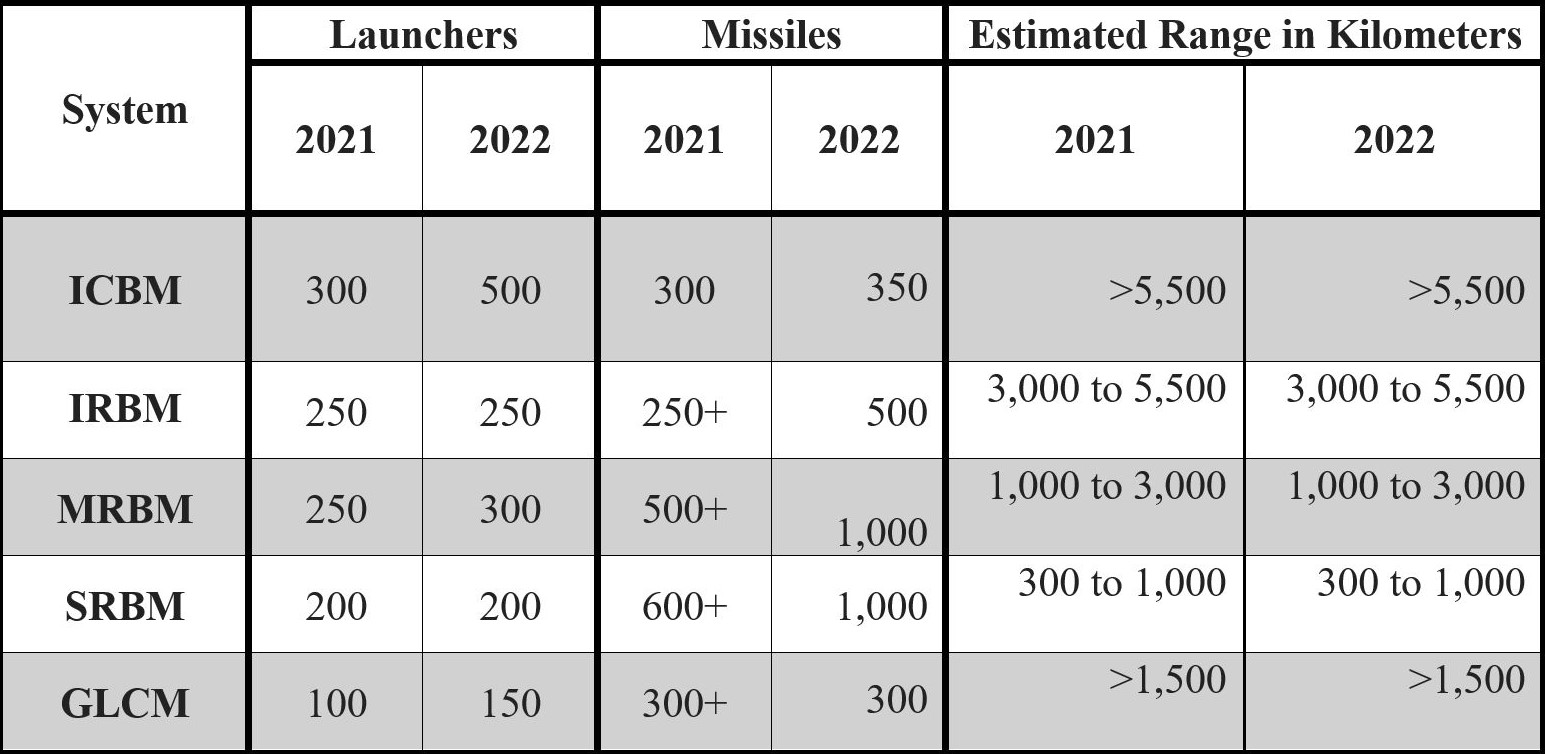
To answer the challenge of supplying EABs, supply bases will be dispersed and prepositioned in areas such as North Australia, the Philippines, and Japan. To present a more difficult target for the Chinese rocket forces, larger support, and amphibious vessels will operate to the west of Japan, the western segment of the Philippine Sea, and bodies of water between Indonesia and Australia. In addition to their typical operations, amphibious vessels (such as amphibious assault ships, helicopter assault ships and expeditionary sea bases), will additionally serve as nodes for logistics operations to forward-deployed EABs.
Moving Marines and Supplies Forward
From the prepositioned supply points on land and larger amphibious and support vessels somewhat distantly afloat, smaller, harder-to-target craft will shuttle Marines and their supplies to sites for use as an EAB. The primary vessel the Marines will use is still in the conceptual phase, but it is called the Landing Ship Medium (LSM). The Navy plans to purchase 18 to 35 LSMs to facilitate its EAB plan. The LSM will be capable of “carrying at least 75 Marines, hauling 600 tons of equipment, and having an 8,000 square foot cargo area…” (Lagrone, 2023).
Larger than the LSM is the Spearhead Class Expeditionary Fast Transport (EPF). This vessel is an aluminum-hulled catamaran, and there are currently 14 in service with the Navy. The EPF is 337 feet long, it can embark 321 Marines plus a crew of up to 40 sailors. Additionally, it has a 1,200 nautical-mile range, a maximum speed of 43 knots, and a cargo capacity of 700 tons (Locker, 2021). Adding to its great utility, the EPF is equipped with an aft helicopter and folding ramp, allowing it to disembark not only its Marines, but also wheeled vehicles to include M1 Abrams tanks. Clearly, this vessel would be ideal for quickly picking up and redeploying a fire’s EAB.
The Utility and Necessity of Supply Drones
When the EPFs and the LSMs are not shuttling Marines and their equipment to new base sites, they can be used as mobile platforms to launch and recover logistics drones. Drones used for resupply have been experimented with for years, and would provide an affordable and easily replaceable method for delivering needed supplies to dispersed groups of Marines.
The utility of drone resupply was made evident in Afghanistan when the Army used two Kaman Corporation, K-MAX unmanned helicopters to resupply remotely located firebases. In 2012, incredibly, the K-MAX, which can carry 4,300 pounds per mission, delivered 750,000 pounds of supplies over the course of 230 missions (Hambling, 2021).
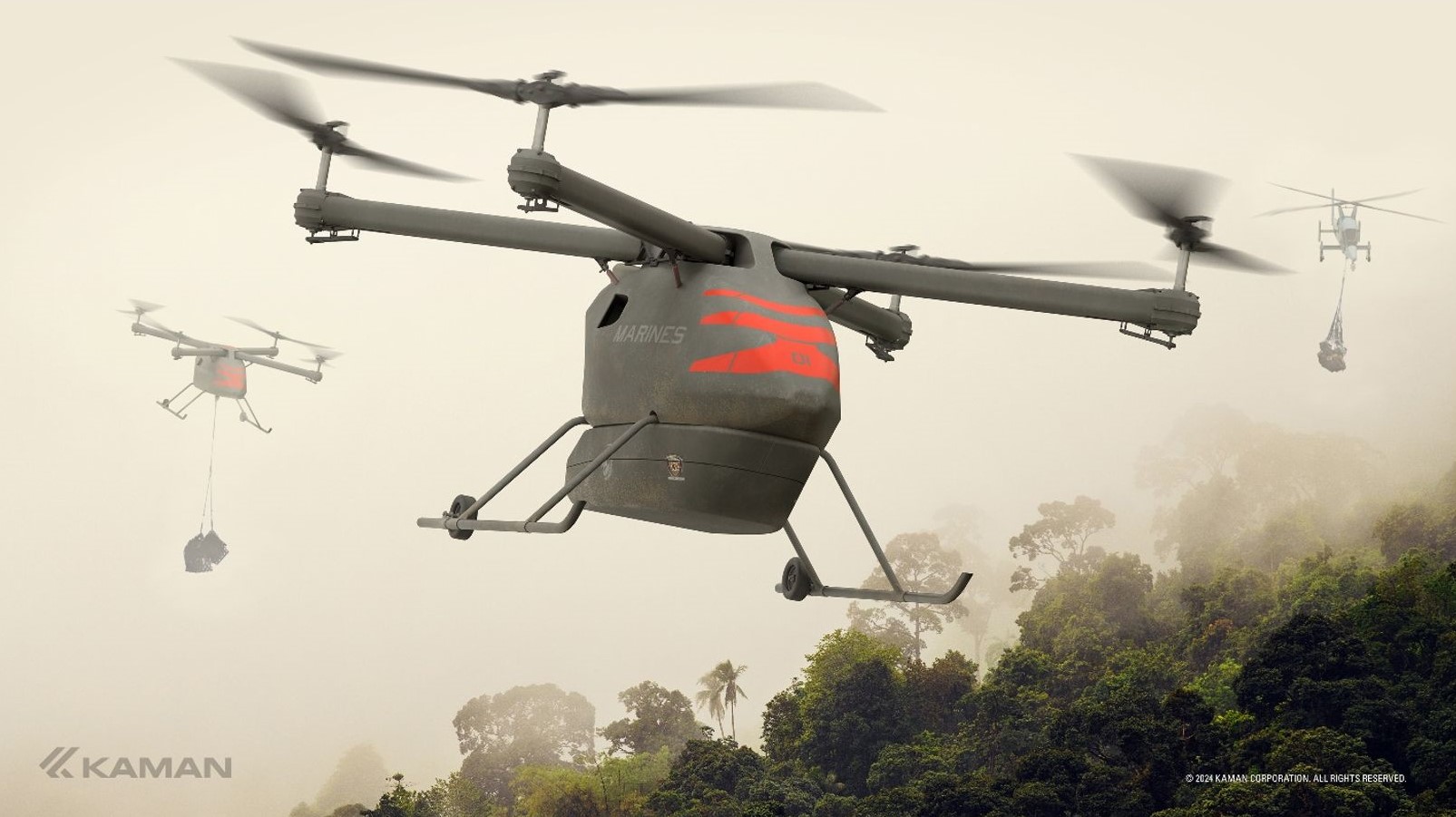
Presently Kaman Corporation has developed its “Kargo UAV,” a quadcopter, designed for expeditionary logistics. The Kargo UAV weighs 1,340 pounds, it has a range of 500 nautical miles and it can carry 800 pounds of supplies at a maximum speed of 121 knots (Kaman Corporation, 2021). The Kargo UAV can be launched from all of the U.S. Navy’s major amphibious vessels, including the EPF and the LSM (once in service). This means that, in addition to having a dedicated fleet for unit mobility, the Marines will also have a mobile fleet of logistics drones, capable of delivering needed supplies to their dispersed EABs.
Conclusion
If a hot war broke out between the U.S. and China, America’s military would have a challenge the likes of which has not been seen since World War II. Given that China has such an extensive array of rockets and missiles, the Marines and any Army unit operating against them would be forced to maintain a high degree of mobility with company-sized elements. This smaller footprint, combined with aggressive, electronic warfare and kinetic strikes on Chinese ISR networks and military infrastructure, would degrade Chinese surveillance and targeting operations of forward-deployed Marines.
To maintain dispersed supply points, the use of drones and light naval vessels to supply forward-deployed Marines will be crucial. Dispersed supply points will reduce the likeliness that they will be targeted and hit. The use of drones and light craft for forward resupply will ensure the continual flow of vital weapons and equipment to dispersed EABs. Drones such as the Kaman UAV will prove particularly useful because they are fast and can land in difficult-to-reach locations. A final point worth mentioning with resupply drones, is that they are inexpensive and easier to replace when compared to a USMC CH-53 Sea Stallion. Additionally, if a resupply drone is lost, it will not cost the life of a pilot and crew.
While more work needs to be done (and fast), the Marines are on the right track with their strategy for confronting China. Any conflict with China will be multifaceted, fast paced and great emphasis will be placed on light, lethal, highly mobile units, paired with a dispersed and fast-paced supply chain. The time and innovation needed to engineer the Marine Littoral Regiments was well spent and they are needed now, less we witness the march of authoritarianism unabated.
References
Feickert, A. (2024). The U.S. Marine Corps Marine Littoral Regiment (MLR) (CRS Report IF12200). Congressional Research Office.https://sgp.fas.org/crs/weapons/IF12200.pdf
Hambling, D. (2021, March 16). U.S. Army pushes ahead with battlefield resupply drones. Forbes. https://www.forbes.com/sites/davidhambling/2021/03/16/us-army-pushes-ahead- with-battlefield-resupply-drones/?sh=4c353a986b94
Kaman Corporation (2021). Kargo UAV: The new standard for expeditionary logistics [Infographic]. Kaman Corporation. https://s3.amazonaws.com/static.militarytimes.com/assets/pdfs/1632155673.pdf
Katzman, D. (2021). Evaluating the logistical supportability of Expeditionary Advanced Base Operations [Unpublished manuscript]. Naval War College. https://apps.dtic.mil/sti/pdfs/AD1144374.pdf
Lagrone, S. (2023, October 16). Draft proposal for ‘affordable’ medium landing ship out to shipbuilders. USNI News.https://news.usni.org/2023/10/16/draft-proposal-for-affordable- medium-landing-ship-out-to-shipbuilders
Locker, R. (2021, June). Expeditionary fast transport ship: A light amphibious warship stand-in capability. Marine Corps Gazette WE 24-WE 25. https://www.mca-marines.org/wp-content/uploads/Expeditionary-Fast-Transport-Ship.pdf
Panella, C. (2024, May 4). China has a lot more missiles with US warships and bases in its sights. Business Insider. https://www.businessinsider.com/us-military-china-missile- problem-getting-worse-2024-5
Author’s Bio
Christian P. Martin is a Michigan-based military researcher and writer. He earned his Master’s degree in Defense and Strategic Studies from the University of Texas at El Paso. His professional interests are history, land, and naval warfare, both conventional and unconventional, with a focus on the developing world and an emergent China.








COMMENTS