

Joe Kent and the Case for Consistency
Against that backdrop, Kent’s position reflects one side of that tension. His record carries the weight of experience. He enlisted in the 75th Ranger Regiment, deployed repeatedly, and completed Special Forces selection to earn his Green Beret. From there, he served as a Chief Warrant Officer before moving into CIA paramilitary work, returning to the same theaters he had already fought in uniform. Over time, the better part of his adult life unfolded inside the machinery of American war.
In parallel, his wife was killed in Syria in 2019 while fighting ISIS. It does not resolve the question. It gives his position a cost most will never bear.
Given that experience, when he argues against entering another war without a defined end state, the argument carries weight. It reflects direct exposure to what war demands and what it leaves behind.
He then carries that experience into action. A framework that rejects open-ended conflict without clear objectives leads, in this case, to resignation. As a result, the logic holds from premise to outcome.
Increasingly, that degree of alignment between belief and action grows rare.
At the same time, his departure raises a separate question about leadership. Kent did not arrive in that position by accident; Donald Trump appointed him. Yet after the resignation, Trump dismissed him as “weak on security.” The criticism arrives after the fact, while the appointment came first.
In sequence, that distinction matters. Appointments reflect priorities. Subsequent reversals expose something else: a pattern of revising judgment once outcomes shift. Over time, that pattern erodes confidence in the decision-making process. More broadly, it points to leadership that reacts to events rather than anticipating them, absorbing contradictions rather than resolving them.
Within a system already under strain, that style introduces its own instability.
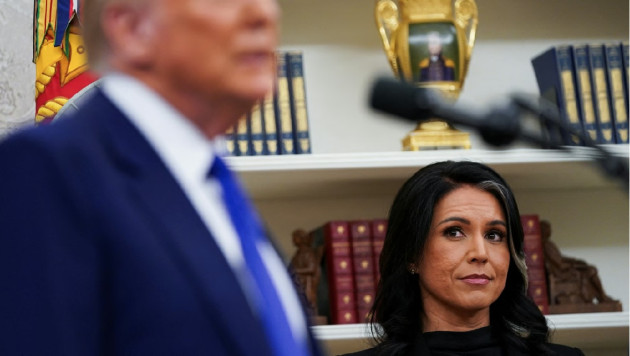
Tulsi Gabbard and the Collapse of Restraint
Within that same environment, Tulsi Gabbard served in the Hawaii Army National Guard and deployed to Iraq, where she worked with a medical unit in Baghdad and earned the Combat Medical Badge. She volunteered during a time of war and saw its costs up close. That experience shaped her political identity, even if the trajectory that followed raises questions.
From the outset, she built that identity on opposition to intervention, arguing that regime-change wars destabilize regions and empower extremist movements. During her 2020 presidential campaign, she pledged to end what she called “wasteful regime-change wars.” In addition, she warned that a conflict with Iran would make Iraq and Afghanistan “look like a picnic.”
At the time, the position was clearly defined and repeatedly stated. It outlined a view of American power grounded in restraint, skepticism toward intervention, and awareness of long-term consequences.
Over time, however, her positions shifted. On Ukraine, she advanced arguments that placed primary responsibility on NATO expansion and U.S. policy, echoing narratives that downplayed Russian agency. She presented that shift as a continuation of her anti-intervention stance, yet the application remained selective.
Now, as the United States moves toward sustained conflict with Iran, the clarity of that earlier position fades. The warnings remain unrevised; instead, they have receded from view.
Over time, a standard applied unevenly loses coherence. A framework that holds in one theater yet dissolves in another cannot guide policy. It becomes situational.
Under those conditions, the pattern stands out. What once read as restraint now aligns with circumstance.
“America First” and the Problem of Definition
From there, a more fundamental question emerges: what does “America First” mean in practice?
The current conflict does not arise from an attack on the United States. Rather, it follows a decision. Policymakers entered it under known conditions. The operation aligns with Israeli objectives, intersects with Saudi interests, and advances certain goals while complicating others.
Consequently, no immediate payoff is visible; a clear timeline is absent, and any defined end state remains difficult to articulate with confidence.
At the same time, economic consequences already register. Regional instability constrains markets. Energy prices rise. Supply chains tighten. Inflation, once central to political messaging, now sits directly in the path of escalation.
I remember sitting in the trenches of eastern Ukraine while American conservative voices argued that supporting Kyiv would drive inflation at home, that higher prices imposed an unacceptable burden. At the time, they framed the argument as restraint. They framed it as prudence.
Now, those voices have largely fallen silent. Laura Loomer among them.
Taken together, the contradiction requires no embellishment. A movement that resisted economic pressure tied to one war now accepts it in another.
If Ukraine is “winning”, can you please tell their criminal president to stop stealing our tax money?
Let them fend for themselves. I want our $120 BILLION back.
Lots of starving American kids. Lots of homeless US veterans. Record high inflation.
I don’t care about Ukraine. https://t.co/smcRbuxqtB
— Laura Loomer (@LauraLoomer) January 21, 2023
No End State, No Coherence
Beyond that, the deeper problem lies in the absence of a stable framework guiding these decisions. The United States enters conflicts regularly; however, clarity around purpose and timing has weakened.
Previously, even contested wars still carried a defined structure. Leaders stated thresholds. They outlined objectives. They connected action to intended outcomes. Over time, that structure has thinned. Decisions now follow circumstance, alignment, and short-term pressure more than consistent strategic logic.
As a result, inconsistency appears across theaters. Risks dominate one debate and fade in another. Concerns over escalation, cost, and duration rise and fall without a governing standard. Over time, that pattern accumulates. Coherence weakens.
In practical terms, a war with Iran will not resolve quickly. The state absorbs pressure and redirects it through proxies. Military action degrades capabilities while reinforcing internal narratives that sustain the regime. Each move produces follow-on effects that shape the next.
Without a defined end state, momentum builds. Events drive decisions; escalation finds its rhythm, and objectives lose precision as commitments deepen.
Eventually, direction grows harder to separate from reaction. The United States commits resources. It places lives at risk. The endpoint remains undefined.
Conclusion: What This Reveals
At this stage, the argument has moved beyond necessity. That ground has already been covered.
Instead, the central question concerns definition: when does the United States choose to fight, and for what purpose?
At present, clarity remains absent. Decision-makers may rely on information outside public view. Even so, outcomes will be judged on what those decisions produce.
Support for those in uniform carries weight. Accordingly, decisions that send them into combat carry responsibility. When those decisions lack coherence, the burden shifts downward.
Over time, a foreign policy built on shifting principles cannot endure. Alignment changes. Pressure builds. Without a stable framework, each decision grows harder to justify than the last.
War does not change. However, the standards used to justify it do. When those standards erode, consequences move quickly from theory to reality.








COMMENTS