

On November 27, Mohsen Fakhrizadeh, the scientist who founded Iran’s military nuclear program in the early 2000s, was assassinated on a busy highway. A truck bomb exploded in front of his vehicle, stopping traffic. Then gunmen came out of a vehicle with machine guns and riddled his car killing him.
At his funeral, however, the Iranians changed their story and now claim that Fakhrizadeh’s killing was done remotely. Iranian state TV’s Arabic-language channel, Al-Alam, claimed the weapons used were “controlled by satellite,” a claim also made on Sunday by the semiofficial Fars news agency. This gives the Iranian authorities a way to explain why no one was reportedly arrested at the scene. Yet, no evidence was produced in support of these claims.
The English-language Press TV reported on Monday that a weapon recovered from the scene of the attack bore “the logo and specifications of the Israeli military industry.”
Al-Alam interviewed a witness the night of the attack who described seeing gunmen open fire at Fakhrizadeh’s vehicle.
Ali Shamkhani, Secretary of the Supreme National Security Council of Iran, said to state TV, “Unfortunately, the operation was a very complicated one and was carried out by [the use of] electronic devices.”
“We have some clues but surely the ‘Monafeghin’ group was involved and the criminal element behind it is the Zionist regime and Mossad,” he added, referring to Israel’s foreign intelligence service.
“Monafeghin” is how Iranian government officials refer to the Paris-based National Council of Resistance of Iran (NCRI), a bloc of opposition groups in exile that seeks an end to Shiite Muslim clerical rule.
The government also blamed the Iranian exile group Mujahedeen-e-Khalq (MEK) for “having a role in this,” again, without offering any evidence. The MEK has been suspected of assisting Israeli operations in Iran in the past. The MEK released a statement vehemently denying any involvement.
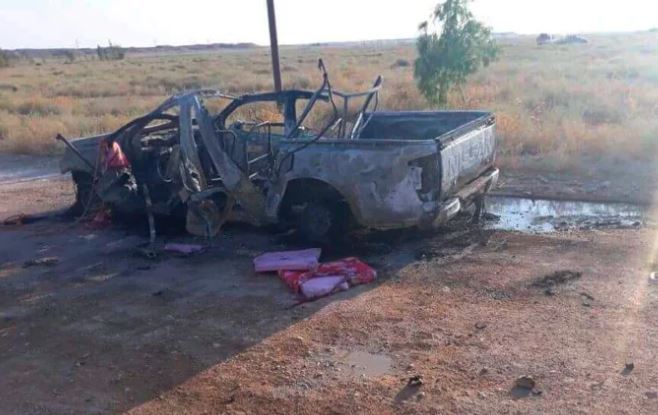
On Sunday, Muslim Shahdan, a senior commander of Iran’s Revolutionary Guards was killed with three other officers in a drone strike soon after crossing the border from Iraq into Syria. The men were believed to have been carrying weapons at the time of the drone strike.
Iranian-proxy militia members retrieved the bodies. Although Saudi-based Al-Arabiya News reported that the drone strike killed Muslim Shahdan, a senior commander in the Islamic Revolutionary Guards Corps, there has not been any independent confirmation as to the exact identification of the deceased officer. Iran has denied that Shahdan was killed in the drone strike.
Israel and the U.S. have long accused Iran and its proxy militias of attempting to smuggle weapons via Iraq to Syria and Lebanon to be used against Israel.
Just last night, Amir Toumaj, an independent researcher whose work has appeared in Long Wars Journal, reported that Habib Savari, an agent for the Intelligence Ministry was assassinated in his car.
https://twitter.com/AmirToumaj/status/1333573904196120576
Iranian opposition media, including the website Javanha, were the first to report this latest killing. The Iranians are vowing revenge at these latest assassinations, but are weighing their options given the change of administration in Washington in the next month.








COMMENTS