

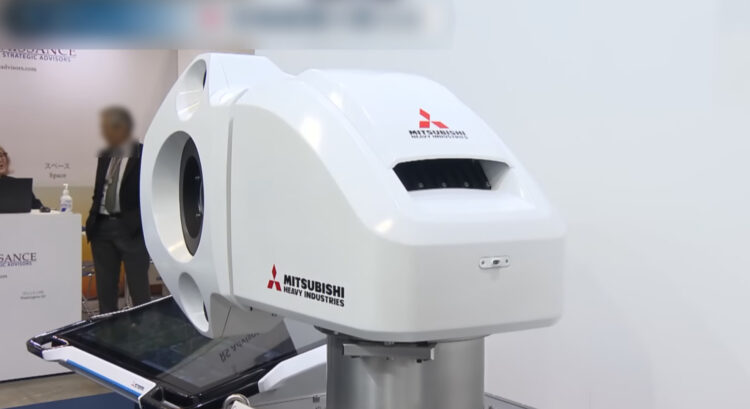

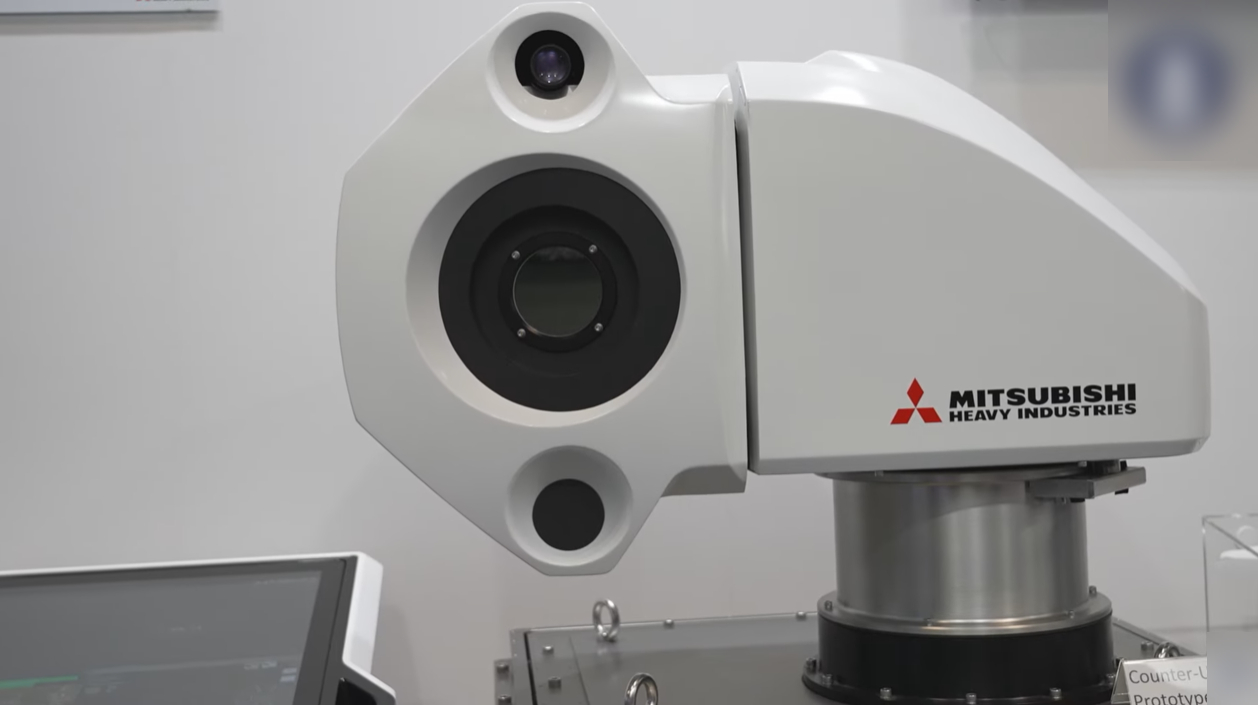
Unlike Mitsubishi’s design, Kawasaki’s prototype had to be mounted on a large trailer-type vehicle as the high voltage would require more power supply and cooling water circulating system.
The prototype displayed by the company, however, only bears a 2-kilowatt laser power.
According to its officials, this anti-drone laser system “can eliminate UAV targets up to a range of several hundred meters,” The Diplomat reported. Moreover, explaining that both of Kawasaki’s variants “use the same 1 micrometer (1/1,000,000 of a meter) band fiber laser.”
Basically capable of detecting hostile drones using an infrared camera and hunt-and-kill using a one-micrometer band fiber laser.
Kawasaki delivered a prototype of the powerful laser system to ATLA in February and is slated to undergo evaluation tests starting this month.
Anti-Drones Systems As Additional Air Defense
With sophisticated drones come equally complex anti-drone systems, and as the former continues to evolve, solutions to resist the latter have become more evident and in demand.
The United States, for one, has long recognized the evolving threat of lethal drones, thus, has been proactive in seeking a reliable and potent C-UAS system.
Raytheon Technologies recently developed a Mobile, Low, slow, small unmanned aircraft system Integrated Defeat System, or M-LIDS, for the US Army. It has been in constant testing and evaluation since its inception in the early 2020s and will soon be fielded not just here in the states but might also be deployed to allied regions enduring drone assaults from adversaries in the past decade, including Middle East partners.
The M-LIDS is a type of C-UAS that uses the Ku-band Radio Frequency Sensor and Raytheon’s Cayote family of effectors on top of an electronic warfare system. The Army has not disclosed much regarding the program other than its plans to convert the two-vehicle system into a single-ride configuration, with field tests taking place this year before it would consider importation.
Another C-UAS system developed was the High Energy Laser Weapon Systems (HELWS), also built by Raytheon. A laser system mounted on a military-grade dune buggy, Polaris MRZR.
Moreover, Raytheon had proven that the system could be paired with the National Advanced Surface-to-Air Missile System (NASAMS) in a field test conducted in March last year.
In a press release, the HELWS received automated target cueing and expanded access to a full spectrum of electro-optical/infrared sensors by integrating NASAMS Fire Distribution Center, increasing its capability to track, identify, and quickly take down drones at tactically relevant distances.
For further reading, check out the review military tech journalist Kelsey D. Atherton wrote last October when he personally fired the HELWS anti-drone laser himself in the high desert of New Mexico.








COMMENTS