
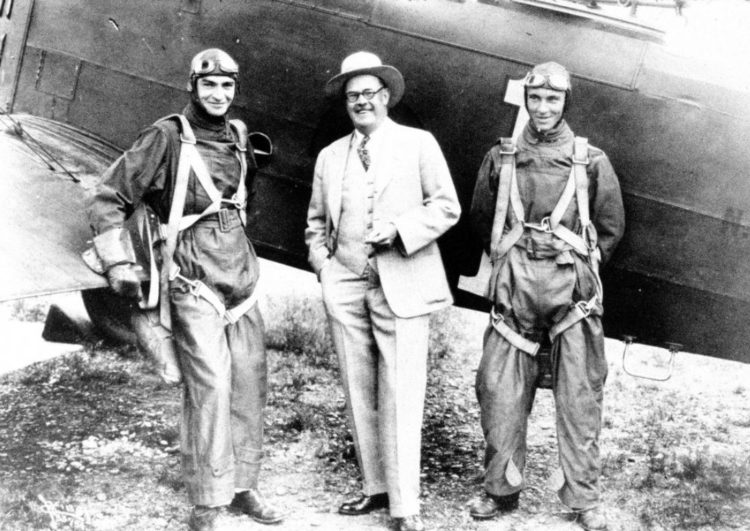
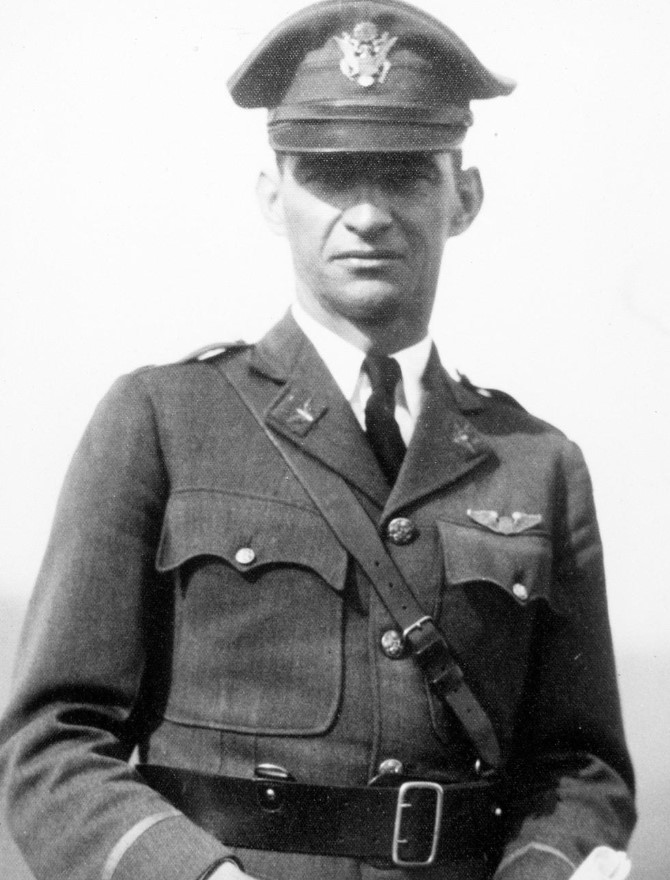
By March, the first airplanes were in Spokane. Fancher was informed that a shipment had arrived via the Northern Pacific Railroad – three crates contained three disassembled planes. Unfortunately, there were no funds, labor or machines provided to transport the crates to the airfield. Three enlisted members of the squadron sprang into action and borrowed two heavy planks from a lumber yard and a crowbar from the Northern Pacific. Using the planks as skids, they loaded the crates and hauled them via truck to the airfield one by one. Realizing that they were on their own to assemble the aircraft, they promptly set their mind to the task and soon three Curtiss 3N6-A2 “Jennys” were sitting on the new flight line.
Although farming and the National Guard kept him busy, Fancher’s civic engagement was relentless. He was active in the Chamber of Commerce and petitioned the state Legislature for more resources for his unit. He was the driving force behind Spokane’s Air Rodeo in1925 and 1926. He ran for Congress in 1926 and came up short against incumbent Congressman Sam B. Hill. Fancher set his sights on winning the National Air Races for Spokane in 1927.
Tragedy struck the 116th on May 29, 1927. Lieutenant Buell Felts was a member of the 116th, and in many ways was like Fancher himself. Felts served in WWI, was ambitious and well known in the community. He was also the owner and publisher of the Spokane Valley Herald. On May 29, Felts flew a training flight with a reporter as his guest passenger. As he approached the Parkwater Airfield at an altitude of 150 feet, he apparently attempted a turn without sufficient speed to sustain it. His plane dropped out of the sky killing Felts and his passenger on impact. The men of 116th were deeply shaken, and so was Fancher; Buell Felts was the unit’s first casualty. Fancher was a pall-bearer at Felt’s funeral and led the effort to have the Parkwater Municipal Airfield was renamed Felts Field. The name change was effective in September 1927 and endures today.
During the summer of 1927, Fancher flew to New York. His goal was to have the 1927 National Air Races hosted by Spokane and had arranged to meet with the National Air Derby Association. His negotiations were successful and enroute back to Spokane he made a stop in South Dakota at the home of President Calvin Coolidge.
A silk streamer bearing “Greetings to the President” and an invitation to the Air Derby was tossed from his plane as he flew over the summer White House. After an appropriate show of aerobatics, he landed and met with the President. Pictures of the two appeared in a number of newspapers. Fancher’s fame as an aviation pioneer blossomed. That autumn, Spokane sponsored the National Air Races. They consisted of two cross country races; the San Francisco – Spokane Derby and the New York – Spokane Derby. There were local races as well and contests of aerobatics and formation flying. The National Air Races were a resounding success. The economic impact and boost in reputation to Spokane were significant; Fancher was a mild celebrity and known by everyone from the president to Charles Lindbergh. 1928 looked just as promising year as 1927 had been.
On April 28, 1928, the town of Wenatchee was dedicating its new airfield during the annual Apple Blossom Festival. Fancher and his men were invited to perform. Fancher was eager to display the prowess of his unit, put on a good show and to support the cause of aviation. A week before the Wenatchee festival, Fancher flew from Spokane to Seattle to attend the funeral of his father-in-law. As he traveled over the Cascade Mountains which divide Washington State into east and west, he was confronted with a violent storm. In search of an opening in the clouds he climbed to 14,000 feet, but storm conditions worsened. With full motor running and the nose of his Douglas plane skyward, he plunged 5,000 feet almost instantly. He was on the brink of bailing out of the plane with his parachute more than once, but he persevered on. After two hours of being lost in fierce wind and rain, he spotted a hole in the clouds and made his way through.
Spring was in the air on Saturday, April 28 when the 116th commander and his men flew from Spokane to Wenatchee. They were excited to be flying together again, and excited for the show that night. Death was the farthest thing from anyone’s mind that morning, and no one could have guessed that Major John Fancher had less than 24 hours to live.
Fancher’s display would be a night-time demonstration of an aerial raid using celebration explosives as supporting pyrotechnics. He had done the same thing to good effect for Armistice Day celebrations and other community events. The weather that day was less than ideal for airplanes, and the commercial planes attending the event declined to fly as previously planned due to the weather conditions. Fancher would not be deterred.
Fancher took to the sky in the late evening. His plane was illuminated and visible to the crowd below. His wife Eveyln watched from a home in the area as her husband gave the crowd a rousing performance. Fancher finished and executed a perfect landing at approximately 10:30 p.m. He walked across the field to an area with four tents set-up for himself and his men. Fancher changed out of his flight gear and into his uniform. He emerged from his tent and began talking to his men about the performance, and mentioned to Lt. Allenburg his dismay that only three of the six explosives he used in the demonstration actually detonated. He asked for the remaining explosives, which were promptly produced. Three were in the bag.
“There is something wrong with these bombs,” Fancher said.
He reached into the bag and took one out. He directed one of the men standing nearby to fire a flare into the air, which gave the dark space some illumination. “Is anyone there?” he called out across a fence into a field. Satisfied that the area was clear he removed the cap on the explosive, “scratched” the piece which set into motion the detonation and threw it into the field. No explosion. “See, that one didn’t go off. I took six up tonight and three of them were just like that one.” “Scratch it twice,” suggested one of the men in the crowd. Fancher replied that doing so was unnecessary and dangerous. He scratched the second bomb and threw it into the field – it detonated several seconds later. “That one was alright,” said Fancher.
Fancher gripped the last bomb in his right hand, removed the top and scratched it with his left thumb. There was a blinding flash and deafening noise. Fancher staggered and fell to the ground. For a few seconds, all were shocked and blinded by the explosion. “My God fellows, I’m hurt,” exclaimed Fancher as he momentarily lost consciousness. Fancher’s right hand had been completely severed, the right side of his face was a mess; he was missing his right eye. His midsection was severely injured and burned. Shreds of his clothing lay scattered on the ground. Fancher’s men descended on their fallen leader. They covered him up and applied a tourniquet to his right arm. One of his men raced for his car; another ran to a phone.
Fancher regained consciousness and said, “Men, I’m blind. I want to sleep for a while … I wish I could have stayed that way.”
Allenburg replied, “No Major, don’t talk that way. Your eye is alright. I can see it just as plain. Lay as quiet as possible, the doctor is on his way.”
“God, fellows do something to ease the pain – my stomach is ripped open,” said Fancher.
Allenburg once again offered comforting words.
“I can see on my left eye. Thank God. I have one eye left.” Fancher, still in shock and unaware of how badly he was hurt, used his left hand to feel for his right eye and his right arm. His men stopped him from searching out his wounds, and pleaded with him to be still.
Those at the scene decided to get Fancher to the hospital rather than to wait for a doctor. His men placed him in Lt. Harley Bryant’s car, laying the front seat down. Allenburg held and tried to comfort Fancher as the car sped toward Saint Anthony’s Hospital in Wenatchee. “Well, boys, I’ve made my last flight and I’m glad it was a night flight, but I’ll still be able to handle a team on the farm, I guess,” Fancher said.
Upon arrival at the hospital, Fancher was conscious but in extreme pain. As they prepared to move him into the operating room, he called out to his men, “It’s alright boys.”
“Do the best you can Doc,” he said to the surgeon in the operating room. “But I know it’s curtains. Goodbye!” He died at 1:30 a.m. on Sunday, April 30 with his wife at his side and his men agonizing in the waiting room.
The shock and outpouring of grief in Spokane and Wenatchee was moving. Wenatchee immediately named their airfield after Fancher. In Spokane, several thousand attended his funeral service, which had to be held at the Masonic Temple in order to accommodate the huge crowd. $12,000 was quickly raised to build the Fancher Memorial Airway Beacon at the air field, which stood for more than 80 years before being removed in July 2012. Officers in his unit wore a mourning badge on their uniforms for the next 30 days.
The adjutant general was equally stricken. More than a decade after his death, Thompson kept a framed picture of Fancher on the wall of his office at Camp Murray.
Fancher had been working on a business deal with famed aviation ace Eddie Rickenbacker to establish an aircraft manufacturing plant in Spokane. He was scheduled to travel to England two weeks after his death to solidify the deal; without Fancher to lead the effort forward it quickly fizzled.
Fancher’s life was an interesting contrast between a small-town farmer, who found tranquility and fulfillment on the family wheat farm versus the larger-than-life aviator who transformed his unit and his community. Fancher always seemed to be at the cutting-edge of an exciting new enterprise, but death incessantly loomed near like a shadow. It was as though the ghosts of Cromwell Dixon, Buell Felts and lost friends from the Great War were always looking over his shoulder. Fancher too, met a tragic end but not in the same way. Even as he fought for his life at St. Anthony’s hospital, he directed his men to make clear to the public that his injuries were not a result of flying. His passion for flying, and faith in the future of aviation stayed with him to the end.
The 116th endured and continued to be among the famed flying units of its time. It would have a new generation of heroes in a new World War – many of its aviators did not return home from the Pacific Theater. Jet engines, the Cold War and constant transformation manifested into the Washington Air National Guard’s 141st Air Refueling Wing. The famed Ace of Spades patch, introduced into the old 116th in 1931 is still worn and celebrated by our citizen-airmen today. Although Fancher died just three years before the introduction of the iconic emblem, he will always be the Ace of the Ace of Spades.
Story by Keith Kosik, Washington National Guard.








COMMENTS