The Marine Corps put an assault amphibious vehicle (AAV) back in the water this week for the first time since one sank last summer, killing nine service members, Marine Corps officials told Insider Thursday. Last July, an AAV assigned to Bravo Company, Battalion Landing Team 1st Battalion, 4th Marin
Read the full article for more on:
Important insights and detailed analysis
Expert commentary on current events
Breaking developments and updates
Updating summary...
Marines Put Assault Amphibious Vehicles Back in the Water for the First Time Since One Sank and Killed Nine Servicemembers
SOFREP News
Speed
1x
Listen
COMMENTS
The Marine Corps put an assault amphibious vehicle (AAV) back in the water this week for the first time since one sank last summer, killing nine service members, Marine Corps officials told Insider Thursday. Last July, an AAV assigned to Bravo Company, Battalion Landing Team 1st Battalion, 4th Marines, part of the 15th Marine Expeditionary […]
U.S. Navy Photo
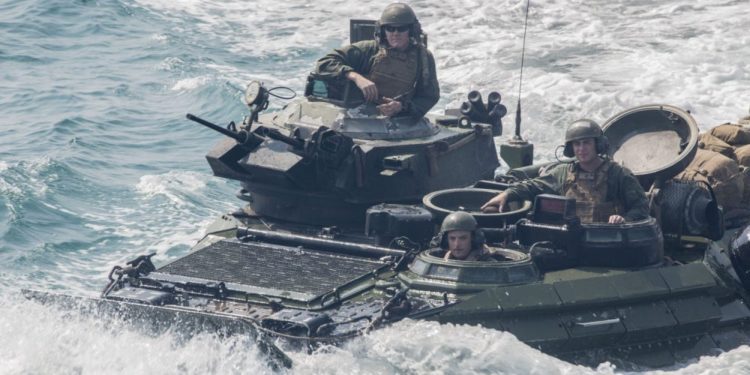
The Marine Corps put an assault amphibious vehicle (AAV) back in the water this week for the first time since one sank last summer, killing nine service members, Marine Corps officials told Insider Thursday.
Advertisement
Last July, an AAV assigned to Bravo Company, Battalion Landing Team 1st Battalion, 4th Marines, part of the 15th Marine Expeditionary Unit, sank off the coast of California as it returned to the amphibious transport dock USS Somerset from San Clemente Island.
“Out of precaution, before we understand what caused this, we are pausing the waterborne operations for amtracs,” Marine Corps Commandant Gen. David Berger said the day after the accident, as the Corps was still searching for the bodies of the deceased, considered only missing at that point.
Marines drive an AAV into the water during training at Camp Pendleton, California. (Photo by Lance Cpl. Alison Dostie/U.S. Marine Corps)
This week, after an eight-and-a-half-month pause, AAVs again started splashing, but with conditions, Corps officials said.
Last Friday, the Marines published requirements for the resumption of AAV waterborne operations, Marine Corps spokesperson Capt. Andrew Wood told Insider on Thursday.
No movement between Navy ships and the shore is permitted, and shore-to-shore movement over water is only permitted once a unit has completed 18 tasks.
Advertisement
Wood said that the tasks “cover a variety of requirements from ensuring training and qualifications for crew and embarked personnel, personnel are properly equipped, vehicles have passed required inspections, and operations are conducted with safety boats, sea state assessments, and positive communication.”
For instance, everyone riding in an AAV has to have completed the full underwater-egress training program, to include training on the Waterborne Egress Capability breathing bottles.
These requirements also apply to the new amphibious combat vehicles that are being introduced as replacements for the AAVs that first entered service in the 1970s.
At the moment, the California-based 1st Marine Division is believed to be the only unit to have met the requirements, division spokeswoman Maj. Kendra Motz told Insider. She said the first AAVs splashed Tuesday.
This article was written by Ryan Pickrell and published on the Insider.
Advertisement
What readers are saying
Generating a quick summary of the conversation...
This summary is AI-generated. AI can make mistakes and this summary is not a replacement for reading the comments.










COMMENTS