

The Southeast Asian country, formerly known as Burma, was a key factor in the fight against the Japanese during World War II. With the Chinese beleaguered by the Japanese to the north, over 200,000 Chinese laborers cut a 717-mile road to bring supplies to the fight.
In May 1944, members of the 5307th Composite Unit (Provisional) known as Merrill’s Marauders crossed 62 miles over the 6,600 foot Kumon Mountain range to capture the strategic Myitkyina airfield. The Marauders’ distinctive unit patch, which is now the crest of the 75th Ranger Regiment, shows the sun of the Chinese Nationalist flag and the Star of Burma.
The National League for Democracy party, led by Aung San Suu Kyi, had won 396 out of 476 seats in the November 8 election, allowing it to form a government for another five years. The military-backed Union Solidarity and Development Party had won only 33 seats.
The military has been demanding that the Union Election Commission look into its claim of 8.6 million irregularities in voter lists in 314 townships. According to the military, these irregularities could have let voters cast multiple ballots or commit what it characterized as other “voting malpractice.” But the election commission rejected the military’s claims stating that there was no evidence to support any election wrongdoing.
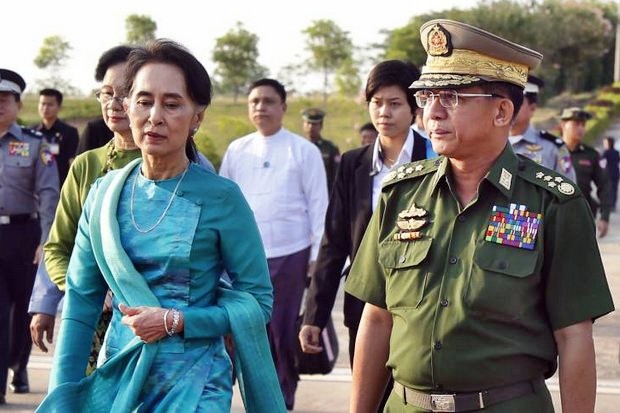
Then on Sunday morning, tensions reached a critical stage when Myanmar’s leader Aung San Suu Kyi and other senior figures from the ruling party were detained in an early morning raid.
Government spokesman Myo Nyunt said that Suu Kyi, President Win Myint, Han Thar Myint, who is a member of the party’s central executive committee, and other leaders had been detained during the raid in the early hours of Monday morning.
“I want to tell our people not to respond rashly and I want them to act according to the law,” he said, adding that he expected to also be detained.
Additionally, all phone lines in the capital of Naypyitaw were cut.
Myanmar’s military had run the country for 50 years before beginning a transition to democracy. However, it had ensured that the current constitution guarantees the country’s generals with a quarter of parliament’s seats and control of a number of key ministries. This had cemented the military’s considerable influence over the state’s affairs.
Myanmar’s parliament was set to open on Monday morning. Yet, the BBC reported that, following the coup, troops are on the streets and that the military has called for the opening of parliament’s new session to be postponed.
A statement from several Western nations urged a “peaceful convening” of parliament and condemned the coup in Myanmar.
“We urge the military, and all other parties in the country to adhere to democratic norms, and we oppose any attempt to alter the outcome of the elections or impede Myanmar’s democratic transition,” said a statement signed by the American, EU, British, and Canadian Embassies among others.








COMMENTS