

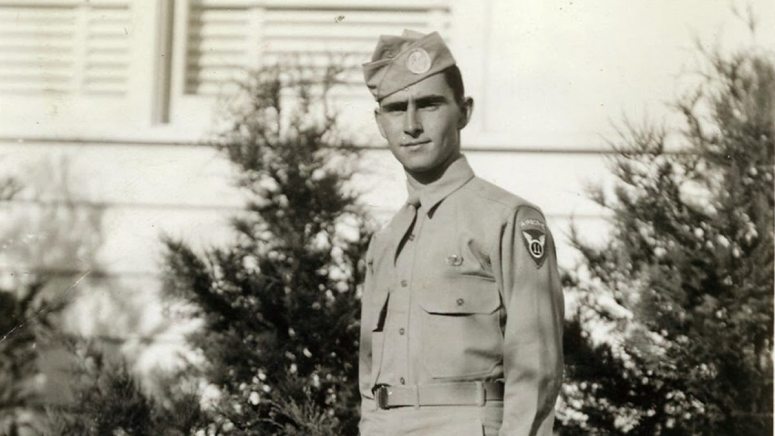
He was assigned to the 511th Parachute Infantry Regiment of the 11th Airborne Division and was sent to training at Camp Toccoa, Georgia. As many who have watched the HBO series Band of Brothers will recall, Toccoa was also where the 506th Parachute Infantry Regiment received its training. The commander of the 511th was Colonel Orin D. “Hard Rock” Haugen and the 11th Airborne was commanded by General Joseph Swing.
Despite his small stature, Serling hung tough throughout the training which washed out a large number of recruits. Because of his size, he felt he had to constantly prove himself. As a result, Serling got into many fights during his training. He fought tankers, fliers, infantrymen, as well as other paratroopers. He joined the boxing team fighting with an unbridled fury that caused him to be labeled a berserker.
In 1944, the division was moved to California before being shipped to the Philippines in November. The division landed on Leyte. There, it would fight as conventional infantry advancing about 40 miles through dense jungle and across steep ridges. The Japanese were a determined enemy bent on dying for their emperor while taking as many Americans with them as possible.
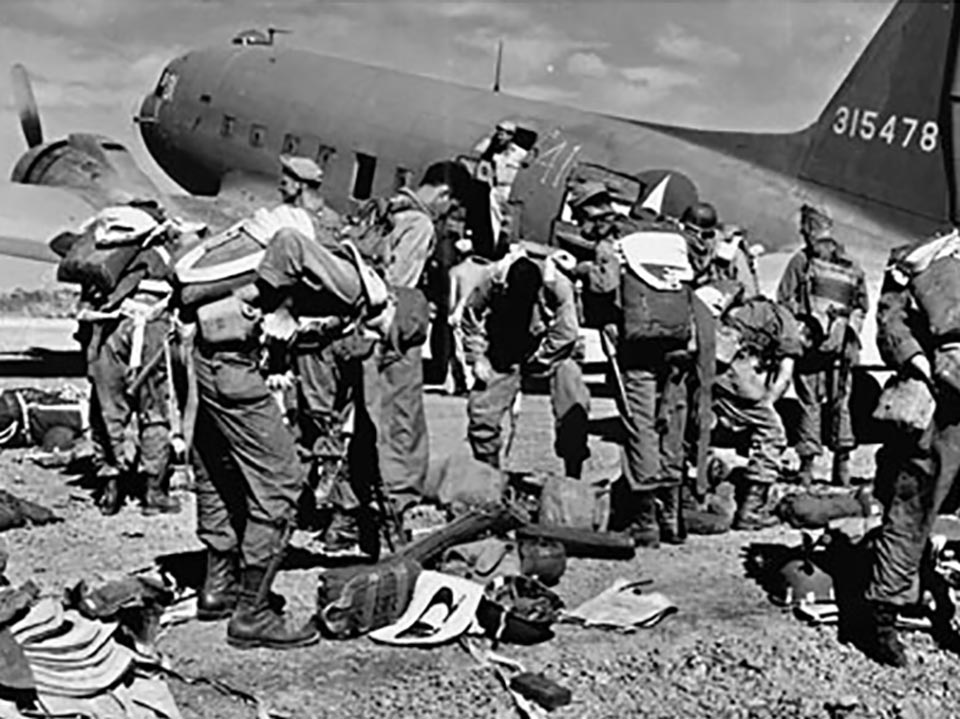
Somewhere along the way, Serling ticked off his commander and was assigned to the company’s demolition platoon, which was thought to be suicide duty.
Serling would lose a good friend Melvin Levy when a pallet of food crashed through a tree, during an airdrop, decapitating Levy in full view of his unit.
Serling was wounded twice in the fighting. His knee wound would plague him for the remainder of his life.
On February 3, 1945, the 11th Airborne Division was badly misdropped in the assault on Manila. The fighting was savage and the Japanese would murder thousands of Filipino civilians. These events would cause Serling a lifetime of nightmares, what would now be labeled as Post-Traumatic Stress (PTS). Serling was recognized for risking his life to save a woman.
“I was bitter about everything and at loose ends when I got out of the service. I think I turned to writing to get it off my chest,” he would recall later. His regiment suffered over 50 percent casualties.
After the war ended, Rod Serling was part of the Japanese Occupation Forces.
His awards and decorations included the Bronze Star, the Purple Heart, Combat Infantryman’s Badge as well as the Parachutist’s and Glider Badges.
Radio and Television Come Calling
Using his G.I. Bill benefits, Serling attended Antioch College in Ohio. He became active in the school’s radio station for which he wrote, acted, and directed some radio shows.
While there, he met Carole Kramer. The two would be married in 1948. To make money during his college years, Serling worked for the Army testing new parachutes. A lucrative occupation, Serling would be paid $50 for each jump. He wasn’t afraid to participate in dangerous tests. For one particularly hazardous assignment, he was paid $1,000 to test a jet ejection seat; three other men had been killed testing it before him.
He became a regular writer for the radio station WLW in Cincinnati. From there, he moved into television, writing for WKLW before quitting and taking up freelance writing.
In 1954, his script Patterns was produced by CBS. It was about a veteran corporate boss that Serling patterned after his WWII commander Colonel “Hard Rock” Haugen.

His phone soon began ringing a lot and he became a hot commodity. He wrote for Playhouse 90 and drew criticism for creating a play about racism in a small southwestern town, something that was taboo at the time.
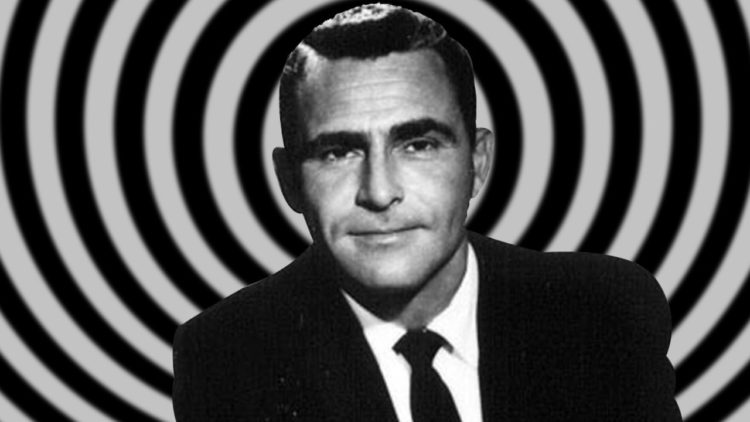
He then submitted a pilot for The Twilight Zone in 1959 fighting against the studio over creative control and writers.
He used his wartime experience as an inspiration for one of the episodes. Episode 19, titled The Purple Testament, depicts an American lieutenant fighting in the Philippines who has the ability to predict whom of his men will live and whom will die.
The series ran for five seasons but by 1964, Serling had grown tired of the show and didn’t fight its cancellation by the studio.
In 1969, he produced and narrated the NBC macabre show Night Gallery that lasted until 1973. During his television career, he would teach courses in writing and drama first at Antioch College and later at Ithaca College.
A heavy smoker (he smoked three-four packs a day throughout his life) Rod Serling suffered a heart attack in May 1975, followed by a second two weeks later. Doctors performed open-heart surgery in an attempt to alleviate his issues, but he suffered another heart attack on the operating table and died two days later on June 28, 1975.
He was buried in Lake View Cemetery, Interlaken, NY.








COMMENTS