

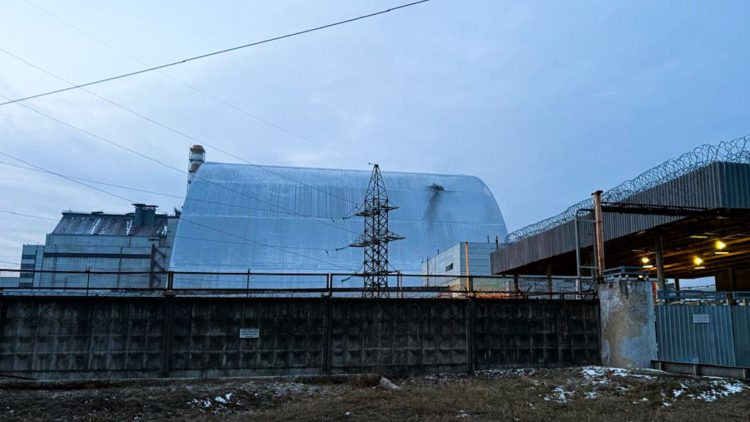
The IAEA, which has had a monitoring team stationed at the site since Russia’s 2022 invasion, released images appearing to show the drone on fire after crashing into the cover.
A History of Russian Aggression at Ukraine’s Nuclear Sites
This is not the first time Russian forces have threatened nuclear facilities in Ukraine.
In the early days of the invasion, Russian troops occupied the Chernobyl plant, holding staff hostage for weeks before retreating.
Moscow continues to control the Zaporizhzhia Nuclear Power Plant, Europe’s largest, where repeated shelling has raised fears of a nuclear catastrophe.
Chernobyl’s destroyed reactor was sealed off in 2016 with a $2.5 billion metal sarcophagus, funded by the international community to prevent radiation leaks.
The fact that a military strike was launched at such a sensitive site has drawn sharp criticism.
During the night of 13-14 Feb, at around 01:50, IAEA team at the Chornobyl site heard an explosion coming from the New Safe Confinement, which protects the remains of reactor 4 of the former Chornobyl NPP, causing a fire. They were informed that a UAV had struck the NSC roof. pic.twitter.com/Ee5NSRgDo8
— IAEA – International Atomic Energy Agency ⚛️ (@iaeaorg) February 14, 2025
President Zelenskyy denounced the attack, stating that Russia remains committed to war and deception rather than peace talks.
“The only country in the world that attacks such sites, occupies nuclear power plants, and wages war without any regard for the consequences is today’s Russia,” Zelenskyy said.
The timing of the strike is notable—it comes just hours before Zelenskyy is set to meet US Vice President JD Vance at the Munich Security Conference.
Ukraine intends to place the Chernobyl attack on the agenda, pushing for stronger international condemnation and security guarantees.
Tensions Rise as US and Russia Discuss Peace Talks
The attack also follows a controversial phone call between US President Donald Trump and Russian President Vladimir Putin, in which they reportedly agreed to initiate peace talks on Ukraine.
Trump’s decision to engage directly with Putin has alarmed Kyiv and European allies, many of whom worry that any rushed deal could come at Ukraine’s expense.
While Moscow has not yet responded to the Chernobyl strike allegations, the attack raises serious questions about Russia’s intentions.
If Russia is truly seeking peace, why is it still launching strikes on sensitive sites with potential global consequences?
The Global Stakes of Attacking Chernobyl
The Chernobyl disaster remains one of the worst nuclear accidents in history, with radioactive contamination affecting large parts of Europe.
While the sarcophagus has contained most of the radiation, experts warn that any direct damage to the structure could have severe consequences.
With global security at risk, Ukraine is now demanding stronger international action against Russia’s reckless military tactics.
As the Munich Security Conference unfolds, world leaders will be forced to confront the reality of Russia’s war strategy—and whether peace negotiations can be trusted when nuclear sites are still being targeted.
What Comes Next?
Ukraine is expected to push for:
- Stronger air defense systems to prevent future attacks on critical infrastructure
- A formal international response to Russia’s nuclear security violations
- Clearer commitments from Western allies amid ongoing US-Russia discussions
Whether this drone strike becomes a turning point in the war or just another chapter in Russia’s escalating aggression, one thing is certain: attacking a nuclear disaster site is a dangerous gamble that could have catastrophic consequences for the entire world.








COMMENTS