

The data collected by the think tank comes mostly from open-source images taken from drones, satellites, and the war arena. This data spans from the start of the war to the end of November, yet the numbers can only be approximated due to the situation.
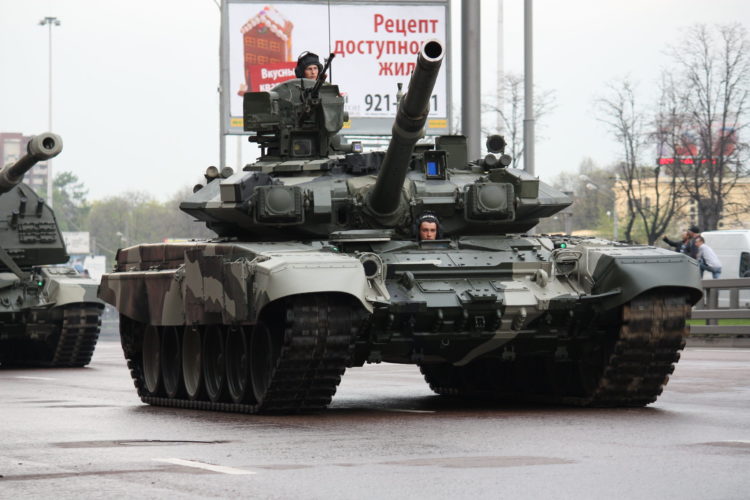
Russia’s army has seen a notable decrease in its tank count, with a 38% drop from 2,927 to 1,800. This has been especially evident in the reduction of its T-72B3 tanks, the upgraded version first provided to the army in 2013.
Other aspects, such as mobility, play a large role when it comes to these advanced tanks, with each type having unique characteristics, making them suitable for different roles on the battlefield depending on terrain or mission requirements. For example, although not as fast as other models, such as the T-80U speed-wise, the T 72B3 has better maneuverability which can be beneficial when navigating narrow passageways or mountainous terrain where nimbleness takes priority over speed, giving it another advantage over heavier counterparts such as the T 90A or even other newer model variants like Armata MBT family or Kurganets 25/30 IFV series vehicles.
The consequences of the battle were severe for Russia, Chipman noted, reducing its tank fleet by 50 percent compared to before the invasion and reducing industrial production, leaving it to rely on older stored weapons to replace losses.
Russians were overly optimistic about their expectations, so they encountered severe losses in tanks at the start of the war, especially in Kyiv. Many armored vehicles were destroyed while traveling in a convoy near the city, and many more were seized or hauled away by agricultural tractors as the offensive was unsuccessful.
The Russian military had expected to be met with a warm welcome in Ukraine and had even prepared for a parade in Kyiv. To their surprise, however, they were met with heavy fire from Ukrainian forces using anti-tank weaponry, which caused many of the tanks to be destroyed.
No clear evidence of any betterment in tank tactics has been seen, with an approximated number of several dozen tanks destroyed in battle since the end of January when trying to capture Vuhledar in Donbas. However, using reconnaissance drones, Ukraine could take out tanks with its artillery.
Video of an Ambush on Russian tanks near Vuhledar.#UkraineRussianWar pic.twitter.com/HG5pJ7PmYu
— Eirik_and_tanks (@Eirik_and_tanks) February 13, 2023
Though the combat losses are noteworthy, Russia has a considerable number of old tanks in long-term storage, believed to amount to 5,000, which implies that Moscow can continue to employ a strategy of attrition for a while.
Ukraine has acquired more tanks, raising its count from 858 to 953, due to the recovery of roughly 500 from Russia and donations from Poland, the Czech Republic, and other countries with Soviet-era armor. Yet, despite these additions, its tank force is still only half the size of Russia’s. This was noted by Henry Boyd, an analyst from the International Institute for Strategic Studies.
Kyiv anticipates a deluge of western tanks and combat vehicles shortly to get a battlefield advantage. Nevertheless, German Defence Minister Boris Pistorius warned on Wednesday that only “half a battalion” of Leopard 2 tanks could be sent to Ukraine, which consists of 14 modern Leopard A6 tanks from Portugal and three.
Pistorius highlighted that although Poland had promised to send a battalion of Leopard 2 tanks to Kyiv, many needed to be more suitable for battle. He additionally noted that Poland was training Ukrainian troops to use them.
According to Ben Barry, an expert in land warfare, Ukraine would likely receive around 250 tanks and other combat vehicles from the 1,000 they had requested.
Barry noted that having enough ammunition and spare parts could provide a “tactical advantage.” Despite this, the analyst and former tank commander questioned whether or not Kyiv had enough combat power to swiftly drive out Russian forces.
Barry predicted another year of bloodshed, where the fighting would be unpredictable – with at least 200,000 casualties between both sides during the preceding period.








COMMENTS