

Technological Features
Rostec has outlined the suite’s array of technological components that contribute to its advanced capabilities. These include:
- Noiseless Coding: The suite employs sophisticated coding techniques to ensure the validity of data transmission, even in the presence of noise or interference.
- Message Symbol Interlacing: This technique reorders the symbols of a message, making it more resilient to signal disruptions.
- Universal Time Synchronization: Precise synchronization of signal processing times enhances communication reliability.
- Parallel Links for Message Transmission: Simultaneous transmission of messages through multiple channels increases the likelihood of successful data exchange.
- AI Integration: Artificial intelligence technology adds a layer of adaptability and intelligence to the communication suite’s functioning.
- High-Frequency-Band Antenna Tuners: These components optimize signal reception and transmission in high-frequency bands.
- Digital Signal Processors: These processors manage and enhance the quality of incoming and outgoing signals.
- Noiseless Encoders and Decoders: These components play a critical role in maintaining the integrity of transmitted data.
Implications for Future Air Operations
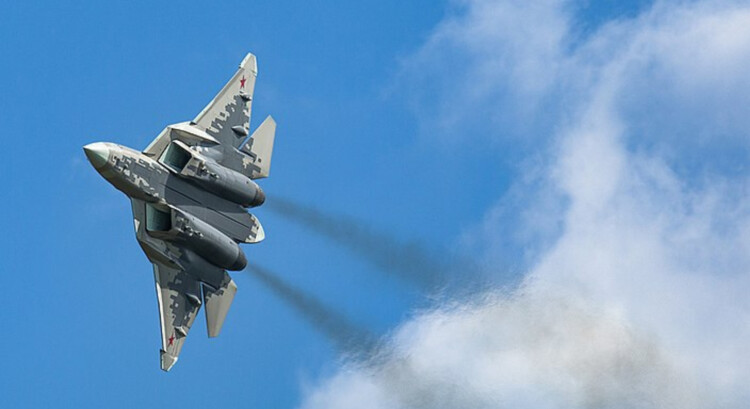
As the Russian Air Force aims to induct a substantial number of Su-57 fighter jets over the coming years, the integration of AI-powered radio communication suites significantly bolsters their operational capabilities. Countering electronic warfare tactics provides a substantial advantage in modern air combat scenarios. Moreover, the suite’s capacity for reliable information exchange with ground-based systems enhances coordination and strategic decision-making, making the entire air fleet more potent and responsive.
Evolution of the Su-57 Fighter Jets: From Concept to Combat Zone
The Su-57 fighter jets emerged from the PAK FA (Prospective Airborne Complex of Frontline Aviation) program, launched in the early 2000s to create a fifth-generation stealth fighter boasting superior maneuverability, advanced avionics, and state-of-the-art weaponry. Overcoming technical hurdles and budget constraints, the Su-57 conducted its maiden flight in 2010, marking Russia’s aerospace progress. Despite developmental challenges, the aircraft transitioned into limited operational service in the Russian Air Force, showcasing its versatility in combat exercises and airshows.
Reports emerged of Su-57s deployed in strike operations over Ukraine, affirming their adaptability in roles like Suppression of Enemy Air Defenses (SEAD). While some operational details may require confirmation (or just mere hearsay, as discussed in the video above), the Russian stealth aircraft involvement aligns with strategic logic, offering Russia a real-world arena to test and refine its cutting-edge technology. This journey epitomizes Russia’s commitment to advancing its military capabilities and adapting to modern warfare complexities.
~
In summary, the upgrade of the Su-57 fighter jet with an artificial intelligence-based communication suite provides Russia with improved tactical communication, counter-jamming capabilities, operational flexibility, and force multiplication advantages. In the context of ongoing conflicts like the invasion of Ukraine, these enhancements can contribute to Russia’s military effectiveness and ability to adapt to dynamic and challenging scenarios.








COMMENTS