On December 11, 2006, with the country turning the other way— the opponents of the president in a yell— a war was launched without ever having been consulted with by anyone. It’s been a decade, recalls the author of this text, and “on the streets, the Mexican Army continues and there is a widespread feeling that it operates with impunity, a war of extermination. Crimes continue and armed groups have diversified their income relying on impunity. There is no effective state policy to compensate for damages to victims or to deter youths from armed groups. The police have not been cleaned up and narco-politics seems to keep the reserves that it had before the start of the confrontation. There aren’t major advances in the criminal justice system; torture, the UN says, is widespread; prisons are schools of criminals; money laundering operations continue to develop and now, all this time, a glimmer of light: the possibility that marijuana might at least be decriminalized.”
Mexicans, At The Cry Of War
Suddenly, as never before, the streets of many cities of our country lost a virginity that it had maintained since the 1910 Revolution: Mexican Army units were displaced but not to the barracks, not to any community in a tragedy by a hurricane or an earthquake. They came with their weapons in front to stay there, in the corners, on the sidewalks, where cops were before.
It wasn’t a minor change for a majority who were used to seeing soldiers on television. With them, from the night to the morning, bulletproof vests appeared, machine guns mounted in open vehicles, outlines of federal police. And what seemed to be a temporary thing kept spreading for months, and then years. Armored cars became common throughout the country while terms such as “executed”, “sicario”, “kidnapped”, “agitated”, “company”, or “decapitated” became part of the jargon of many in the media, of journalists and of the population in general.
Read More: Borderlands Beat
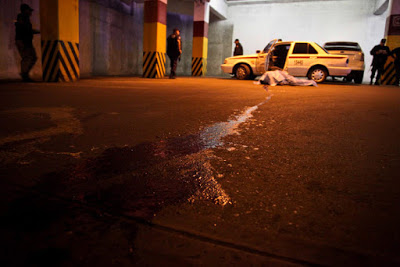
Featured Image – A taxi driver is assassinated in a shopping center in Culiacán. Photo: Rashide Frias, Cuartoscuro – Borderlands Beat
Already have an account? Sign In
Two ways to continue to read this article.
Subscribe
$1.99
every 4 weeks
- Unlimited access to all articles
- Support independent journalism
- Ad-free reading experience
Subscribe Now
Recurring Monthly. Cancel Anytime.
On December 11, 2006, with the country turning the other way— the opponents of the president in a yell— a war was launched without ever having been consulted with by anyone. It’s been a decade, recalls the author of this text, and “on the streets, the Mexican Army continues and there is a widespread feeling that it operates with impunity, a war of extermination. Crimes continue and armed groups have diversified their income relying on impunity. There is no effective state policy to compensate for damages to victims or to deter youths from armed groups. The police have not been cleaned up and narco-politics seems to keep the reserves that it had before the start of the confrontation. There aren’t major advances in the criminal justice system; torture, the UN says, is widespread; prisons are schools of criminals; money laundering operations continue to develop and now, all this time, a glimmer of light: the possibility that marijuana might at least be decriminalized.”
Mexicans, At The Cry Of War
Suddenly, as never before, the streets of many cities of our country lost a virginity that it had maintained since the 1910 Revolution: Mexican Army units were displaced but not to the barracks, not to any community in a tragedy by a hurricane or an earthquake. They came with their weapons in front to stay there, in the corners, on the sidewalks, where cops were before.
It wasn’t a minor change for a majority who were used to seeing soldiers on television. With them, from the night to the morning, bulletproof vests appeared, machine guns mounted in open vehicles, outlines of federal police. And what seemed to be a temporary thing kept spreading for months, and then years. Armored cars became common throughout the country while terms such as “executed”, “sicario”, “kidnapped”, “agitated”, “company”, or “decapitated” became part of the jargon of many in the media, of journalists and of the population in general.
Read More: Borderlands Beat
Featured Image – A taxi driver is assassinated in a shopping center in Culiacán. Photo: Rashide Frias, Cuartoscuro – Borderlands Beat










COMMENTS