The article discusses the brutal tactics employed by Russian forces in Kherson, Ukraine, where drone strikes target civilians and humanitarian efforts, creating a climate of terror. It highlights the erosion of wartime ethics and the need for accountability and action against these war crimes.
Key points from this article:
The drone strikes in Kherson have resulted in over 200 civilian deaths since Russia's retreat from the Dnipro's west bank in 2022, with incidents including attacks on children and humanitarian vehicles.
How the use of drones to target civilians, including a marked UNHCR vehicle and children in playgrounds, has created a pervasive atmosphere of fear and disrupted normal life in Kherson.
Why the ongoing violence and lack of accountability for Russian forces necessitates international pressure and sanctions to deter further war crimes and protect Ukrainian civilians.
Updating summary...
The Human Safari in Ukraine
Benjamin Reed
Speed
1x
Listen
COMMENTS
Russia’s war in Kherson has descended into a sport of civilian hunting; a moral collapse broadcast online for the world to ignore.
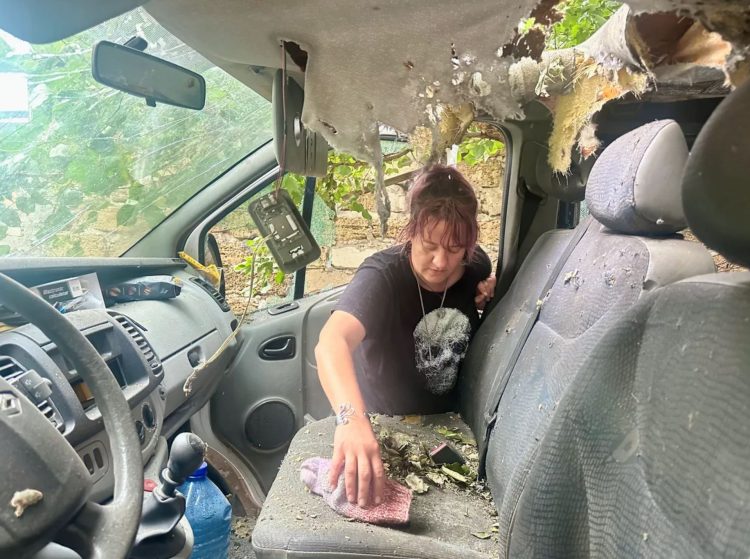
Olha Chernyshova, a volunteer delivering humanitarian aid, is cleaning her car after a second drone attack. Photo: Zarina Zabrisky.
In this drone war, there are endless chances to kill the enemy: by the scores, if you are good at it. At the Kyiv suicide-drone operator’s course, I once overheard students debating whether to target medics tending the wounded—the same tactic Russians were practicing on a much larger scale. The idea sickened me at first. Then I remembered: snipers have been shooting at medics for more than a century. It is an old tactic, illegal but effective; it breaks morale and bleeds manpower.
Advertisement
I had seen the same logic on video: medevac vehicles hit mid-evacuation and reduced to burning wrecks. You can feel the terror ripple through the ranks when even the wounded realize rescue may never come. War is hell, as the saying goes; but hell used to have rules.
Now those rules are dissolving. Russia has poured acid on what remains of that fragile notion of restraint. Humanity is a word invented by a species ashamed of its history.
The lowest valley of human morality, deeper even than the battlefield itself, is what the Russians have turned Kherson into: a hunting ground. Soldiers and civilians alike now call it the “human safari.” It is a sport in which ordinary life becomes the prey and drones serve as rifles. The name evokes old colonial expeditions: Europe’s wealthy stalking lions across African plains for trophies and stories. Only now the trophies are human. The thrill lies in annihilating routine: a man walking his dog, a mother buying groceries, a child chasing a ball. There is no military logic to it, only the cold arithmetic of terror—make life itself unlivable, one errand at a time.
Advertisement
The investigation began in May 2024, focused on free Ukrainian Kherson City. The attacks use small kamikaze drones and Mavic-style quadcopters fitted with bomb drops: cheap, mass-produced, accurate enough to hover over intersections like vultures. Reports from Human Rights Watch and the United Nations verify more than 150 separate incidents since July 2024; Ukrainian prosecutors have logged over 1,000 suspected cases, with the death toll since Russia’s retreat from the west bank of the Dnipro in 2022 now exceeding 200 in Kherson alone. Each incident is another notch in a bottomless descent, tumbling like a fishing weight into the Mariana Trench.
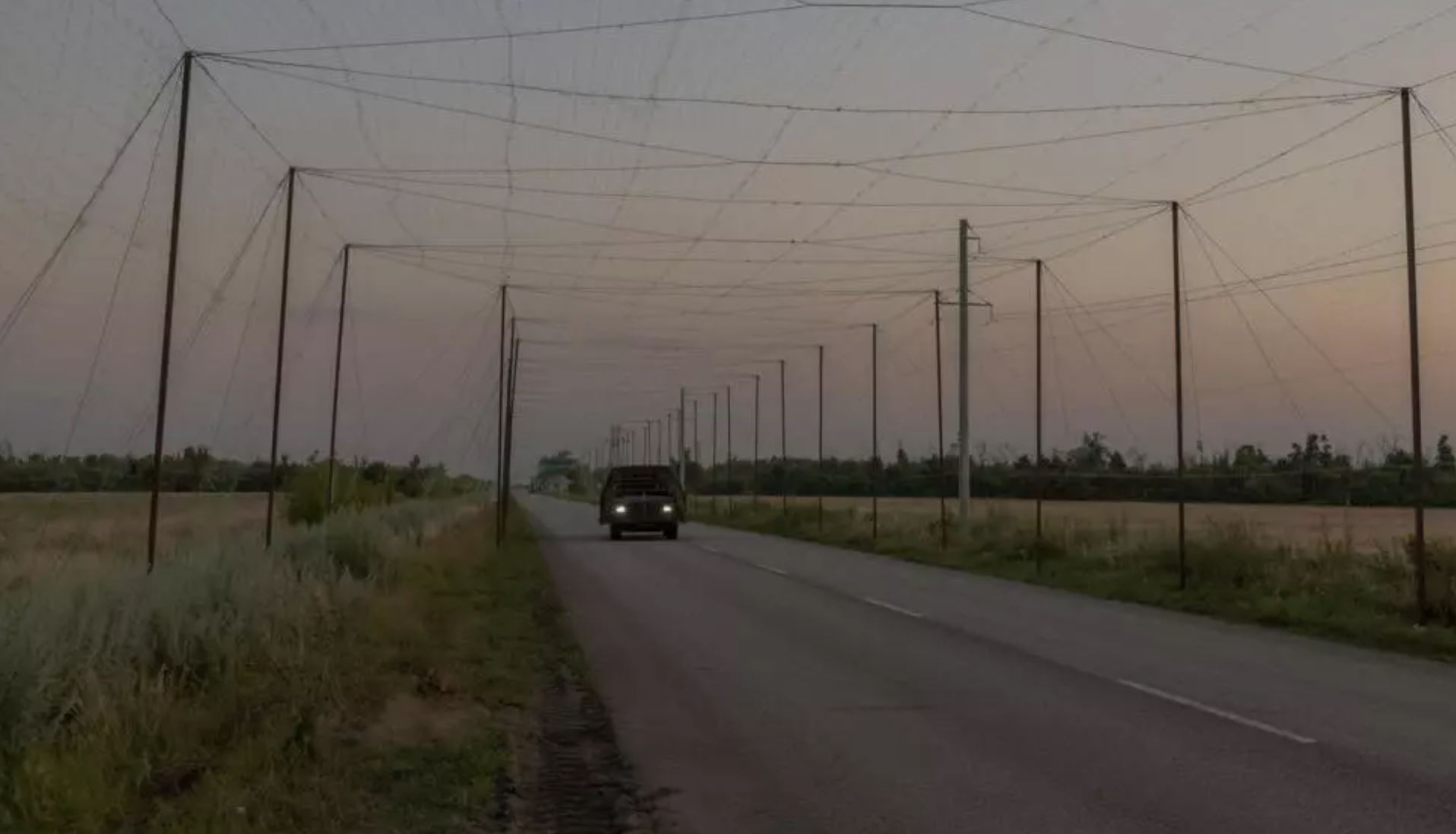
Anti-drone netting protects a road in Ukraine. Image Credit: Roman Pilipey / AFP via France 24
The victims are anyone attempting normalcy. On July 12, 2024, a child was killed and his grandmother injured when a drone dropped a grenade directly above them; the explosion scattered debris across a nearby playground. In August, a group of teenagers repairing a bicycle was hit; two died instantly. In September, a UNHCR vehicle clearly marked with humanitarian insignia was struck while distributing food to the elderly. The Russians are not only killing innocent, Russian-speaking civilians; in some cases, they record the strikes, add a soundtrack, and upload the footage—branding their barbarity.
Advertisement
The irony borders on biblical. Kherson is overwhelmingly Russian-speaking: the very people Vladimir Putin claimed he invaded Ukraine to protect as “historical Russian subjects.” His forces now hunt those people for terror, for sport, or both. The pretext of “liberation” has become parody; what began as empire dressed up as rescue has devolved into predation.
Hundreds of cases now define a pattern. Children hit in playgrounds. Aid convoys shredded. Firefighters and paramedics killed in “double-tap” strikes: drones hitting once, then returning to strike rescuers. In one video from July 2024, a firefighter runs toward a burning car before a second drone slams into him. The tactic echoes the “double-tap” doctrine condemned in other conflicts, only here it has become routine.
Kherson lives under a constant hum. Markets close early. Streets empty. People move in short bursts between shelters while the sky is watched like an enemy. Residents describe it as living under a “permanent eclipse”: the light of ordinary life smothered by the shadow of arbitrary death.
Advertisement
Yet even in that darkness, resistance endures. Civilians share drone-spotting apps, build improvised detectors, and risk the streets to deliver food and medicine. Main thoroughfares now have commercial-grade drone nets to protect civilians; in other cities those nets are used chiefly for logistics. Russia may pour the acid, but humanity finds buffers—small acts of decency that resist erasure.
The “human safari” is not just a war crime. It is a mirror. It forces us to ask whether the rules we invoke in war were ever more than myths: paper shields against the nature we would rather not admit is still our own.
I remember fighting in the trenches of eastern Ukraine at the start of the war: Russian artillery smashing into Donbas homes, livestock left to wander, pig farms abandoned—an ordinary landscape turned grotesque. I thought then that Europe had reached a nadir, that it could not get worse. I was wrong. The Russians have found new ways to make this a hellscape; they possess no restraint. European militarism and an unhinged eastern despotism now combine, and everything in their wake suffers.
There must be a reckoning. Too many lines have been crossed: chemical weapons reports, deliberate targeting of homes and hospitals, the abduction of children, the torture and execution of POWs. If this conflict ends with the front lines frozen and no accountability, those responsible will escape justice while Ukrainians continue to live the consequences. They will wage shadow campaigns to pursue retribution; Russia will be left to its normal life. That cannot stand.
If justice is to mean anything, pressure must be tangible and unrelenting. Tighten sanctions. Target the logistics and industries sustaining the drone campaign. Keep Ukraine armed so Russia cannot assume these crimes will pass without cost. Let Moscow understand that impunity brings consequences; allow no safe harbor for those who weaponize the skies against civilians. Force can be a deterrent when it is precise, proportionate, and paired with law.
Advertisement
What readers are saying
Generating a quick summary of the conversation...
This summary is AI-generated. AI can make mistakes and this summary is not a replacement for reading the comments.










COMMENTS