

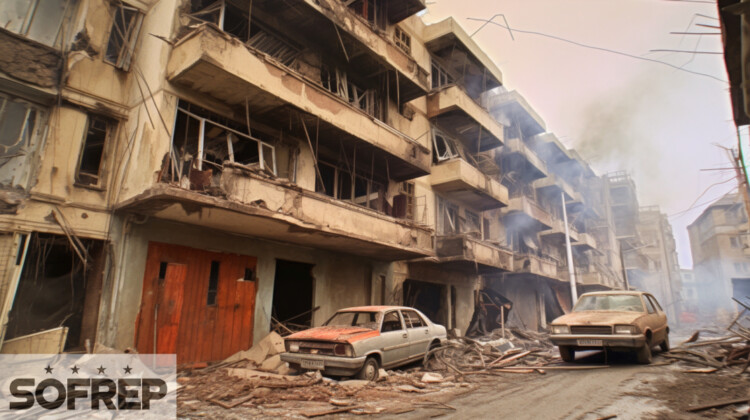
Azerbaijan is shelling civilian residential areas of #Stepanakert This is a building next to us with no military target in vicinity. pic.twitter.com/EZtJsAEBNg
— Siranush Sargsyan (@SiranushSargsy1) September 19, 2023
Quick Recap: Events Leading to the Latest Nagorno-Karabakh Crisis
The recent flare-up began in the fall of 2020 when Azerbaijan launched a military campaign that liberated several cities, villages, and settlements previously occupied by Armenian forces during a 44-day conflict. The war ended with a Russia-brokered ceasefire, but tensions have persisted. Notably, since December, Azerbaijan has effectively blockaded the only route into Nagorno-Karabakh from Armenia, known as the Lachin Corridor, further straining relations between the two countries.
Then, in April this year, Azerbaijan’s decision to open a checkpoint on a key highway raised tensions in the Nagorno-Karabakh region to new heights. While Azerbaijan claimed it was necessary to intercept and deter military shipments from Armenia to Nagorno-Karabakh, protests erupted, and it became apparent that the true intention was to block Armenian passage.
Armenia and ethnic Armenian leaders in Nagorno-Karabakh strongly condemned the checkpoint, asserting that Azerbaijan aimed to isolate Karabakh Armenians and solidify its control over the region.
The situation is further complicated by the fact that the ceasefire has been enforced by approximately 3,000 Russian peacekeepers, who are currently occupied with Russia’s full-scale invasion of Ukraine. Armenian Prime Minister Nikol Pashinyan recently expressed concerns that Russia was “spontaneously leaving the region,” adding a layer of uncertainty to the situation.
Zakharova, announced the participation of “Armenian armed formations” in the conflict.
Russia calls on Armenia and Azerbaijan to stop hostilities and return to a diplomatic settlement, Zakharova said.
Moscow is alarmed by the sharp escalation of the situation, noted the… pic.twitter.com/dDkfB1iKUQ
— S p r i n t e r F a c t o r y (@Sprinterfactory) September 19, 2023
In an effort to address the humanitarian aspects of the crisis, Azerbaijan permitted aid from the International Committee of the Red Cross to enter Karabakh via two roads, one through the Lachin Corridor from Armenia and the other via Azerbaijan’s Aghdam road.
~
The situation in Nagorno-Karabakh remains highly fluid and volatile, with potential regional and international implications. The case remains delicate despite international mediation and diplomatic initiatives involving not only Russia but also the United States and the European Union. Especially with the many complex issues and historical grievances Azerbaijan and Armenia have to address.
As both sides trade accusations and tensions continue to rise, it is crucial for all parties involved, as well as the international community, to pursue diplomatic avenues for de-escalation and a lasting peace agreement to prevent further loss of life and instability in the region.








COMMENTS