

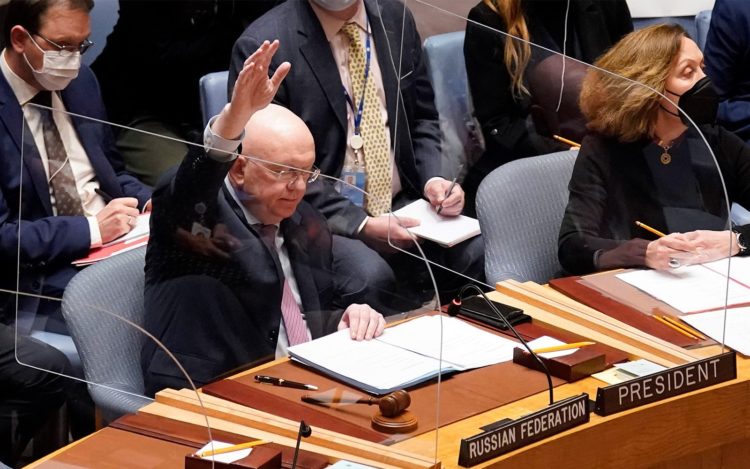
French Representative Nicolas de Rivière accused Moscow’s aggression of killing civilians and destroying vital infrastructure all for Russia’s ‘imperialist’ aspirations, calling the invasion a reconquest of the Russian empire. “The result of today’s vote is clear. Russia is alone,” he mentioned, adding that Russia is neglecting its responsibilities as a member of the Security Council and is “using the UN Charter to violate its fundamental principles.”
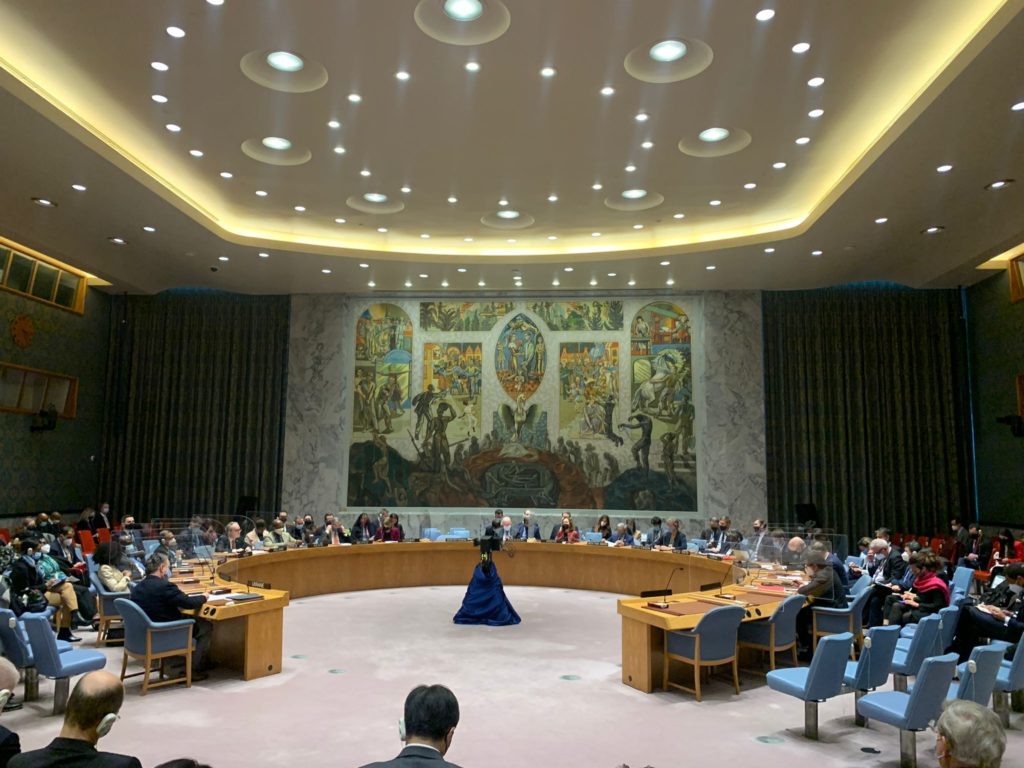
Indian UN Ambassador T. S. Tirumurti, who chose to abstain, commented that “dialogue is the only path forward.” UAE Representative Ambassador Lana Nesseibeh, who also abstained, noted that the United Arab Emirates would continue its effort to find ‘inclusive and consultative processes’ now that the draft had been vetoed. Meanwhile, UN Ambassador Zhang Jun, who was the only permanent council member to abstain, warned that such actions could “shut the door” to peaceful negotiation, citing the political and economic complexities of the Ukraine crisis and the subsequent invasion.
After not responding to accusations of abusing his country’s veto power, Russian Ambassador to the UN Vasily Nebenzya turned the tables on the draft’s sponsors. He claimed that the sponsors were “sipping tales” about the real situation in Ukraine, alluding to the West’s attempt to hide that they had been supplying Donbas with weapons.
“You have made Ukraine a pawn in your own game… this resolution is nothing other than yet another brutal, inhumane move on this Ukrainian chessboard”, he said.
In response, Ukrainian Ambassador Sergiy Kyslytsya, known for his fiery statements against his Russian counterpart, was in disbelief at Nebenzya’s “diabolical script,” which was in his words, “a rather detailed application for a seat in Hell.” Kyslytsya then asked the council to dedicate a moment of silence, which was followed by a round of applause throughout the chamber. “To pray for the souls of those that have already been killed or may be killed,” said Kyslytsya, inviting Nebenzya to “pray for salvation,” a heated Kyslytsya said.
After the meeting, UN Secretary-General Antonio Guterres shared his thoughts to the press, “The United Nations was born out of war to end war… today, that objective was not achieved”. However, he stressed that efforts to find settlements must not cease and called back to how the UN Charter was able to stand firm in the past.
In light of Russian veto in UNSC I addressed my request to members of the Council to adopt necessary decision to convene an emergency special UNGA session pursuant to GA resolution 377A(V) since Russia didn’t let Council act as required to maintain international peace & security pic.twitter.com/DdQNtK3tWN
— Sergiy Kyslytsya 🇺🇦 (@SergiyKyslytsya) February 26, 2022
Even with the failed resolution, Russia’s isolation in the results of the meeting remains a major point of interest. Furthermore, Ukrainian Ambassador Sergiy Kyslytsya called for an emergency special session of the UN General Assembly to vote on a similar resolution where no country has veto power.
What Is A Veto, And Why Was The Russian Veto Expected?
The role of the United Nations Security Council (UNSC) is to maintain peace and security across the globe following the devastation of World War II. The UNSC is tasked to recommend adjustments or settlements for disputing parties and can resort to imposing sanctions on countries that the UN body deems acted inappropriately or had violated international law. Furthermore, it may possibly mobilize forces under the United Nations Command (UNC), as was seen during the Korean War, the first unified international command in history.
Despite its world-renowned status, the effectiveness of the UN’s ability to maintain the peace has been scrutinized throughout the years, mostly due to the permanent member’s veto power which had been abused or used to protect the P5’s allies (or themselves) despite committing human rights abuses, the act of war, and the like.
A ‘no’ vote from any of the five permanent Council members can veto any resolution proposed to it. Currently, China, France, Russian Federation, the UK, and the US comprise the body’s permanent members.
Article 27 of the Charter of the United Nations states that resolutions with an affirmative vote of 9 members out of 15, including the concurring votes of the permanent members, can pass the UNSC. If in the case that any one of the permanent members utilizes their veto power in any resolution, the said resolution does not pass.
If you’re wondering where the veto powers came from, the authors of the Charter gave the victors of World War II the power to veto so that they would have a single voice on the matters of war and peace, assuming that they would agree on which specific resolutions to veto as a whole. However, it was soon realized that this was not the case and that the veto power of each P5 member was used to protect allies from sanctions and condemnations or protect themselves from sanctions and condemnations—as was seen with the recent Russian veto.
Non-permanent members also have the power of a veto in essence, just that it’s done collectively through a ‘no’ vote. If more than 6 members of the UNSC do not support a resolution, it will definitely fail as it can no longer have nine votes required to pass a resolution. While possible, this does happen quite rarely (almost never).
As recorded by the Security Council Report, Russia actually holds the most number of vetoes to date, with over 143 vetoes as of 2020, the US trails with 83. In 2018, Rusia also vetoed 12 resolutions pertaining to Syria’s use of chemical weapons against civilians during the Syrian Civil War. In fact, historically, the former Soviet Union was known to use its veto so much that Soviet Ambassador to the UN Vyacheslav Molotov had been nicknamed “Mr. Veto,” mostly due to counter the US’ reluctance to admit new members from the communist eastern block to join the United Nations.
Tuning in to SOFREP for the first time? Click here and enjoy a free 2-month trial membership and be up to date with the latest developments in Ukraine and elsewhere around the globe.








COMMENTS