

I will continue to do everything in my power to contribute to an immediate cessation of hostilities and urgent negotiations for peace. pic.twitter.com/vhAol1kyfi
— António Guterres (@antonioguterres) March 2, 2022
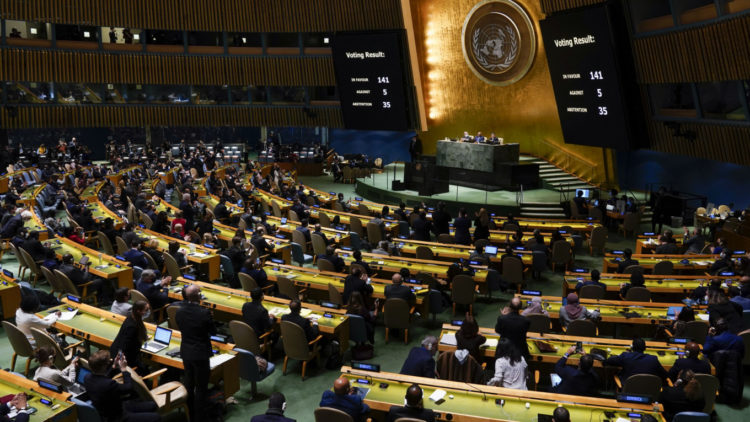
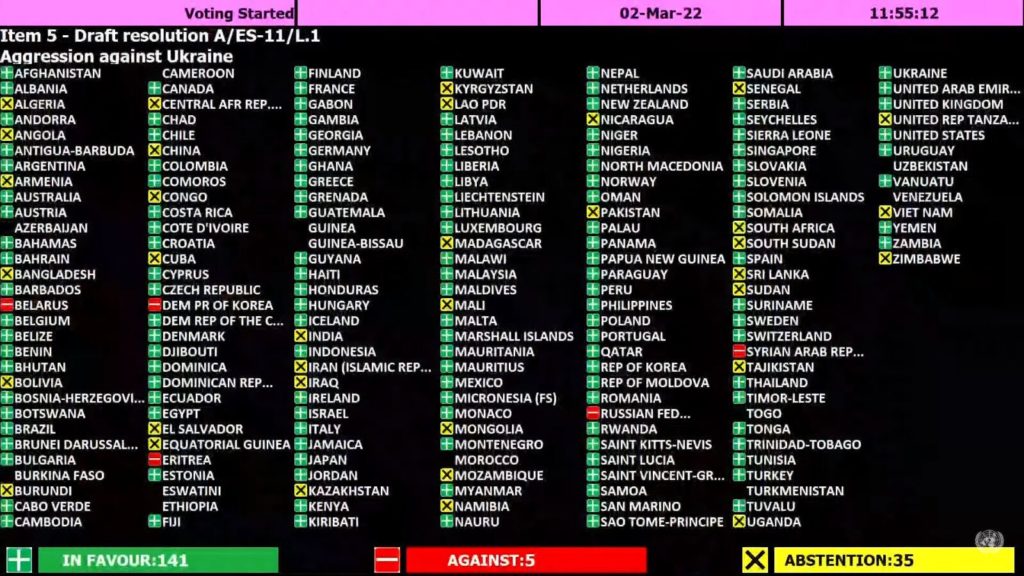
US Secretary-General Antonio Guterres stated that the UNGA’s collective messages had been heard by the world “loud and clear.”
“End hostilities in Ukraine – now. Silence the guns – now. Open the door to dialogue and diplomacy — now,” he said through a statement. “As bad as the situation is for the people in Ukraine right now, it threatens to get much, much worse. The ticking clock is a time bomb,” he continued. “We don’t have a moment to lose.”
In response, Russia’s UN Representative Vasily Nebenzya denied what was said during the UNGA speeches that they were targeting civilians. He exerted again that the so-called ‘special military operation’ was to end Ukraine’s civilian attacks on the Russian allied Donetsk and Luhansk “People’s Republics” and even went on to say that the Ukrainians were using these civilians as human shields.
“Your refusal to support today’s draft resolution is a vote for a peaceful Ukraine free from radicalism and neo-Nazism,” he told the UNGA.
China’s UN Representative Zhang Jun stated that the vote did not take full consideration of the complexity of the crisis and that it does not highlight the importance of the principle of indivisible security.
On the other hand, US Representative to the UN Linda Thomas-Greenfield warned that Russia had been preparing to increase the brutality of its campaign in Ukraine and that they had been using lethal weaponry such as cluster munitions and vacuum bombs to inflict maximum damage on Ukrainian soil.
Why Does This Particular UNGA Session Matter?
This particular UNGA session matters as it was the first time in 40 years that the Uniting for Peace resolution was invoked, with the last session of its kind convened due to the Israeli crisis in 1982. The resolution can be invoked when members of the United Nations Security Council fail to exercise their responsibilities of maintaining peace. This manifested when Russia used its veto power to block a UNSC resolution that condemned their invasion of Ukraine. In the UNGA, no country can veto any resolution.
While adopting a UN resolution condemning the Russian attack may be successful on paper, this does not mean actual violence and Russian aggression in Ukraine would halt. In simpler terms, the resolution is non-binding, which means it does not have the capacity to be legally binding. This is why the United Nations have been the subject of extreme criticism over the decades due to its perceived ineffectiveness in preserving peace and stability.
It does, however, carry enormous political weight. It signifies that the majority of the world agrees on a critical world issue (that being Russia’s unfounded and unjustified reasons for invading Ukraine) and can potentially unify to put an end to said issue through fiscal and economic sanctions or simply through negotiations. It is a symbolic win for Ukraine and its allies as more countries may join their call for more sanctions in an attempt to pressure Russia to stand down, especially when it was reported that civilians were being targeted by Russian forces in its various assaults.
As was reported by SOFREP in the past week, these sanctions had already been imposed on Russia, including its financial system, several banks, Russian oligarchies, and Putin himself. Countries that imposed sanctions on Russia were the United States, the European Union, Ukraine, Germany, the United Kingdom, Japan, Australia, South Korea, and even Switzerland, to name a few. The most notable recent sanction was the banning of several Russian banks from SWIFT, an international payment system that could wreak havoc for the Russian business atmosphere along with its economy.
If you’re just tuning into SOFREP for the first time, click here to enjoy a free 2-month trial membership and be kept up to date on developments in Ukraine and elsewhere around the globe.








COMMENTS